Silver Crescent Moon Necklace: Metallurgy, Gauges & Buying Guide
An expert technical guide to buying a silver crescent moon necklace, covering sterling grades, chain gauges, casting methods, and oxidation treatments.

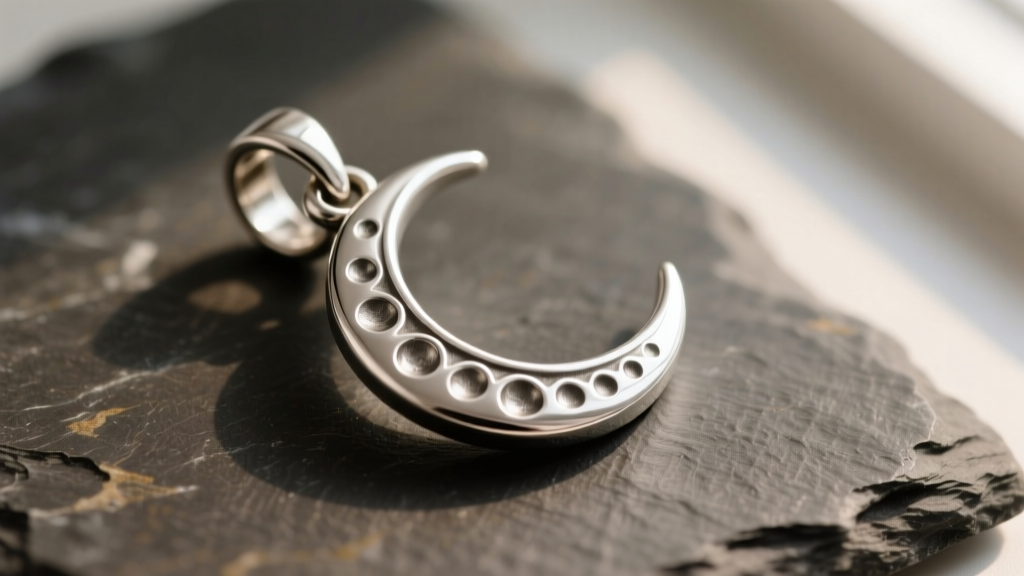
When selecting a silver crescent moon necklace, most buyers focus solely on the aesthetic silhouette or the symbolic meaning of the lunar motif. However, a technical deep dive reveals that the longevity, drape, and structural integrity of this specific pendant shape depend entirely on metallurgical choices, manufacturing methods, and chain mechanics. The crescent shape presents unique engineering challenges: the tapering 'horns' are structural weak points, and the broad surface area demands specific finishing techniques to highlight lunar textures without looking flat. This guide explores the exact specifications you need to evaluate when investing in high-quality lunar jewelry.
The Metallurgy of Silver Pendants: Fine vs. Sterling vs. Argentium
The structural viability of a crescent moon pendant is dictated by the Vickers hardness (HV) of the silver alloy used. Because the tips of the crescent taper to a fine point, they are highly susceptible to bending, snagging, and deformation during daily wear.
999 Fine Silver
Fine silver boasts a Vickers hardness of approximately 25 HV in its annealed state. While it is completely hypoallergenic and highly resistant to tarnish, it is far too soft for the delicate horns of a crescent moon. If a pendant is crafted from 999 silver, the tips must be exceptionally thick (over 2.5mm) to prevent bending, which ruins the elegant taper of the design. According to the Gemological Institute of America (GIA), fine silver is best reserved for bezel settings or heavy, solid casts rather than delicate, tapered silhouettes.
925 Sterling Silver
Composed of 92.5% silver and 7.5% copper, sterling silver achieves a hardness of roughly 65 HV when annealed, and up to 110 HV when work-hardened. This makes it the industry standard for crescent pendants. The copper provides the necessary tensile strength to support thin, sweeping horns. However, the copper content introduces the risk of firescale (cuprous oxide) during soldering and makes the piece prone to sulfide tarnishing over time.
Argentium 935 and 960
For buyers seeking superior tarnish resistance without sacrificing strength, Argentium silver replaces a portion of the copper with germanium. This creates a transparent germanium dioxide layer on the surface that drastically slows oxidation. Argentium 935 has a hardness of roughly 80 HV and is highly recommended for intricate, textured moon pendants that would be difficult to polish if heavy tarnish were to develop in the craters.
Manufacturing Techniques: Casting vs. Die-Striking
How the silver crescent moon necklace is formed dictates its density, porosity, and edge sharpness. Understanding these methods helps you assess quality and pricing.
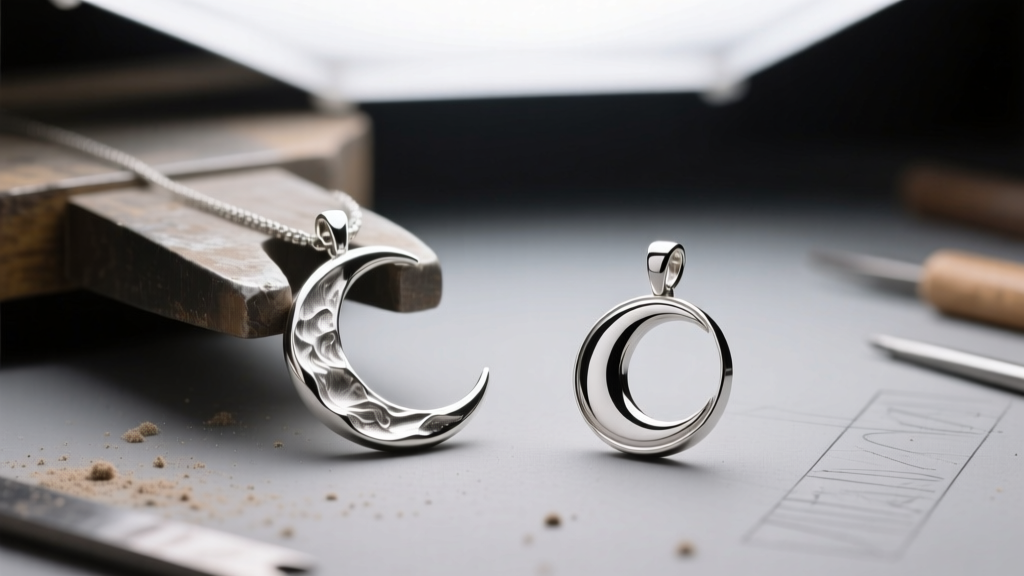
Lost-Wax Casting: The majority of artisan and boutique moon pendants are cast. A wax model is invested in plaster, burned out, and molten silver is forced into the cavity. While this allows for deep, intricate lunar craters and 3D topography, cheap casting can result in sub-surface porosity. If the jeweler does not use vacuum or centrifugal casting with properly degassed metal, microscopic air bubbles can cause pitting on the high-polish surfaces. Always inspect the flat edges of a cast crescent for tiny pinholes.
Die-Striking: Mass-market and high-volume crescent moons are often die-struck from sheet silver under immense pressure. This compresses the grain structure of the metal, making it denser and harder than cast silver. Die-struck moons are incredibly durable and feature razor-sharp edges, but they are generally limited to flat or shallow-stamped designs rather than deep, sculptural craters.
Hand-Fabrication: The most expensive tier involves sawing the crescent from thick sheet silver and doming it using steel punches. The metal is work-hardened during this process, resulting in a remarkably resilient pendant with a distinct, organic weight.
Bail Engineering and Chain Gauge Compatibility
The bail (the loop connecting the pendant to the chain) drastically alters how a crescent moon drapes against the collarbone. Furthermore, the chain gauge must be carefully matched to the pendant's weight and the bail's internal diameter.
| Chain Style | Recommended Gauge | Pendant Weight Capacity | Technical Notes |
|---|---|---|---|
| Cable Chain | 1.0mm - 1.2mm | 2g - 6g | Standard choice; ensure links are soldered to prevent pulling apart at the clasp. |
| Rope Chain | 1.2mm - 1.5mm | 5g - 12g | Excellent tensile strength; the twisted links reflect light, complementing high-polish moons. |
| Box Chain | 1.0mm - 1.4mm | 3g - 8g | Avoid gauges under 1.1mm; thin box chains are notorious for kinking and catching on skin hair. |
| Wheat Chain | 1.5mm - 2.0mm | 8g - 15g | Best for heavy, solid-cast 3D crescents; highly resistant to tangling and kinking. |
Bail Placement Mechanics: A traditional soldered ring bail placed at the top center of the crescent's arc allows the moon to hang horizontally, cradling the collarbone. Conversely, an integrated bail placed at one of the 'horns' forces the pendant to hang diagonally. If a horn-bail design is chosen, the chain must be heavy enough (at least 1.5mm) to provide counter-tension; otherwise, the lightweight chain will bunch up at the top of the neck, pulling the pendant off-center.
Surface Finishes: Oxidation and Patina Pooling
The surface treatment of a silver crescent moon necklace defines its visual depth. Because the moon motif relies heavily on texture to mimic lunar topography, surface finishes are not merely decorative—they are structural enhancements.
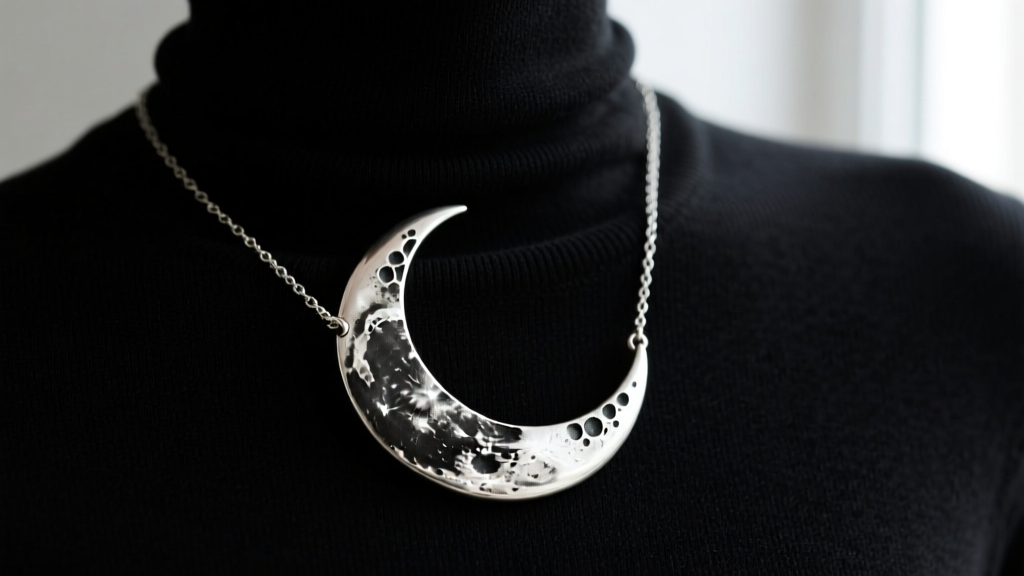
Chemical Oxidation: Artisans use liver of sulfur (potassium polysulfide) to intentionally tarnish the silver, turning it deep black or gunmetal grey. The piece is then polished on the high points, leaving the dark patina pooled exclusively in the engraved craters and crevices. This technique, known as antiquing, provides massive visual contrast. To seal this finish and prevent the dark patina from rubbing off onto clothing, high-end makers apply a micro-crystalline wax, such as Renaissance Wax, which locks the oxidation in place.
Satin and Matte Blasting: For a more modern, celestial look, the silver is blasted with fine glass beads or aluminum oxide. This creates a uniform, non-reflective frosted surface that mimics the actual dusty regolith of the moon. Matte finishes hide micro-scratches exceptionally well but require specialized rubber polishing blocks to restore if they become shiny from friction over time.
Pricing Tiers and Authenticity Verification
When evaluating the market for silver crescent moon necklaces, pricing is a direct reflection of manufacturing overhead, material purity, and finishing labor. Use this framework to assess value:
- Mass-Market / Dropshipped ($15 - $40): Typically die-struck or poorly cast 925 silver. Often plated with rhodium to prevent tarnish, which masks the true silver color and gives it a cold, steel-like appearance. Bails are often glued or poorly soldered.
- Artisan / Boutique ($60 - $180): Vacuum-cast or hand-fabricated. Features deep, hand-engraved textures, proper chemical oxidation, and secure, laser-welded bails. Often stamped with both a '925' purity mark and a registered maker's mark.
- Fine Jewelry / Designer ($250 - $800+): Heavy-gauge Argentium or sterling silver, often featuring flush-set diamonds, sapphires, or inlaid meteorite. Hand-finished through multiple grits of sandpaper (from 220 up to 1200) before final polishing with jeweler's rouge.
Expert Verification Tip: Always inspect the inside of the bail or the flat back of the pendant with a 10x jeweler's loupe. A legitimate piece will feature a crisp '925' stamp. If the stamp is blurry, shallow, or missing entirely on a piece claiming to be solid silver, it is likely silver-plated base metal. For comprehensive hallmark identification, consult the Santa Fe Symposium resources on jewelry manufacturing standards.
Maintenance and Tarnish Prevention
Proper maintenance of a textured silver crescent moon requires avoiding common cleaning mistakes. Never use liquid silver dips on an oxidized moon pendant; the harsh thiourea chemicals will strip the intentional dark patina from the craters, leaving the piece looking flat and over-polished. Furthermore, if your crescent moon features inlaid stones like turquoise, opal, or lapis lazuli, avoid ultrasonic cleaners entirely, as the high-frequency vibrations can shatter the stones or dissolve the epoxy adhesives used in the inlay process.
For routine maintenance, use a treated jeweler's cloth (such as a Sunshine cloth) to gently buff only the raised, high-polish edges of the crescent. Store the necklace in an airtight anti-tarnish ziplock bag with a 3M anti-tarnish strip to absorb ambient sulfur compounds, ensuring the silver remains pristine for decades.


