Silver Square Pendant Necklace: Material Grades Compared
Compare sterling, Argentium, and fine silver for your next silver square pendant necklace. Learn alloy properties and edge durability.

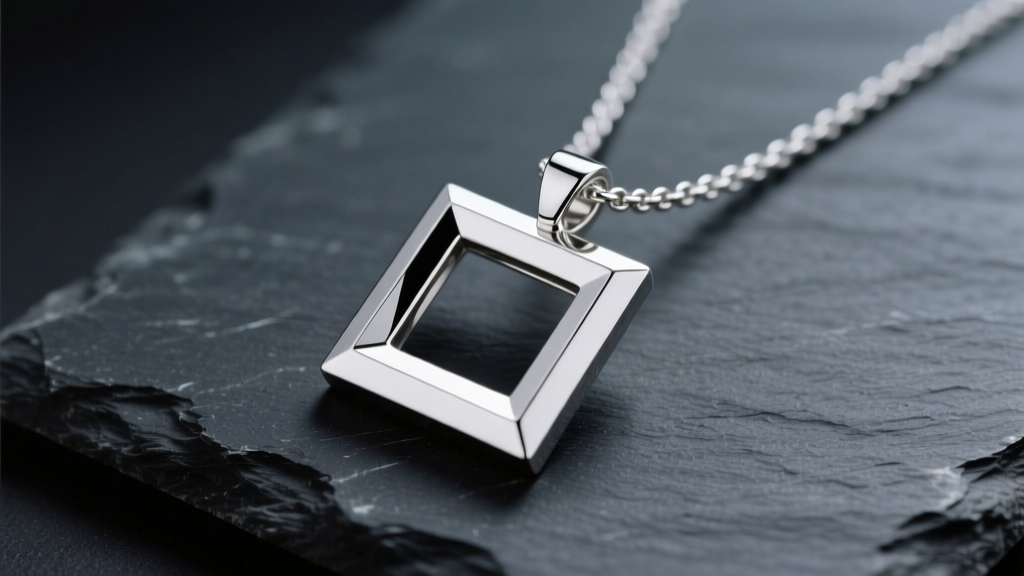
The appeal of a silver square pendant necklace lies in its unapologetic geometry. Whether you are drawn to brutalist thick squares, minimalist razor-thin plaques, or hollow architectural frames, the square shape projects a modern, structured aesthetic that organic or circular pendants simply cannot match. However, from a metallurgical and jewelry-design perspective, the square silhouette is remarkably unforgiving. Flat mirror-like planes act as magnifying glasses for micro-scratches, while sharp 90-degree corners concentrate impact forces, making them highly susceptible to blunting, denting, and edge wear.
Choosing the right silver alloy is not just a matter of budget; it is a structural necessity for geometric jewelry. In this guide, we dissect the material properties, hardness ratings, and real-world failure modes of the most common silver alloys used in square pendants, helping you make an informed, long-lasting investment.
The Geometry Factor: Why Square Pendants Demand Better Alloys
Unlike circular or oval pendants, which naturally deflect impacts and distribute kinetic energy along a continuous curve, a square pendant features four distinct corners and broad, flat faces. When a square pendant is dropped or swung against a hard surface, the kinetic energy is absorbed almost entirely by the leading corner. This localized stress can cause corner folding, chipping, or severe blunting if the metal's Vickers Hardness (HV) is too low.
Furthermore, the broad, flat planes of a square pendant are highly visible. Any uneven tarnishing, polishing swirl marks, or surface pitting will immediately catch the light and draw the eye. Therefore, the alloy you choose must possess both high structural rigidity and superior tarnish resistance to maintain the crisp, clean lines of the geometry.
Decoding Silver Alloys: What You Are Actually Buying
When shopping for a silver square pendant necklace, the term "silver" is often used as a catch-all. However, the elemental composition drastically alters the pendant's lifespan. According to the Gemological Institute of America (GIA), understanding these alloy variations is critical for evaluating jewelry quality.
Sterling Silver (925): The Industry Standard
Sterling silver consists of 92.5% pure silver and 7.5% alloying metals, almost always copper. The copper provides the necessary tensile strength to hold shapes and secure stone settings. However, copper is highly reactive to sulfur in the atmosphere, leading to the formation of copper sulfide—the black tarnish that plagues silver jewelry. On a large, flat square pendant, patchy sulfur tarnish can look like water damage or improper plating if not cleaned regularly.
Argentium Silver (935/960): The Modern Upgrade
Argentium silver replaces a portion of the copper with the metalloid germanium. As documented by Argentium Silver, when exposed to oxygen, the germanium migrates to the surface and forms a transparent, protective layer of germanium dioxide. This layer effectively blocks sulfur and moisture from reaching the copper underneath, making Argentium highly tarnish-resistant. Crucially, Argentium can be heat-hardened to nearly double the hardness of standard sterling, making it vastly superior for protecting the sharp corners of a square pendant.
Fine Silver (999): The Soft Alternative
Fine silver is 99.9% pure silver. While it is completely immune to copper-based tarnish and possesses a brilliant, snowy luster, it is far too soft for geometric jewelry. With a Vickers Hardness of roughly 25 HV, a fine silver square pendant will dent if pressed against a steering wheel or dropped on a tile floor. It is best reserved for bezel settings or intricate wire-wrapping, not structural geometric pendants.
Silver-Plated Brass: The Budget Trap
Plated pendants feature a thin micron-layer of silver over a brass or copper core. While initially cheap and bright, the sharp corners of a square pendant are the first places the plating will wear away due to friction against clothing and skin oils. Once the brass core is exposed on a corner, the piece cannot be polished back to its original state without re-plating.
Material Properties Comparison Chart
The following table breaks down the critical metallurgical data for silver alloys commonly used in geometric pendants. Pricing reflects the approximate raw material and manufacturing premium relative to standard sterling silver.
| Alloy Grade | Composition | Vickers Hardness (HV) | Tarnish Resistance | Corner Durability | Price Premium |
|---|---|---|---|---|---|
| Sterling (925) | 92.5% Ag, 7.5% Cu | ~65 HV (Annealed) | Moderate (Requires polishing) | Moderate (Will blunt over time) | Baseline |
| Argentium (935) | 93.5% Ag, Ge, Cu | ~75 HV (Work-hardened) | High (Germanium oxide layer) | High (Resists edge folding) | +15% to 25% |
| Argentium (960) | 96% Ag, Ge, Cu | Up to 130 HV (Heat-hardened) | Very High | Excellent (Retains sharp 90° edges) | +30% to 40% |
| Fine (999) | 99.9% Ag | ~25 HV | Very High (No copper) | Poor (Dents and folds easily) | +5% to 10% |
| Plated Brass | Brass core, Ag flash | ~100 HV (Core dependent) | Low (Once scratched) | Poor (Plating wears off corners) | -60% (Budget) |
Edge Durability and Corner Blunting in Square Designs
To understand why a silver square pendant necklace loses its crisp edges over time, we must look at the Vickers Hardness (HV) scale. Standard annealed sterling silver sits at about 65 HV. When a 925 sterling square pendant experiences a lateral impact—such as swinging against a desk edge—the kinetic energy exceeds the metal's yield strength at that localized point. The result is "corner blunting," where the sharp 90-degree angle flattens into a rounded edge.
Argentium 960, however, can be precipitation-hardened in a kiln at 300°C (572°F) for up to two hours. This process aligns the crystalline structure of the germanium and copper, pushing the hardness to an impressive 130 HV. At this hardness level, the silver is nearly as rigid as 14k yellow gold. For a heavy, architectural square pendant meant to be worn daily, heat-hardened Argentium will retain its razor-sharp factory edges for years, whereas standard sterling will require periodic filing and re-polishing by a jeweler to maintain its geometric integrity.
Real-World Failure Modes to Avoid
- Uneven Sulfur Tarnish: On wide, flat square faces, humidity and sulfur trapped against the skin can cause large, dark, irregular patches. This is highly visible on mirror-polished 925 sterling.
- Bail Shear Stress: Square pendants are often heavier and swing with more momentum than delicate circular pendants. The bail (the loop connecting the pendant to the chain) experiences severe shear stress. Ensure the bail is laser-welded or cast as a single piece with the pendant, rather than soft-soldered.
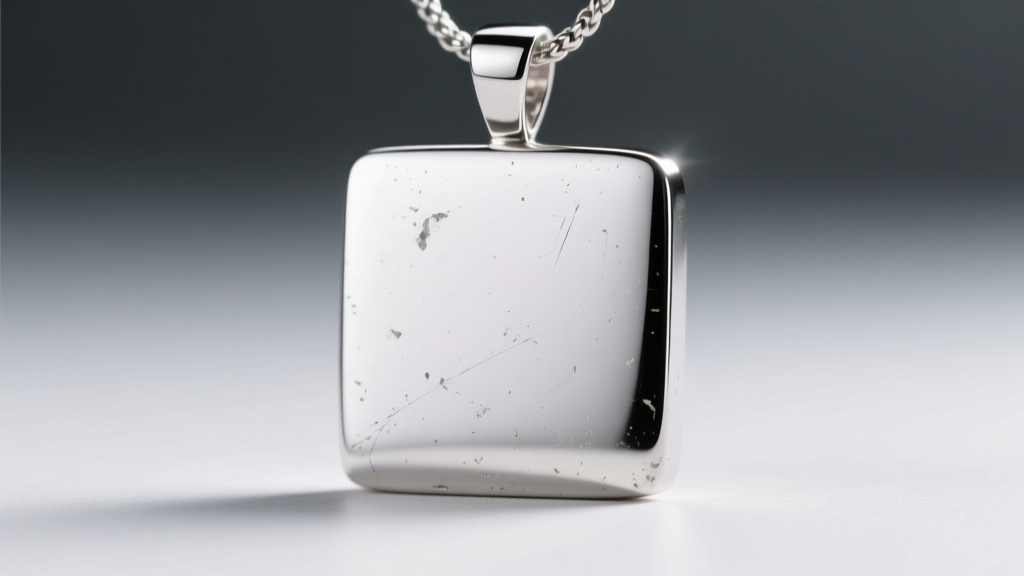
- Polishing Swirls: When attempting to remove tarnish from a flat sterling silver square using a rotary Dremel tool or harsh abrasive pastes, it is incredibly easy to create uneven "dishing" or swirl marks. Flat planes require perfectly flat polishing mediums, like impregnated jeweler's rouge cloths, to maintain optical flatness.
Sourcing and Hallmark Verification
Because geometric jewelry relies heavily on the illusion of precision, buying from reputable sources is paramount. The Jewelers of America strongly advises consumers to look for clear, legally mandated quality marks. For sterling silver, look for the "925" or "Sterling" stamp, usually located on the back of the pendant or on the chain's clasp tag. For Argentium, you will often see the "935" or "960" stamp, sometimes accompanied by the brand's specific hallmark.
Beware of unbranded square pendants stamped simply with "Silver" or "Tibetan Silver." Tibetan silver is historically a copper-nickel alloy containing little to no actual silver, and it can cause severe contact dermatitis. If the square pendant features a brushed or matte finish, verify whether the texture is achieved through sandblasting (which is durable) or a chemical etching (which can wear off on the high points of the geometry).
Final Verdict: Which Alloy Wins for a Square Pendant?
If you are investing in a high-end, thick, or architectural silver square pendant necklace where crisp 90-degree corners and broad, reflective planes are the main design features, Argentium 960 is the undisputed champion. Its ability to be heat-hardened ensures the geometry survives daily impacts, while the germanium oxide layer keeps the flat surfaces brilliantly white without constant chemical dipping.
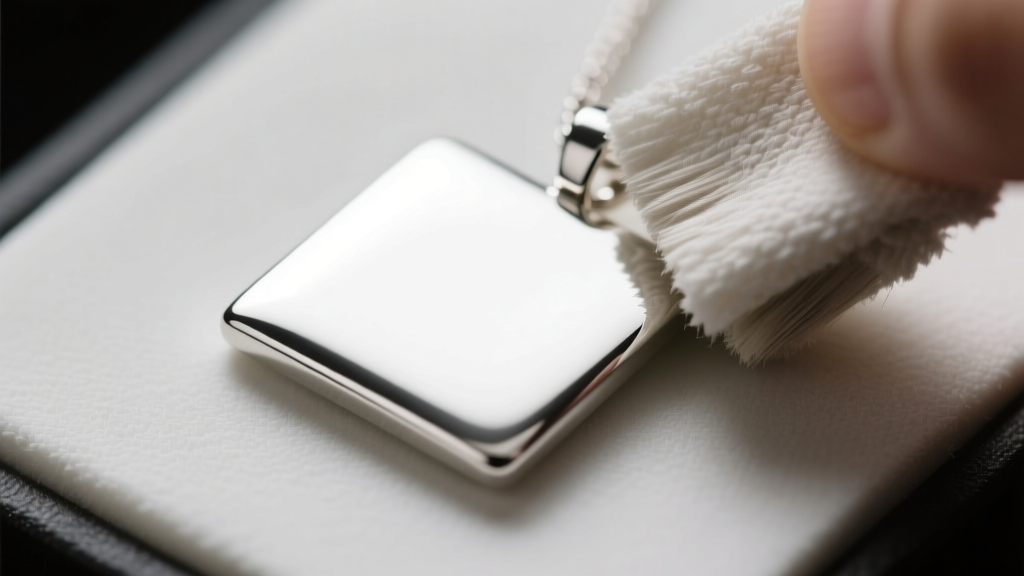
For budget-conscious buyers or those who prefer a vintage, lived-in patina, standard 925 Sterling Silver remains an excellent choice. Just be prepared to maintain the flat surfaces with a high-quality, non-abrasive microfiber polishing cloth specifically designed for silver, and avoid storing the pendant in humid environments to protect those vulnerable geometric edges.