Sonichu Necklace Guide: Materials, Craftsmanship & Collector Value
An expert technical guide to Sonichu necklace craftsmanship, covering lost-wax casting, vitreous enamel, and chain selection for custom meme jewelry.

The Evolution of Internet Culture Jewelry
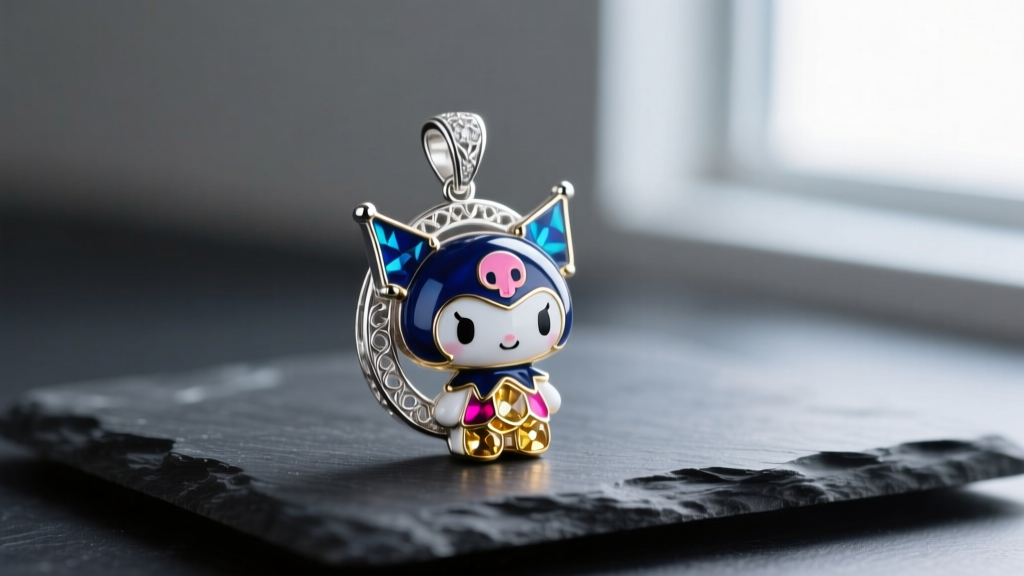
As of 2026, the bespoke internet-culture jewelry market has matured from cheap, mass-produced novelty items into a highly specialized sector of custom metallurgy and enamel art. The Sonichu necklace—a pendant featuring the iconic, fan-created hybrid character—stands as a prime case study in this evolution. What began as a niche meme has prompted serious collectors to commission high-end, technically complex character pendants. Crafting a premium Sonichu necklace requires navigating severe metallurgical challenges, including asymmetrical weight distribution, multi-color vitreous enameling, and precise lost-wax casting. This expert deep dive deconstructs the technical specifications, material grades, and structural engineering required to produce a museum-quality character pendant.
Metallurgy and the Lost-Wax Casting Process
The foundation of any high-end Sonichu necklace is the metal base. While budget pieces rely on zinc alloy die-casting or 3D-printed resins, collector-grade pendants are cast in 925 sterling silver or 14k gold. The complex, jagged silhouette of the Sonichu character (specifically the lightning bolt tail and spiked quills) makes it highly susceptible to casting defects.
Overcoming Porosity in Complex Silhouettes
Character pendants with varying thicknesses—such as a thick torso tapering into thin, spiky quills—cool at uneven rates during the casting process. This differential cooling traps gas bubbles, resulting in surface porosity that ruins the canvas for enameling. To combat this, expert jewelers utilize vacuum-assisted centrifugal casting and deoxidized silver alloys.
- Silicon-Deoxidized Sterling: Standard 925 silver contains 7.5% copper, which oxidizes rapidly and causes firescale. Deoxidized alloys replace a fraction of the copper with silicon or zinc, yielding a denser cast with minimal surface pitting.
- Investment Burnout Curves: The castable wax master (often 3D printed using high-resolution resins like Formlabs Castable Wax 40) requires a precise burnout schedule. A slow ramp to 1350°F (732°C) ensures zero ash residue remains in the intricate crevices of the character's design.
- Shrinkage Compensation: Sterling silver shrinks approximately 1.5% to 2% upon cooling. CAD designers must scale the original 3D model by a factor of 1.018 to ensure the final pendant meets exact millimeter specifications.
Color Theory in Metal: Vitreous vs. Cold Enamel
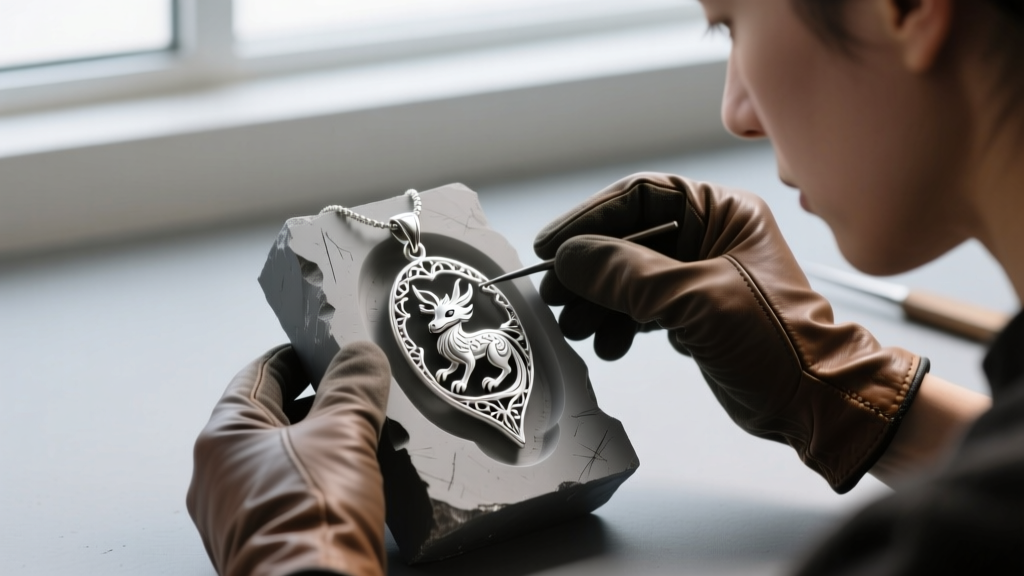
The Sonichu character requires a vibrant, specific color palette: electric blue, bright yellow, and stark red. Achieving these colors in metal requires a choice between traditional vitreous enamel and modern cold enamel (epoxy resin). For a true collector's piece, vitreous enamel is the undisputed standard.
| Feature | Vitreous Enamel (Glass) | Cold Enamel (Epoxy Resin) |
|---|---|---|
| Composition | Fused silica glass with metallic oxides | Two-part thermosetting polymer resin |
| Firing Temperature | 1400°F – 1500°F (760°C – 815°C) | Cures at room temperature or low heat (150°F) |
| UV Resistance | Exceptional; will never fade or yellow | Poor to moderate; prone to yellowing over 3-5 years |
| Durability | Hardness of 5-6 on Mohs scale; scratch-resistant | Soft; easily scratched by keys or abrasion |
| Best Application | Champlevé or Cloisonné on silver/gold | Base metals, 3D printed plastics, budget pieces |
The Champlevé Technique
For a Sonichu necklace, the champlevé method is most appropriate. The jeweler uses a CNC mill or hand graver to carve deep recesses (cells) into the silver base. These cells are packed with finely ground glass frit. According to the Gemological Institute of America (GIA), the piece must be fired in a kiln multiple times, as the glass shrinks when it melts. The enamel must be stoned flat with an alundum stone and polished to a high gloss, ensuring the metal dividing lines (cloisons) are perfectly flush with the glass surface.
"The true test of a master enameler is not just color matching, but managing the coefficient of thermal expansion between the glass and the silver substrate. If the enamel cools too quickly, it will craze or pop out of the recess entirely." — Master Jeweler's Benchmark, 2025.
Structural Integrity: Bail Sizing and Chain Mechanics
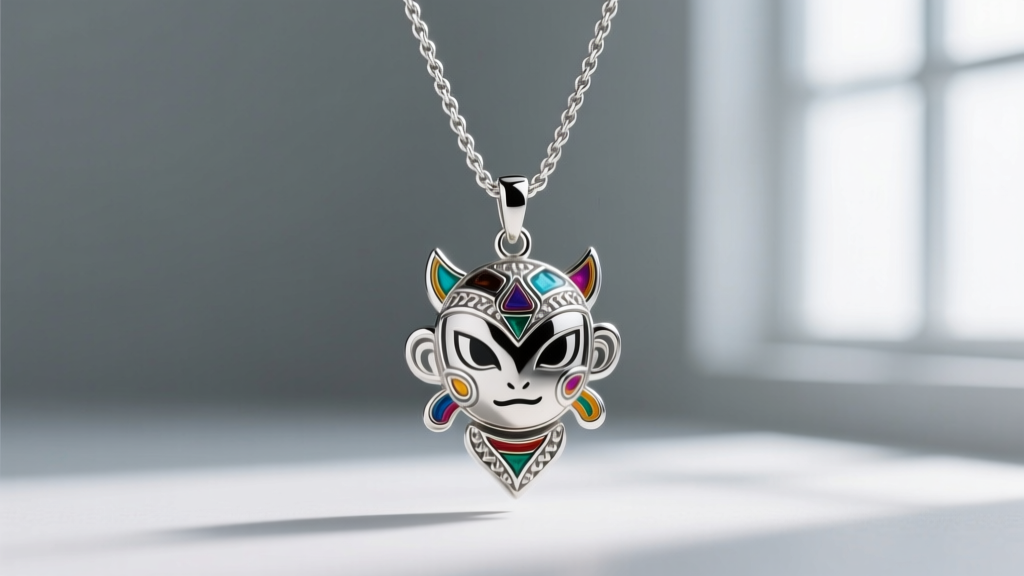
A frequent failure point in custom character jewelry is the bail—the loop that connects the pendant to the chain. The Sonichu design is notoriously asymmetrical and top-heavy due to the large head and quills relative to the lower body. If suspended from a standard, flimsy jump ring, the pendant will constantly flip upside down, scratching the enamel against the wearer's chest.
Engineering the Perfect Bail
To maintain proper orientation, a custom Sonichu necklace requires a tapered, soldered tube bail positioned precisely at the pendant's calculated center of gravity. This is rarely at the very top of the character's head; often, it must be integrated into the upper quills or a hidden back-plate to allow the pendant to lay flat against the sternum.
Chain Selection for Heavy Pendants
Character pendants cast in solid silver and filled with glass enamel typically weigh between 18 and 35 grams. Standard 1.0mm cable chains will stretch, kink, and eventually snap under this dynamic load. We recommend the following chain profiles for heavy, asymmetrical pendants:
- 2.5mm Wheat (Spiga) Chain: The woven, semi-rigid structure of a wheat chain distributes weight evenly and resists kinking. It provides a premium, rope-like aesthetic that complements detailed pendants.
- 2.0mm Box Chain: Composed of square, interlocking links, box chains offer high tensile strength and a smooth surface that won't catch on the pendant's bail.
- Avoid Rope and Cable Chains: Rope chains trap dirt and can fray under heavy asymmetric loads, while thin cable chains lack the structural rigidity to support a 30-gram enamel piece.
2026 Market Valuation and Commissioning Framework
Commissioning a bespoke, fine-jewelry-grade Sonichu necklace is an investment in wearable internet history. The market for high-end meme artifacts has stabilized, with collectors treating these pieces similarly to limited-edition art toys or bespoke comic art. When commissioning a piece, buyers should expect the following pricing tiers based on material and technique:
- Tier 1: 3D Printed Resin with Cold Enamel ($80 - $150) - Suitable for casual wear or cosplay. Prone to UV yellowing and scratching. Usually cast in base metals or painted resins.
- Tier 2: Cast Sterling Silver with Cold Enamel ($250 - $450) - A solid metal base ensures longevity, but the resin colors will eventually require professional repolishing and refilling.
- Tier 3: Solid 925 Silver with Vitreous Champlevé Enamel ($800 - $1,500+) - The ultimate collector's grade. Requires CAD modeling, lost-wax casting, and multiple kiln firings by a specialized enamelist. These pieces are heirloom-quality and retain their vibrant colors indefinitely.
When vetting a jeweler for a custom Sonichu necklace, always request to see their portfolio of champlevé work. Ask specifically about their burnout schedules for castable resins and whether they use deoxidized sterling silver. A true master of the craft will understand that translating a 2D internet meme into a 3D, enameled metallurgical artifact is not a novelty—it is a rigorous test of structural engineering and artistic discipline.


