Spinning Necklace Materials: Titanium vs Steel vs Silver
Compare titanium, steel, and silver for your spinning necklace. Discover how metal hardness, friction, and weight affect spin time and durability.

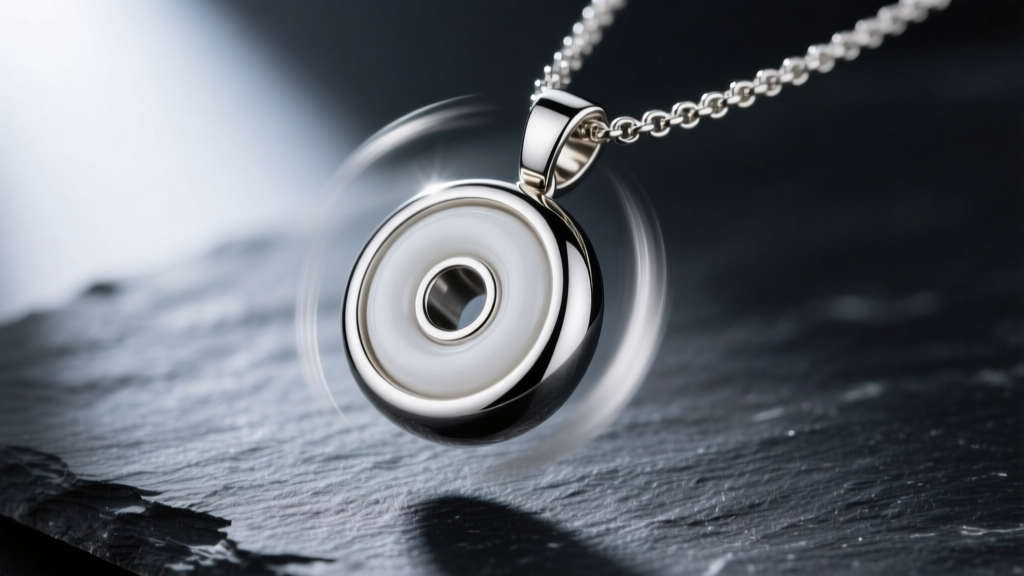
The Physics of Fidget Jewelry: Why Material Dictates Spin Time
Kinetic jewelry, specifically the spinning necklace, has evolved from a niche sensory tool into a sophisticated category of functional fine jewelry. Whether utilized for ADHD grounding, anxiety relief, or simply as a dynamic visual accessory, the mechanical heart of a spinning pendant relies entirely on its metallurgical properties. Unlike static pendants, a spinning necklace must endure constant friction, torsional stress, and prolonged contact with the corrosive environment of human skin oils.
The fundamental physics governing a kinetic pendant is rotational inertia, defined by the formula I = mr². To maximize spin duration, mass must be concentrated at the outer edge of the pendant. However, increasing mass also increases the gravitational load on the cervical spine and the chain bail. Therefore, selecting the right metal requires balancing density, Vickers hardness (HV), and the coefficient of friction. In this guide, we dissect the three dominant materials used in high-end spinning necklaces: Grade 5 Titanium, 316L Surgical Steel, and Sterling Silver.
Core Material Breakdown: Hardness, Friction, and Galling
Grade 5 Titanium (Ti-6Al-4V)
When discussing titanium in kinetic jewelry, it is crucial to distinguish between commercially pure Grade 2 titanium and aerospace-grade Grade 5 (Ti-6Al-4V). Grade 5 is alloyed with 6% aluminum and 4% vanadium, pushing its Vickers hardness to approximately 350 HV. This extreme hardness prevents the micro-scratching that occurs when a user repeatedly flicks the outer ring with their fingernails.
Titanium’s primary advantage for a spinning necklace is its biocompatibility and low thermal conductivity. It feels warm to the touch and will never react with acidic sweat, making it the premier choice for users with nickel allergies or contact dermatitis. However, titanium’s low density (4.43 g/cm³) means a titanium outer ring will have a shorter spin time compared to a steel ring of the exact same dimensions. To compensate, designers must increase the physical volume of the outer ring, which can result in a bulkier pendant profile.
316L Surgical Stainless Steel
316L stainless steel is the workhorse of kinetic jewelry. The "L" denotes low carbon, while the addition of 2-3% molybdenum provides exceptional resistance to chloride pitting—the exact type of corrosion caused by human sweat. With a density of 8.0 g/cm³, steel provides the necessary peripheral mass to sustain long, gyroscopic spin times without requiring an oversized pendant.
According to the British Stainless Steel Association, 316L maintains structural integrity under continuous mechanical stress. Its Vickers hardness sits around 150-200 HV. While softer than Grade 5 titanium, it is significantly harder than silver, preventing the "galling" (cold welding of friction surfaces) that plagues softer metals in kinetic mechanisms. For users who prioritize spin duration and a satisfying, weighty tactile feedback, 316L is unmatched.
Sterling Silver (925) & The Galling Problem
Sterling silver (92.5% silver, 7.5% copper) offers unparalleled luster and traditional fine jewelry appeal, but it presents severe engineering challenges for a spinning necklace. Pure silver has a Vickers hardness of just 25 HV; even alloyed to 925 standards, it rarely exceeds 90 HV. When two pieces of sterling silver rub against each other in a kinetic mechanism, the friction generates localized heat and micro-welding, a destructive phenomenon known as galling.
To engineer a functional sterling silver spinning pendant, jewelers must use a bimetallic approach. The outer decorative shell is cast in 925 silver, but the inner friction track and the central spindle must be machined from hardened steel or ceramic. Furthermore, because constant fidgeting transfers sebum and sulfur-rich skin oils to the metal, the silver must be plated with a thick layer of rhodium to prevent rapid tarnishing. The Gemological Institute of America (GIA) notes that rhodium plating not only prevents oxidation but also increases surface hardness, providing a slicker track for the spinning mechanism.
Comparative Data: Spin Performance & Wear Metrics
When evaluating a spinning necklace for daily wear, the interplay between weight, hardness, and environmental resistance dictates the lifespan of the piece. Below is a comparative matrix of the core materials used in kinetic pendants.
| Material | Density (g/cm³) | Hardness (HV) | Spin Potential | Sweat Corrosion Resistance | Maintenance Level |
|---|---|---|---|---|---|
| Grade 5 Titanium | 4.43 | ~350 | Moderate | Exceptional | Low |
| 316L Steel | 8.00 | ~180 | High | Excellent | Low |
| 925 Sterling Silver | 10.36 | ~75 | Very High | Poor (Requires Plating) | High |
| Tungsten Carbide | 15.60 | ~1500 | Extreme | Exceptional | Low |
The Hidden Failure Point: Bearing Seizure and Chain Torque
The metal of the outer ring is only half the equation. The true failure point in any spinning necklace is the central pivot mechanism and the bail connecting it to the chain.
Ceramic Hybrid Micro-Bearings
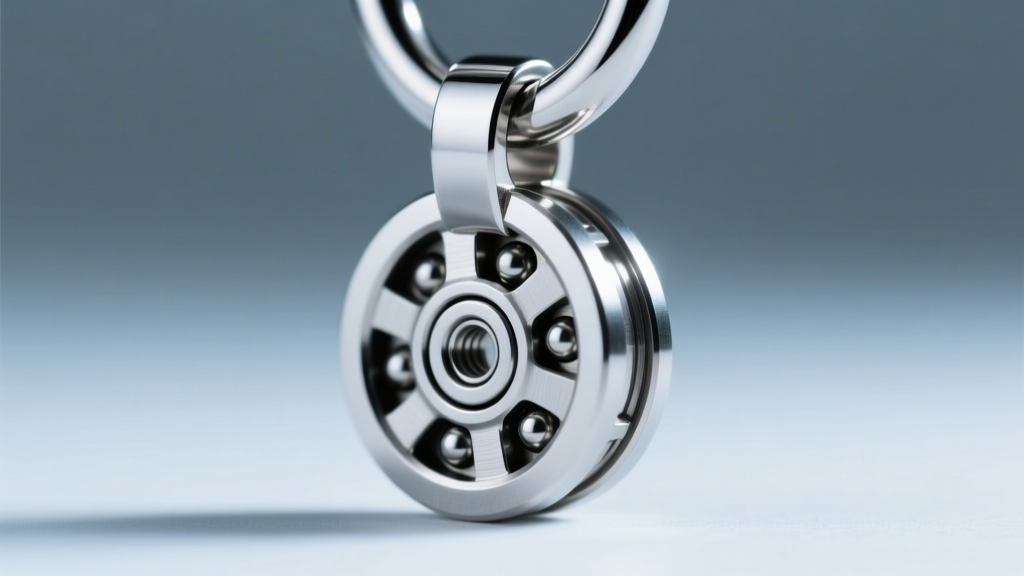
High-end kinetic pendants utilize micro-bearings, typically in the 686ZZ or 608ZZ size classes. Standard full-steel bearings are prone to seizing when infiltrated by dead skin cells, lint, and sebum from constant finger contact. The superior choice is a ceramic hybrid bearing, featuring Silicon Nitride (Si3N4) balls within a stainless steel race. Ceramic balls are lighter, harder, and generate less friction, allowing for spin times exceeding 60 seconds from a single flick. Furthermore, ceramic hybrids require less lubrication, reducing the accumulation of dust and grime inside the pendant housing.
Bail and Chain Stress Testing
A spinning mass generates gyroscopic precession. When you wear a spinning necklace and move your body, the pendant resists changes to its axis of rotation, transferring torsional torque directly to the bail and the chain. Standard 1mm cable chains will rapidly work-harden and snap under this kinetic stress. For any kinetic pendant weighing over 15 grams, you must pair it with a minimum 2mm box chain, wheat chain, or a titanium rope chain to withstand the multidirectional shear forces.
Maintenance Protocols for Kinetic Pendants
Maintaining a spinning necklace requires a different approach than static jewelry. The introduction of oil-based lubricants (like WD-40 or sewing machine oil) into the bearing is a common novice mistake; these fluids attract microscopic dust, eventually creating an abrasive paste that destroys the bearing races.
- Daily Cleaning: Wipe the outer ring with a microfiber cloth to remove acidic skin oils, especially if wearing un-plated sterling silver.
- Bearing Flushing: If the spin time degrades, submerge the pendant in 99% isopropyl alcohol and spin it vigorously. This dissolves sebum and evaporates completely without leaving a residue.
- Ultrasonic Caution: While titanium and steel respond well to ultrasonic cleaning, the high-frequency vibrations can sometimes shatter the delicate ceramic balls inside a hybrid micro-bearing if left in the bath for too long. Limit ultrasonic cycles to 60 seconds.
Final Verdict: Matching Metal to Your Fidget Style
Choosing the right spinning necklace ultimately depends on your sensory preferences and skin chemistry. If you require a lightweight, hypoallergenic pendant that you can wear 24/7 without maintenance, Grade 5 Titanium is the definitive choice. If your priority is maximum spin time, a satisfying heavy weight, and rugged durability, a 316L Stainless Steel kinetic pendant with a ceramic hybrid bearing will provide the best mechanical performance. Finally, if you demand the prestige and brilliance of traditional fine jewelry, opt for a Rhodium-Plated 925 Sterling Silver piece, provided it features a hardened steel inner track to prevent galling.


