Square Cross Necklace Materials: Gold, Silver, Steel & Titanium
Compare gold, silver, steel, and titanium for your square cross necklace. Discover the best metals for durability, weight, and skin sensitivity.


The square cross necklace—often recognized as a Greek cross or a geometrically framed Latin cross—represents a unique intersection of faith, fashion, and structural engineering. Unlike traditional elongated crosses, the square cross features equal or near-equal arm lengths, creating a wider, more balanced horizontal profile. This symmetry is visually striking, but it fundamentally alters how the pendant interacts with gravity, friction, and the chain it hangs from. When selecting a square cross necklace, the metal you choose dictates not only the aesthetic and price but also the structural longevity of the piece. In this comprehensive metallurgical guide, we break down the physical properties, failure modes, and ideal use cases for the four dominant metals in the 2026 jewelry market: sterling silver, solid gold, surgical stainless steel, and aerospace-grade titanium.
The Structural Demands of a Square Cross Design
The geometry of a square cross pendant concentrates kinetic energy differently than a teardrop or standard Latin cross. Because the mass is distributed more evenly across the horizontal and vertical axes, the pendant is less prone to flipping upside down. However, this wider profile means the bail (the loop connecting the pendant to the chain) experiences multidirectional torque when the wearer moves. If the bail is cast too thinly in a soft metal, it will eventually oval out or snap. Furthermore, the flat, broad surfaces typical of square cross designs act as a canvas for scratches, making the Vickers hardness (HV) of your chosen metal a critical factor in long-term wearability. According to the Gemological Institute of America (GIA), understanding alloy composition is essential for predicting how a precious metal will withstand daily friction.
Material Breakdown: The Big Four
Sterling Silver (925): The Classic but High-Maintenance Choice
Sterling silver is an alloy containing 92.5% pure silver and 7.5% copper (or occasionally zinc). With a Vickers hardness of roughly 60-70 HV, it is the softest metal commonly used for square cross pendants. While it offers a brilliant, highly reflective white luster, its softness means that the sharp, geometric corners of a square cross will round off over years of daily wear. Additionally, the copper content makes it highly susceptible to tarnishing (silver sulfide formation) when exposed to sulfur in the atmosphere or human sweat. For a square cross, we highly recommend seeking out rhodium-plated 925 silver, which adds a microscopic, hard, and tarnish-resistant barrier that preserves the sharp geometric lines of the pendant.
Solid Gold (14k vs 18k): Heirloom Weight & Wear
Gold is the traditional standard for fine religious and geometric jewelry, but pure 24k gold is far too soft (approx. 25 HV) for a daily-wear pendant. The industry relies on 14k and 18k alloys. 18k gold (75% pure gold) offers a rich, warm color but sits at around 110-125 HV, making it prone to micro-scratches on the broad flat planes of a square cross. 14k gold (58.5% pure gold), alloyed with copper, silver, and zinc, boasts a hardness of 130-150 HV. For a square cross necklace that will be worn daily, 14k gold is the superior metallurgical choice. It provides enough structural rigidity to keep the bail perfectly round and maintains the crisp, sharp edges of the square arms far better than its higher-karat counterparts.
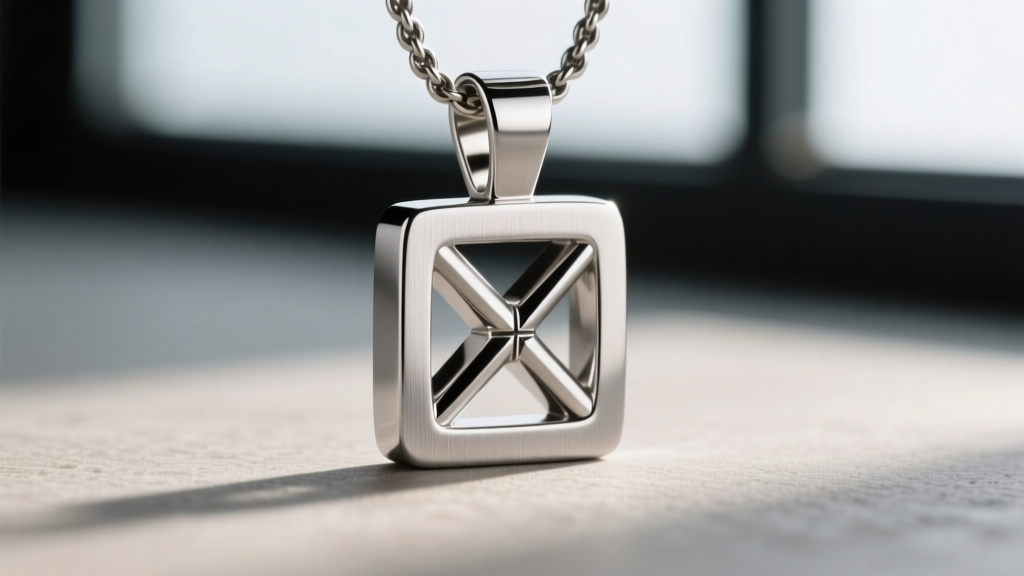
Surgical Stainless Steel (316L): The Indestructible Option
If you want a square cross necklace that will outlive you without showing a single scratch, 316L stainless steel is the answer. The "L" stands for low carbon, and the addition of molybdenum provides exceptional resistance to pitting and corrosion. With a Vickers hardness of 150-190 HV, steel is incredibly difficult to scratch. However, its density (approx. 8.0 g/cm³) makes it noticeably heavy. A solid steel square cross pendant over 1.5 inches in width can cause neck fatigue if paired with a thin chain. Furthermore, steel cannot be traditionally cast or easily soldered by a standard jeweler; if the bail breaks, it requires specialized laser welding to repair.
Grade 5 Titanium (Ti-6Al-4V): The Hypoallergenic Marvel
While pure Grade 1 titanium is soft, Grade 5 titanium (an alloy of titanium, aluminum, and vanadium) is the standard for high-end, durable jewelry. With a hardness of roughly 340 HV, it is twice as strong as steel but nearly 45% lighter (density of 4.43 g/cm³). A square cross necklace crafted from Grade 5 titanium offers the visual heft and substantial dimensions of steel without the neck strain. Because it is too hard to cast using traditional lost-wax methods, titanium square crosses are typically CNC-machined from solid billets, resulting in mathematically perfect, razor-sharp geometric edges that will never dull or scratch in normal wear. As noted by ASTM International standards, Ti-6Al-4V is also entirely biocompatible, making it the ultimate choice for wearers with severe nickel or copper contact dermatitis.
Head-to-Head Comparison Matrix
Use the table below to evaluate which metal aligns with your budget, lifestyle, and maintenance tolerance for a square cross pendant.
| Metal / Alloy | Hardness (HV) | Density (g/cm³) | Tarnish / Corrosion | Avg. Price (1" Pendant) |
|---|---|---|---|---|
| 925 Sterling Silver | 60 - 70 | 10.36 | High (Requires Polishing) | $40 - $120 |
| 14k Solid Gold | 130 - 150 | 12.9 - 14.6 | None (May scratch) | $250 - $600 |
| 18k Solid Gold | 110 - 125 | 15.2 - 15.9 | None (Scratches easily) | $400 - $950 |
| 316L Stainless Steel | 150 - 190 | 8.00 | Very Low (Passive Layer) | $25 - $80 |
| Grade 5 Titanium | 340 | 4.43 | None (Fully Inert) | $80 - $250 |
Chain Pairing: Matching the Pendant's Metallurgy
A square cross pendant demands a chain that complements its geometric rigidity. The most common mistake consumers make is pairing a heavy, wide square cross with a flimsy cable chain, leading to premature chain snapping. The geometric synergy of a square cross is best highlighted by a Box Chain or a Wheat (Spiga) Chain. Box chains mirror the square geometry of the pendant, creating a cohesive, modern look. Wheat chains offer a braided, semi-rigid structure that prevents the pendant from sliding too freely, keeping the cross centered on the chest.
Gauge Recommendations by Metal:
- Titanium & Steel Pendants: Due to their high tensile strength but lower weight (in titanium), pair with a 1.5mm to 2.0mm box chain. Ensure the chain's jump rings are soldered shut, as the torque of a wide square cross can pull unsoldered rings apart.
- 14k Gold Pendants: A 1.2mm to 1.5mm solid wheat chain provides adequate support. Avoid hollow gold chains entirely; the friction from the pendant's bail will wear through the hollow links within months.
- Sterling Silver Pendants: Opt for a 2.0mm oxidized silver rolo chain. The darker oxidation in the chain's crevices provides a beautiful visual contrast to a polished square cross pendant.
Maintenance & Failure Modes by Metal
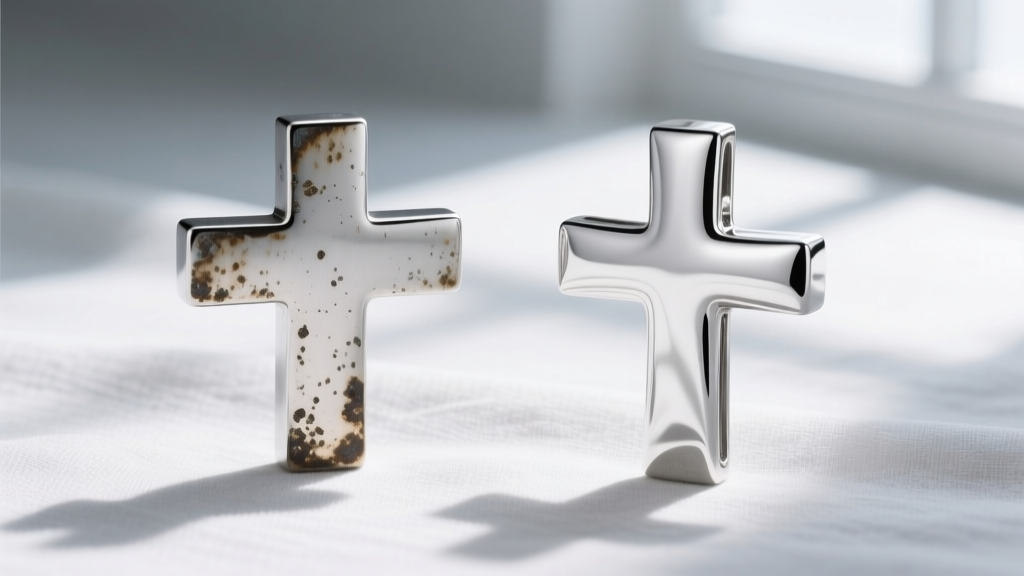
Every metal has a specific failure mode when subjected to the daily rigors of wearing a square cross necklace. Understanding these will save you from unexpected repairs.
"The bail is the weakest point of any geometric pendant. When a square cross swings, it acts as a lever against the bail's interior curve. Always inspect the bail's thickness, regardless of the metal's overall hardness." — Master Bench Jeweler Protocol, 2025
Silver Failure Mode: Work hardening and eventual snapping. As silver bends slightly against the chest over time, the copper alloy work-hardens, becoming brittle. The bail will eventually snap without warning. Solution: Have a jeweler anneal the bail every 3-5 years, or buy a pendant with a reinforced, double-soldered bail.
Gold Failure Mode: Bail thinning. 14k and 18k gold do not snap easily; instead, the chain acts like a saw, slowly filing away the inside of the gold bail until it is paper-thin. Solution: Inspect the bail with a loupe annually. Re-tipping a gold bail is a standard, inexpensive bench repair.
Steel & Titanium Failure Mode: Jump ring deformation. Because the pendants themselves are virtually indestructible, the failure point shifts to the chain's clasp or the unsoldered jump ring connecting the pendant. Solution: Always use a split ring or a soldered jump ring to attach a steel or titanium square cross to the chain.
Final Verdict: Choosing Your Metal
Selecting the right material for your square cross necklace comes down to your tolerance for maintenance versus your budget. If you desire a lightweight, mathematically perfect, and entirely scratch-proof piece with sharp geometric lines, Grade 5 Titanium is the undisputed champion of modern metallurgy. For those seeking traditional heirloom value and the warm luster of precious metals, 14k Solid Gold offers the best balance of richness and structural integrity. Avoid 18k gold for wide square crosses unless it is a special-occasion piece, and choose 316L Stainless Steel only if you prefer a heavier, more substantial drape on the chest. By matching the metal's physical properties to the unique structural demands of the square cross geometry, you ensure your necklace remains a flawless statement piece for decades to come.


