How to Choose the Standard Men's Necklace Length for Your Build
Discover how to find the perfect standard men's necklace length. Our step-by-step guide covers measuring, chain widths, and styling for every build.


Why the Standard Men's Necklace Length Dictates Your Entire Look
Finding the correct standard men's necklace length is not merely a matter of guessing; it is an exercise in proportion, anatomy, and personal style. A chain that sits too high can feel restrictive and visually choke the neckline, while one that drops too low can get lost in your wardrobe or swing awkwardly during movement. According to GQ's Men's Jewelry Guide, the right necklace length anchors your outfit, drawing the eye to the chest and framing the face without overpowering your natural build.
Unlike women's jewelry, which often relies on delicate, adjustable chains, men's chains are typically heavier, wider, and cut to fixed lengths. This means that understanding the exact measurements—and how they interact with your neck circumference, shoulder width, and torso length—is critical before you make a purchase. In this comprehensive guide, we will break down the exact dimensions, hardware considerations, and step-by-step measuring techniques you need to find your ideal fit.
The Definitive Chart of Standard Men's Necklace Lengths
The jewelry industry recognizes four primary lengths for men's chains. While custom sizing is always an option, these standard increments account for 95% of the market. Below is a breakdown of where each length falls on the average male physique and the specific use cases for each.
| Length (Inches / cm) | Placement on Body | Best Chain Widths | Ideal Use Case |
|---|---|---|---|
| 18" (45 cm) | Base of the neck / Collar | 2mm - 4mm | Slim builds, minimalist pendants, choker-style wear |
| 20" (50 cm) | Resting on the collarbone | 3mm - 6mm | The universal standard; ideal for everyday wear and t-shirts |
| 22" (55 cm) | Mid-chest / Upper sternum | 4mm - 8mm | Larger builds, statement pieces, heavy pendants |
| 24" (60 cm) | Lower chest / Solar plexus | 6mm - 12mm | Streetwear, layering, oversized medallions |
As noted in the Tiffany & Co. Necklace Length Guide, the 20-inch chain is widely considered the true standard men's necklace length. It sits comfortably just below the Adam's apple and rests perfectly on the collarbone, making it visible with an unbuttoned shirt but easily tuckable under a crewneck.
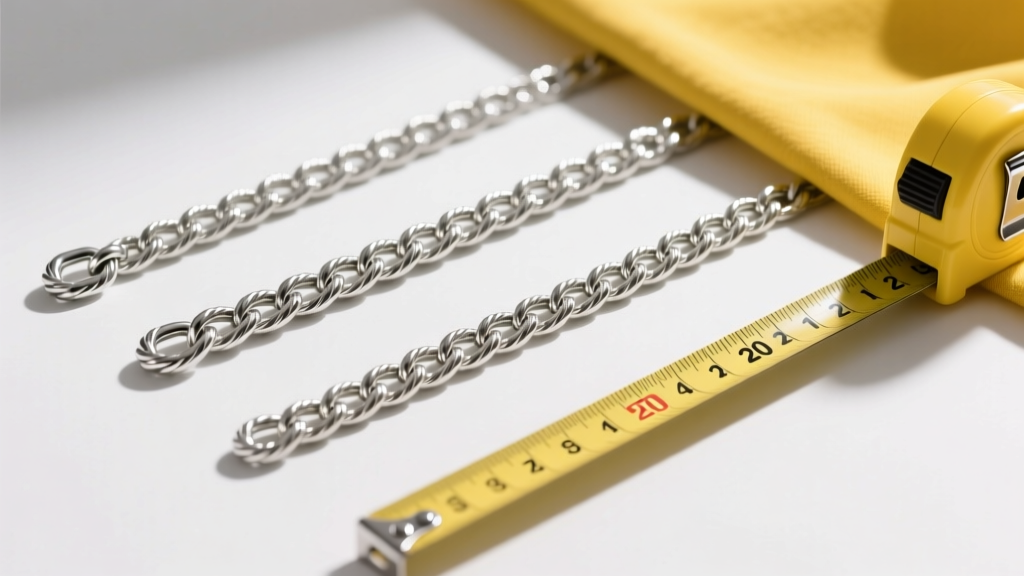
Step-by-Step: How to Measure Your Ideal Chain Length
Do not rely on your t-shirt size or height alone to determine your chain length. A man who is 6'2" with a narrow frame might wear a 20-inch chain perfectly, while a man who is 5'9" with a thick, muscular neck and broad traps might require a 22-inch chain to achieve the exact same visual placement. Follow these steps to measure accurately.
Step 1: The String and Mirror Method
Take a non-stretchable piece of string, dental floss, or a tailor's measuring tape. Drape it around your neck so the ends hang down your chest. Stand in front of a mirror and adjust the string until the bottom loop rests exactly where you want the chain to sit. For the standard collarbone look, ensure the string touches the bony prominence of your clavicle. Pinch the string at that point, remove it, and lay it flat against a ruler to get your exact measurement.
Step 2: Accounting for Pendant Drop
If you plan to wear a pendant, you must factor in the "drop"—the additional length the pendant adds to the chain. A 20-inch chain paired with a 1.5-inch pendant will visually wear like a 21.5-inch chain. If you want the pendant to rest precisely on your sternum, subtract the pendant's height from your desired final resting length to find the chain size you should buy.
Step 3: Factoring in Neck Circumference
Men with a neck circumference over 16.5 inches should automatically add 1 to 2 inches to the standard 20-inch baseline. A thick neck will push the chain outward, causing it to ride higher on the chest than it would on a slimmer frame. Always prioritize comfort; a chain should allow you to comfortably slip two fingers between the metal and your skin.
Matching Chain Widths, Weights, and Clasp Hardware
Length is only half the equation. The width (gauge) of the chain drastically affects how a specific length feels and drapes. A 20-inch chain in a 2mm box style weighs roughly 12 grams and feels virtually weightless. That same 20-inch length in an 8mm Cuban link style can weigh over 90 grams, creating a heavy, pulling sensation that requires specific hardware to stay secure.
- 2mm - 4mm (Lightweight): Best for 18" and 20" lengths. These widths are subtle, perfect for sliding small bail pendants through. Standard 7mm to 9mm lobster clasps are sufficient here.
- 5mm - 7mm (Midweight): The sweet spot for 20" and 22" lengths. These chains make a statement without looking ostentatious. Because of the increased weight, upgrade your clasp to a 12mm lobster claw or a fold-over safety clasp to prevent accidental unhooking.
- 8mm - 12mm+ (Heavyweight): Reserved for 22" and 24" lengths. Chains of this thickness are rigid and do not drape well on shorter lengths. You must use a box clasp with a double safety latch or a heavy-duty magnetic clasp rated for over 100 lbs of pull force.
Furthermore, pay attention to the pendant bail. If you are buying a 5mm chain, the inner diameter of your pendant's bail must be at least 6.5mm to allow the chain to slide through without grinding against the metal edges, which can cause premature wear on both the chain links and the pendant.

Styling Rules for the 20-Inch and 22-Inch Sweet Spots
When styling the standard men's necklace length, the goal is intentionality. The 20-inch and 22-inch lengths are the most versatile in a man's arsenal, but they require different approaches depending on your wardrobe.
"The 20-inch chain is your everyday workhorse. It frames the face and sits perfectly in the V of an unbuttoned Oxford shirt. The 22-inch chain is your statement piece, designed to rest over a plain white tee or a lightweight hoodie." — Menswear Styling Principles
For a modern 2026 aesthetic, mixed-metal layering has become highly popular. Try pairing a 20-inch 3mm silver rope chain with a 24-inch 5mm yellow gold Figaro chain. The 4-inch gap ensures the chains do not tangle, while the contrast in color and texture adds depth to your outfit. Avoid layering chains of the exact same length and width, as this creates a bulky, tangled mess that detracts from the individual pieces.
Common Sizing and Hardware Mistakes to Avoid
Even experienced jewelry buyers make critical errors when selecting chain lengths and hardware. Avoid these common pitfalls to ensure your investment lasts a lifetime:
- Ignoring Clasp Tension: Shorter chains (like 18-inch) experience more lateral tension when you turn your head. A weak spring-ring clasp will inevitably snap. Always opt for a solid lobster claw on chains under 20 inches.
- Buying Hollow Links: Many budget brands sell 6mm chains that are hollow inside to save on gold weight. While they look thick, they dent easily, cannot support heavy pendants, and are nearly impossible to repair if a link snaps. Always invest in solid or semi-solid links.
- Overlooking Material Grades: If you are buying sterling silver, ensure it is stamped "925" and ideally rhodium-plated to prevent rapid tarnishing from skin oils. For stainless steel, verify it is 316L surgical grade, which is highly resistant to corrosion and safe for sensitive skin.
- Forgetting the Haircut Factor: If you frequently change your hairstyle or grow a thick beard, remember that longer hair can catch on the links of wider chains (especially rope and box styles). If you have long hair, opt for smoother chains like the snake or herringbone style, though be aware that herringbone chains are prone to permanent kinking if bent.
By understanding the mechanics of the standard men's necklace length, you can confidently select a piece that complements your physique, integrates seamlessly with your wardrobe, and provides comfortable, everyday wear. Measure carefully, invest in solid hardware, and let the chain do the talking.


