Star Map Necklace Materials: Silver vs Gold vs Titanium Guide
Discover how different metals affect your star map necklace. We compare silver, gold, and titanium for laser engraving, durability, and price.

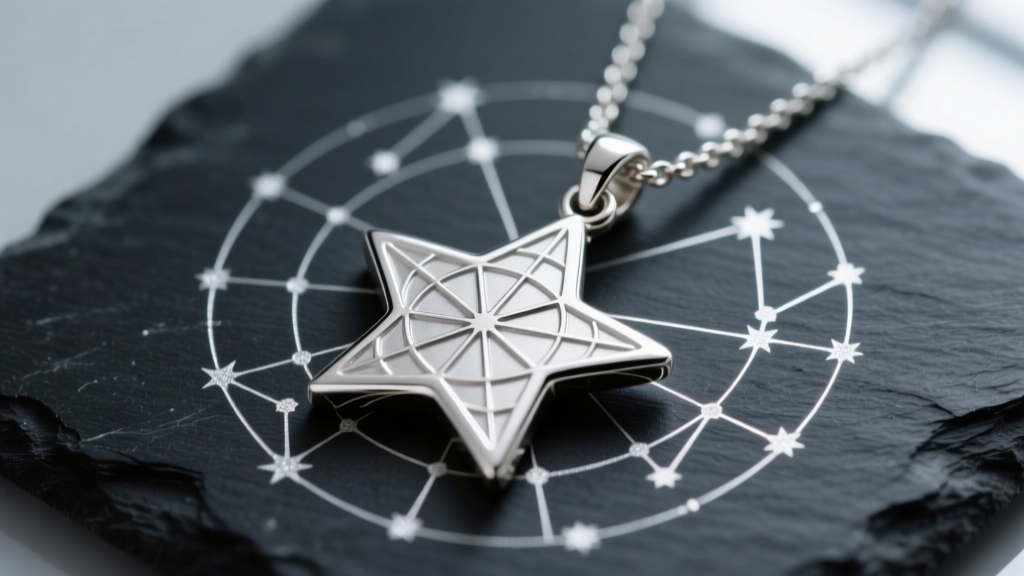
A star map necklace is more than just a piece of jewelry; it is a precise astronomical snapshot of a specific date, time, and location. Whether commemorating a birth, an anniversary, or a personal milestone, the celestial alignment captured in these pendants requires exacting detail. However, the emotional resonance of a custom star map necklace is only as enduring as the metal it is engraved upon. As of 2026, advancements in laser engraving technology have expanded the possibilities for personalization, but the fundamental metallurgy of the base material remains the ultimate deciding factor for longevity, contrast, and wearability.
Choosing the right metal involves navigating a complex matrix of tarnish resistance, skin sensitivity, and how the alloy reacts to high-intensity fiber lasers. This comprehensive guide breaks down the material properties of the most popular metals used for star map pendants, providing actionable insights to ensure your celestial memory lasts a lifetime.
The Physics of Laser Engraving on Precious Metals
To understand why material choice matters, one must first understand how modern jewelers etch constellations into metal. The industry standard in 2026 is the MOPA (Master Oscillator Power Amplifier) fiber laser, which operates at a 1064 nm wavelength. Unlike older CO2 lasers that merely scratch the surface, MOPA lasers can alter the pulse width and frequency to either ablate (vaporize) the top layer of metal or anneal it (heat it to create an oxidized mark without breaking the surface).
- Annealing: Ideal for metals like titanium and certain steel alloys, creating high-contrast dark or colored marks without compromising the structural integrity or smooth finish of the pendant.
- Ablation (Deep Engraving):strong> Necessary for silver and gold to create physical grooves that catch the light and hold oxidizing agents (like liver of sulfur) for permanent contrast.
The thermal conductivity and reflectivity of the chosen metal dictate the laser's effectiveness. Highly reflective metals like pure gold or silver require specific pulse frequencies to prevent the laser beam from scattering, which can result in blurred star maps and illegible coordinate text.
Silver Alloys: Sterling (925) vs. Argentium
Silver remains the most popular canvas for star map necklaces due to its brilliant reflectivity and the striking contrast achieved when deep engravings are oxidized. However, not all silver is created equal.
Traditional Sterling Silver (925)
Composed of 92.5% silver and 7.5% copper, traditional sterling is highly workable and takes deep laser ablation beautifully. The copper content, however, is its Achilles' heel. Copper reacts with sulfur and moisture in the air, causing tarnish. While a light tarnish on the surface can be polished away, aggressive polishing will eventually wear down the raised surfaces of your star map, flattening the intricate details of the constellations over time.
Argentium Silver (935 / 960)
Argentium replaces a portion of the copper alloy with germanium. According to metallurgical data referenced by the Gemological Institute of America (GIA), the germanium forms a transparent, protective oxide layer on the surface that drastically slows down tarnishing. For a star map necklace, Argentium is vastly superior. Because it rarely tarnishes, the wearer does not need to subject the pendant to frequent polishing, thereby preserving the razor-sharp edges of the laser-engraved stars and text for decades.
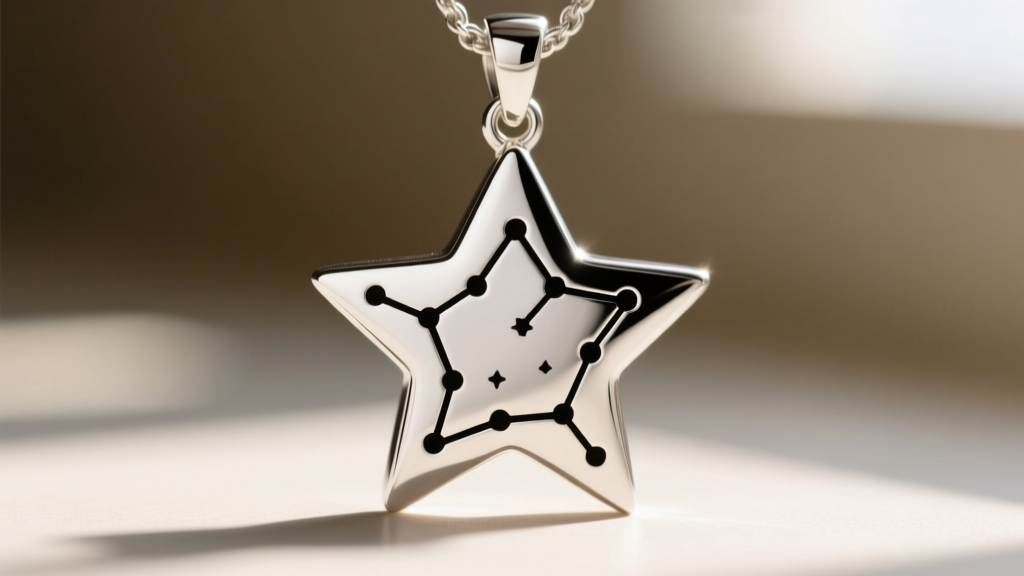
The Gold Dilemma: Solid 14k vs. Vermeil
Gold offers a warm, luxurious backdrop for a celestial map, but buyers must be exceptionally wary of marketing terms like 'gold plated' or 'vermeil' when it comes to engraved jewelry.
The Danger of Engraving Vermeil
The Federal Trade Commission (FTC) Jewelry Guides stipulate that for an item to be legally marketed as 'vermeil,' it must consist of a sterling silver base coated with gold of at least 10k fineness, with a minimum thickness of 2.5 microns. While 2.5 microns is sufficient for a plain pendant, laser engraving will instantly vaporize this microscopic gold layer.
Jeweler's Warning: If you order a star map engraved on a vermeil pendant, the laser will cut through the gold plating and expose the raw sterling silver underneath. The engraved grooves will be silver, while the surface is gold. Furthermore, the exposed silver in the grooves will tarnish rapidly, creating a muddy, uneven appearance that cannot be polished without removing more of the surrounding gold plating.
Solid 14k Gold: The Only Viable Option
For a gold star map necklace, solid 14k gold (58.5% pure gold alloyed with silver, copper, and zinc) is the minimum recommended standard. The alloy metals in 14k gold provide enough hardness for the laser to carve crisp, deep lines without the metal warping under thermal stress. Because the color is consistent all the way through, the engraving will remain gold, though jewelers often use specialized chemical darkening agents to create contrast in the grooves so the stars stand out against the bright background.
Titanium and Stainless Steel: The Modern Canvas
For those seeking extreme durability, hypoallergenic properties, and modern aesthetics, aerospace-grade metals have surged in popularity for personalized jewelry.
Grade 5 Titanium (Ti-6Al-4V)
Titanium is exceptionally strong, lightweight, and completely impervious to tarnish and corrosion. Grade 5 titanium, which includes aluminum and vanadium, is harder than pure Grade 2 titanium, allowing for incredibly precise, microscopic laser etching. When hit with a MOPA laser, titanium can actually produce vibrant colors (blues, purples, and golds) through surface oxidation without any dyes. A star map etched in deep blue against a brushed grey titanium background is a striking, modern alternative to traditional precious metals.
316L Surgical Stainless Steel
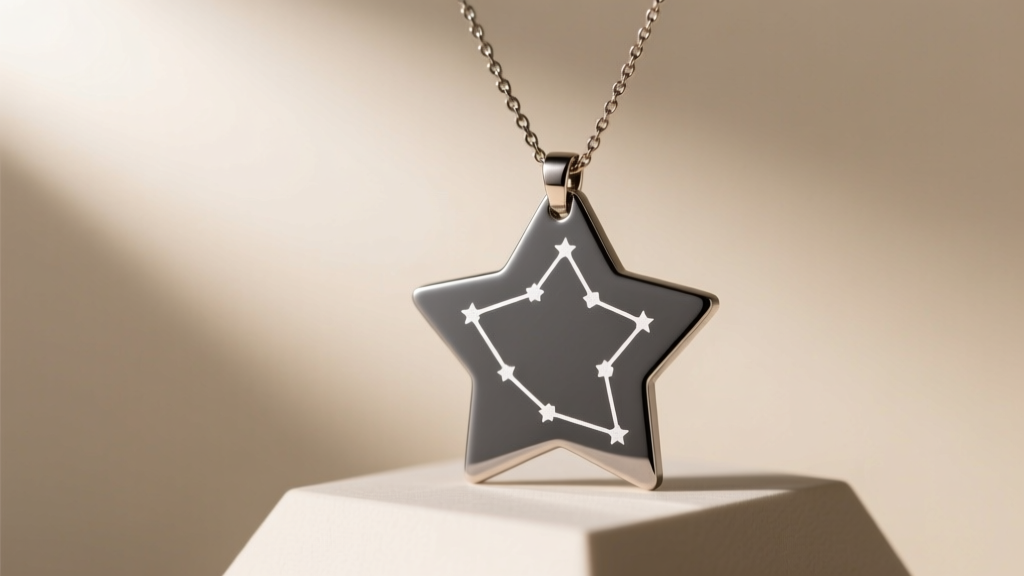
Often marketed as a budget-friendly alternative, 316L stainless steel is highly resistant to rust and takes laser annealing very well, producing stark black marks on a silver-grey surface. However, it is significantly heavier than titanium and cannot be easily resized or repaired by a traditional jeweler if the chain or bail breaks. It is an excellent choice for everyday, rugged wear, provided the buyer accepts its limitations in traditional jewelry repair.
Material Comparison Matrix
Use the following data table to compare the physical properties, engraving outcomes, and 2026 market pricing for custom star map pendants.
| Material | Engraving Method | Contrast Quality | Tarnish Risk | Est. Price Range (Pendant Only) |
|---|---|---|---|---|
| Sterling Silver (925) | Deep Ablation | Excellent (with oxidation) | High | $45 - $90 |
| Argentium Silver (935) | Deep Ablation | Excellent (with oxidation) | Very Low | $75 - $130 |
| Solid 14k Yellow Gold | Deep Ablation | Good (requires chemical darkening) | None | $250 - $450 |
| Grade 5 Titanium | MOPA Annealing / Color | Superior (High contrast / Color) | None | $60 - $120 |
| 316L Stainless Steel | MOPA Annealing | Excellent (Stark black on grey) | None | $25 - $50 |
Chain Selection and Clasp Mechanics
The pendant is only half the equation; the chain must complement the star map without distracting from it, while providing secure hardware.
- Box Chains: The optimal choice for star map pendants. The geometric, square links reflect light beautifully and are incredibly strong, resisting kinking and snapping better than delicate cable chains.
- Rope Chains: While beautiful, the twisted grooves of a rope chain can catch on the bail (the loop connecting the pendant to the chain), causing unnecessary friction and wear over time.
- Clasp Hardware: Insist on a lobster clasp rather than a spring-ring clasp. Spring rings are notorious for failing due to their tiny, easily fatigued internal springs. A solid cast lobster clasp, ideally with a soldered jump ring at the opposite end, ensures your custom celestial map remains securely around your neck.
Final Verdict: Choosing Your Celestial Canvas
When investing in a star map necklace, the material must align with your lifestyle and maintenance preferences. For traditionalists who want the classic, high-contrast look of dark stars on bright metal and are willing to occasionally wipe their jewelry with a treated cloth, Argentium Silver offers the best balance of beauty, engraving depth, and tarnish resistance. For those with active lifestyles, metal allergies, or a preference for modern aesthetics, Grade 5 Titanium provides an indestructible, lightweight canvas that will keep your personal constellation perfectly preserved for generations.