Silver Safety Pin Necklace: Technical Guide & Buying Specs
Explore the metallurgy, construction mechanics, and styling specs of the silver safety pin necklace. Expert guide to gauges, alloys, and chains.

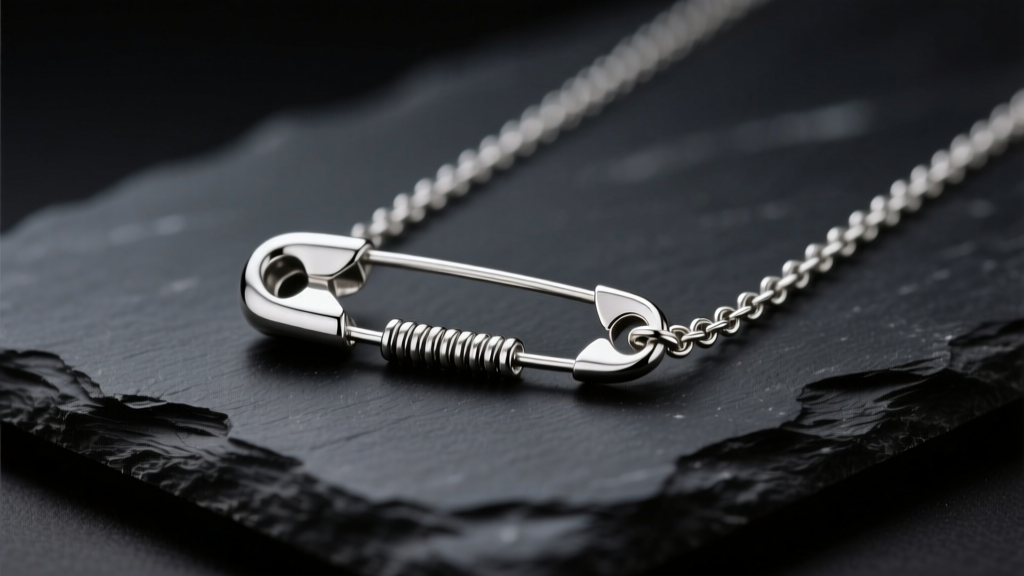
The Anatomy of a Silver Safety Pin Necklace
The silver safety pin necklace has transcended its punk-rock origins to become a staple of contemporary minimalist and edgy jewelry design. However, beneath its deceptively simple silhouette lies a complex interplay of metallurgy, mechanical tension, and structural engineering. Unlike cast pendants that rely solely on aesthetic molding, a functional or semi-functional safety pin pendant requires precise wire manipulation. For jewelry experts and discerning collectors, understanding the technical specifications of these pieces is crucial for evaluating quality, longevity, and wearability.
At its core, the safety pin consists of four distinct mechanical zones: the sharp point, the hood (or cap), the spring coil, and the retaining clip. In high-end sterling silver iterations, the transition between these zones must be seamless to prevent snagging on delicate fabrics or skin. The point is typically blunted to a 45-degree angle for jewelry applications, eliminating the piercing hazard while retaining the iconic visual profile. According to manufacturing standards outlined by the Jewelers of America, the finishing of these micro-components separates mass-produced novelty items from fine jewelry.
Wire Gauge and Spring Tension Mechanics
The structural integrity of a silver safety pin necklace is dictated by its wire gauge. Most commercial fashion jewelry utilizes 20-gauge (0.81mm) or 22-gauge (0.64mm) wire, which is prone to bending and losing its spring tension over time. Expert silversmiths prefer 16-gauge (1.29mm) or 14-gauge (1.63mm) half-hard sterling silver wire. This thickness provides the necessary rigidity to maintain the pin's shape while allowing the spring coil to function if the piece is designed to open and close.
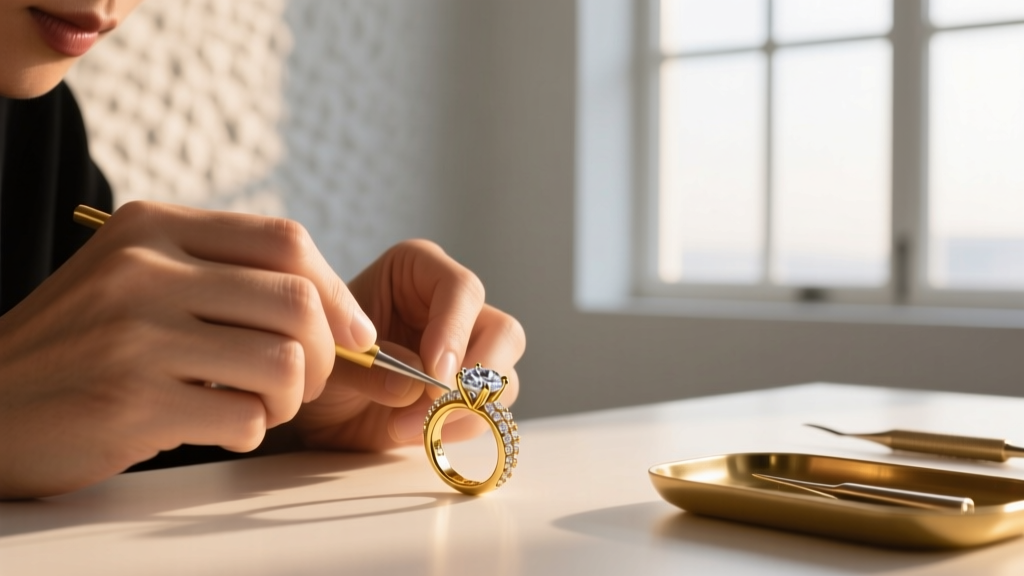
The spring coil itself is the most vulnerable component. It must be wound with exact mathematical precision—typically three to four tight loops—to distribute mechanical stress evenly. If the coil is wound too loosely, the pin will lack the tension required to snap securely into the hood. If wound too tightly without proper annealing, the silver will suffer from work-hardening and eventually snap at the base of the coil. Master jewelers often use a mandrel and a rawhide mallet to ensure uniform coil diameter before the final polishing stage.
Metallurgy: 925 Sterling vs. Argentium Silver
When investing in a silver safety pin necklace, the specific alloy used dramatically impacts the piece's tarnish resistance and tensile strength. Traditional 925 sterling silver is an alloy of 92.5% pure silver and 7.5% copper. While copper adds necessary hardness, it is also the culprit behind oxidation and tarnishing, particularly in the tight crevices of the spring coil where polishing cloths cannot reach.
For superior performance, experts increasingly recommend Argentium silver. Argentium replaces a portion of the copper with germanium, which forms a transparent, self-healing oxide layer on the surface. This makes it highly resistant to tarnish and significantly harder than traditional sterling. The Gemological Institute of America (GIA) notes that advanced silver alloys like Argentium are ideal for intricate mechanical jewelry components that require both durability and low maintenance.
| Alloy Type | Composition | Tarnish Resistance | Hardness (Vickers) | Best For |
|---|---|---|---|---|
| 999 Fine Silver | 99.9% Ag | Excellent | ~25 HV (Too Soft) | Non-moving cast pendants |
| 925 Sterling | 92.5% Ag, 7.5% Cu | Moderate | ~65 HV | Standard fashion jewelry |
| Argentium 935 | 93.5% Ag, Ge, Cu | Superior | ~80 HV | Mechanical pins, springs, clasps |
| Argentium 960 | 96.0% Ag, Ge, Cu | Superior | ~95 HV | High-end luxury safety pin necklaces |
Chain Pairing and Bail Engineering
The way a safety pin pendant interfaces with its chain is a critical, yet often overlooked, element of necklace design. The "bail"—the loop through which the chain passes—determines the pendant's orientation and kinetic movement.
Orientation and Weight Distribution
There are two primary bail configurations for safety pin necklaces:
- The Hood Bail: Soldered directly to the pin's hood (cap). This causes the pin to hang vertically, parallel to the chain drop. This orientation is sleek, minimalist, and prevents the pin from flipping upside down.
- The Coil Bail: A larger jump ring or sliding tube that passes through the spring coil itself. This allows the pin to hang horizontally across the collarbone. However, because the pin is asymmetrical, the coil bail requires a heavier chain to prevent the pendant from sliding off-center.
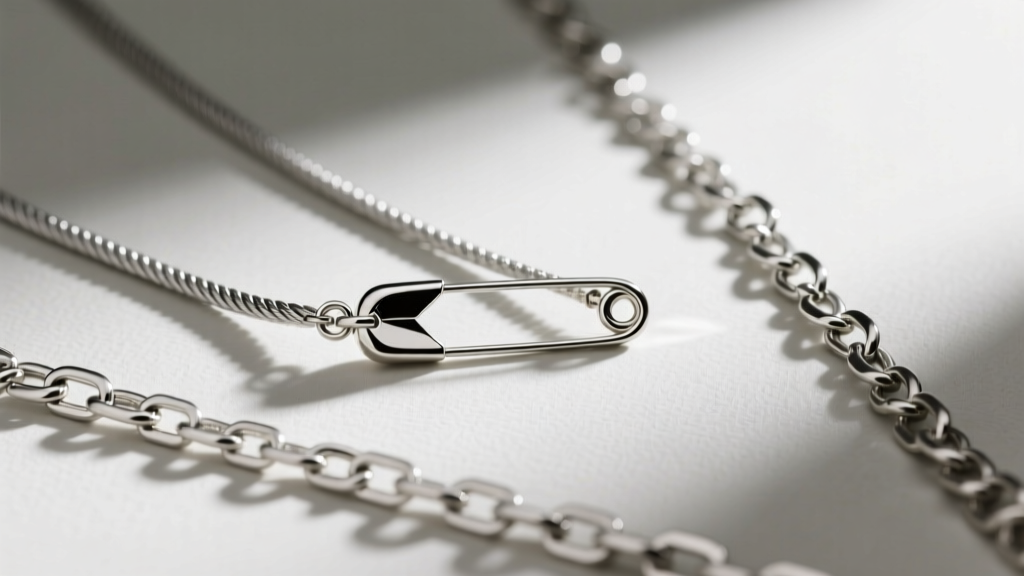
For horizontal (coil bail) configurations, a 2.0mm to 3.0mm curb or Cuban chain is recommended. The flat links of a curb chain provide friction that keeps the heavy pin centered. For vertical (hood bail) drops, a delicate 1.2mm cable or rolo chain is perfectly adequate, as the pendant's weight is aligned with the chain's natural drape. According to metallurgical sourcing guides from Rio Grande, matching the chain's tensile strength to the pendant's gram weight is essential to prevent clasp failure or chain elongation.
Hallmarking and Authenticity Verification
Because the safety pin design relies on thin wire and small components, finding the hallmark can be challenging. By law, precious metals must be stamped, but on a safety pin necklace, the "925" or "935" stamp is often microscopic. Experts recommend using a 10x jeweler's loupe to inspect the inside of the hood, the flat base of the retaining clip, or the interior of the soldered jump ring. If a piece lacks a hallmark entirely, or if the stamp is merely plated onto a base metal core, it should be avoided. High-end artisans will also include a registered maker's mark alongside the purity stamp, ensuring traceability and accountability for the metallurgical claims.
Pricing Tiers and Market Valuation
Evaluating the fair market value of a silver safety pin necklace requires looking past the brand name and analyzing the raw material weight, construction method, and finishing quality. Prices generally fall into three distinct tiers:
- Mass-Market / Cast ($25 - $60): These pieces are typically cast from molds rather than hand-wound from wire. They often feature a "fake" spring coil that is solid and non-functional. The silver is usually lightweight (under 3 grams), and the hood may be glued rather than soldered.
- Artisan / Hand-Fabricated ($80 - $180): Crafted from half-hard sterling or Argentium wire. The spring is functional, the hood is securely soldered, and the piece weighs between 4 and 8 grams. These offer the best balance of mechanical integrity and everyday wearability.
- Luxury / Designer ($250 - $600+): Brands in this tier utilize heavy-gauge wire (12g or 14g), incorporate secondary materials (like black rhodium plating or pavé diamonds on the hood), and feature proprietary locking mechanisms within the hood to secure the pin point.
Maintenance: Preserving Spring Tension and Finish
Maintaining a silver safety pin necklace requires specific care protocols, particularly if the piece features a functional spring mechanism. Standard silver polishing cloths are effective for the straight wire segments but cannot reach the interior of the spring coil or the deep recesses of the hood.
Expert Warning: Never place a functional safety pin necklace in an ultrasonic cleaner. The high-frequency vibrations can alter the work-hardened tension of the spring coil, causing it to loosen and fail to snap securely into the hood. Furthermore, ultrasonic waves can dislodge soldered jump rings if the piece has pre-existing micro-fractures.
Instead, use a specialized silver dip solution for deep cleaning, followed by a thorough rinse in distilled water and immediate drying with compressed air to prevent water spots in the coil. For routine maintenance, a soft-bristled makeup brush dipped in a mild, phosphate-free dish soap solution can gently agitate dirt out of the spring crevices without compromising the metal's structural integrity.
Final Verdict: Selecting Your Hardware
The silver safety pin necklace is a triumph of functional jewelry design, marrying subcultural aesthetics with precise mechanical engineering. When selecting a piece, prioritize Argentium silver for its superior hardness and tarnish resistance, and always verify the wire gauge to ensure the spring coil will maintain its tension over years of wear. By understanding the technical nuances of bail placement, chain pairing, and alloy composition, you can curate a piece that is not only visually striking but structurally enduring.


