How to Keep Necklaces From Tangling: Weave & Storage Science
Discover the physics of chain weaves and metal friction. Learn exactly how to keep necklaces from tangling using technical storage and layering methods.

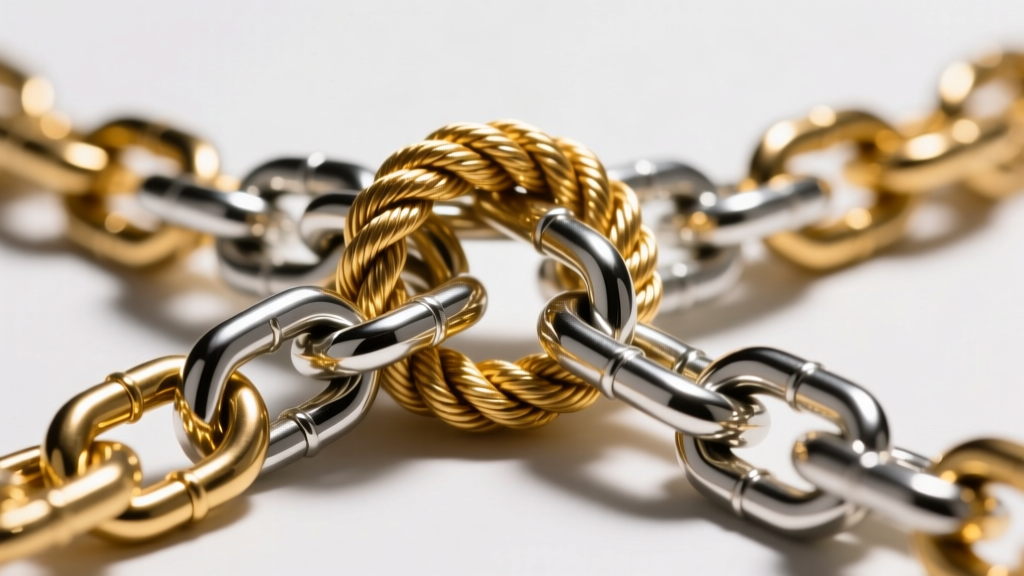
Tangling is not a matter of bad luck; it is a predictable outcome of physics, topology, and material science. When you ask how to keep necklaces from tangling, the answer requires looking past generic jewelry box advice and examining the structural geometry of chain weaves, the friction coefficients of precious metals, and the kinetics of confined storage. As jewelry designers and metallurgical experts, we approach necklace maintenance as an engineering problem. This deep dive breaks down the exact mechanics of why chains knot and provides technical, actionable frameworks to prevent it.
The Topology of Tangles: Why Chains Knot
In 2007, physicists Dorian Raymer and Douglas Smith published a landmark paper in the Proceedings of the National Academy of Sciences (PNAS) titled "Spontaneous knotting of an agitated string." Their research proved that any flexible string longer than 46 centimeters (roughly 18 inches) confined in a space and subjected to agitation has a near 100% probability of forming complex knots within seconds.
Necklaces are essentially agitated strings. When placed in a drawer or jewelry box, the kinetic energy from opening and closing the drawer, or simply moving the box, provides the agitation. The free end of the necklace (often near the clasp) weaves through the adjacent loops of the chain. Because the chain is confined, the ends cannot easily back out, resulting in a ratcheting effect where the knot tightens with every subsequent movement. To stop this, we must manipulate the variables: confinement, agitation, and the chain's structural geometry.
Chain Weave Analysis: Tangling Propensity Index
Not all chains are created equal. The topology of the chain weave dictates its surface friction and its ability to fold back onto itself. According to manufacturing data from Rio Grande, a leading jewelry supply house, the interlocking geometry of links directly correlates to knot probability.
| Chain Architecture | Surface Friction | Knot Probability | Structural Vulnerability |
|---|---|---|---|
| Box Chain | Low (Smooth flat planes) | Low (2/10) | Hinge points can snap under torque |
| Rope Chain | High (Twisted spiral grooves) | Extreme (9/10) | High; grooves catch on micro-fibers |
| Wheat Chain | Moderate (Woven ovals) | Moderate (5/10) | Low; highly durable and flexible |
| Snake Chain | Very Low (Tightly packed rings) | Near Zero (1/10) | Extreme; kinks permanently if bent |
| Cable Chain | Moderate (Uniform round links) | High (7/10) | Moderate; jump rings are weak points |
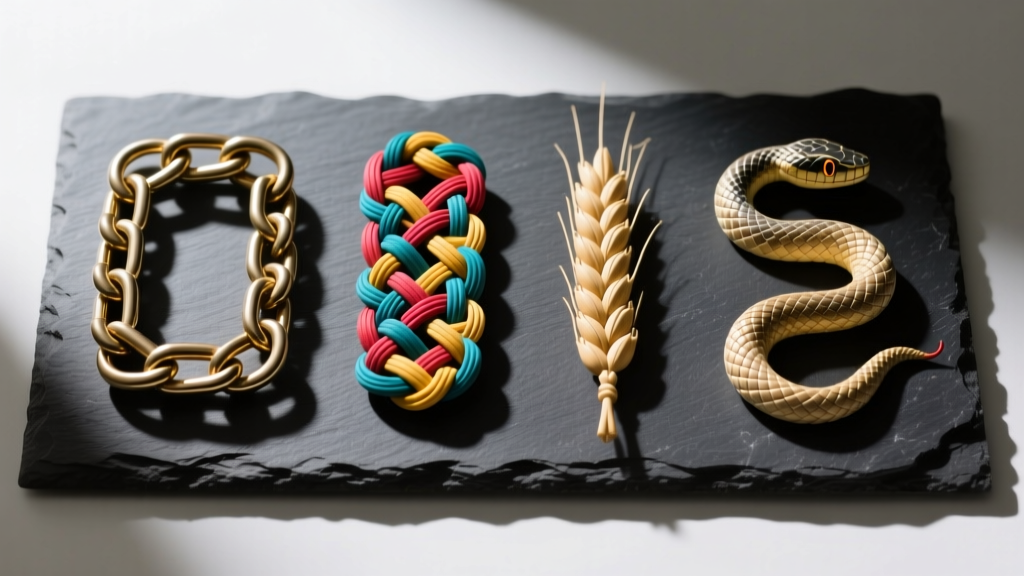
The Rope Chain Problem: Rope chains are notorious for tangling because their twisted, spiral geometry acts like a gear. When agitated, the grooves of a rope chain will catch on adjacent links, pulling them into the spiral and creating a complex, multi-point knot. If you own rope chains longer than 20 inches, they must be stored suspended or individually sleeved.
The Box Chain Advantage: Box chains feature square links connected at 90-degree angles, creating flat exterior planes. This drastically reduces the surface area available for friction and prevents adjacent links from catching inside one another, making them highly resistant to spontaneous knotting.
Hardware & Clasp Mechanics: The Hidden Snag Points
A chain is only as tangle-resistant as its weakest hardware component. The clasp assembly is often the primary instigator of knots. Standard lobster clasps require a jump ring to connect to the opposite end of the chain. If the jump ring is 4mm and the chain links are 1.5mm, the jump ring acts as a large, open hook that will inevitably catch on the links during storage.
Upgrading Your Clasp Architecture
- Laser-Welded Jump Rings: Ensure all jump rings are laser-welded or soldered shut. An open seam on a jump ring, even a microscopic one, will slice through delicate cable chains and act as a snag point.
- Hidden Box Clasps: For chains 2mm or thicker, replace the lobster clasp with a hidden box clasp with a figure-8 safety latch. This creates a seamless cylinder at the nape of the neck, eliminating the bulky hardware that catches on other jewelry.
- Neodymium Magnetic Clasps: For lightweight chains (under 1.5mm), high-grade neodymium magnetic clasps encased in smooth stainless steel or PVD-coated titanium offer a zero-snag profile.
Layering Physics: Weight and Length Differentials
Layering necklaces is a popular styling technique, but it introduces complex kinetic interactions. When two chains of similar length and weight are worn together, body movement causes them to braid around one another. To prevent this, you must apply the principles of pendulum physics and mass distribution.
The 5-Centimeter Delta Rule: When layering, the length difference between any two chains must be a minimum of 5 centimeters (2 inches). This ensures that the pendulum swing of the longer chain operates on a completely different arc than the shorter chain, preventing their paths from crossing and braiding.
Furthermore, pendant mass plays a critical role. A 1mm chain with a lightweight 2-gram pendant will bounce and tangle with adjacent layers. By anchoring the longer chain with a heavier pendant (e.g., 8 to 12 grams), you increase its inertia. The heavier pendant acts as a plumb bob, keeping the lower chain taut and resisting the kinetic agitation that causes braiding.
Advanced Storage Kinetics: Beyond the Jewelry Box
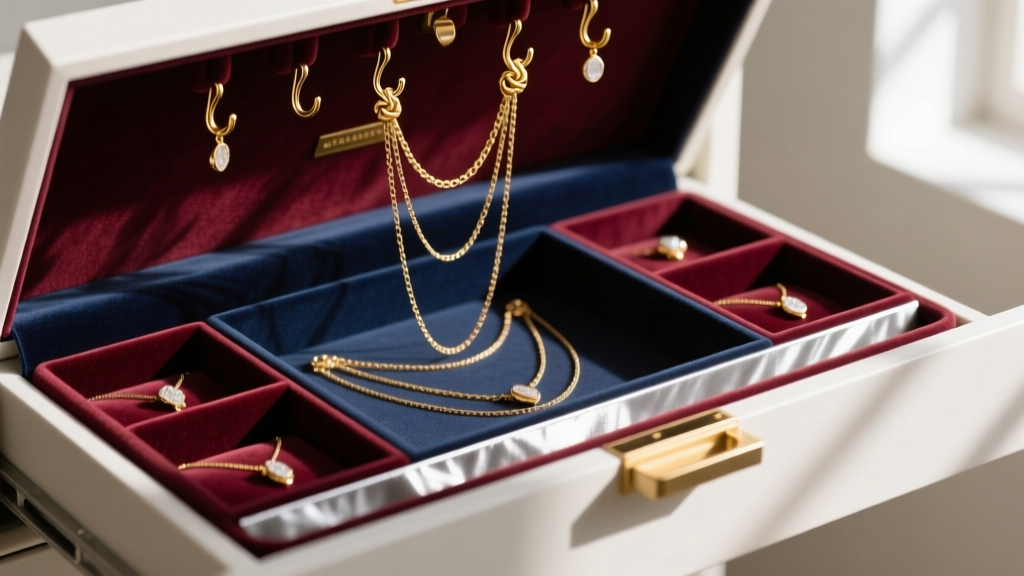
The standard velvet-lined jewelry box is a tangling hazard. It confines multiple chains in a single agitated space. Furthermore, the materials used in cheap jewelry boxes actively degrade your metals, increasing surface friction.
The Danger of PVC and Polyurethane
Many commercial jewelry organizers are lined with PVC (polyvinyl chloride) or low-grade polyurethane foams. Over time, these materials off-gas plasticizers and trace amounts of hydrochloric acid. According to the Gemological Institute of America (GIA), these airborne chemicals accelerate the formation of silver sulfide (tarnish) on sterling silver and copper alloys. Tarnish is not just a cosmetic issue; it creates a microscopically rough surface on the metal, drastically increasing the friction coefficient between links and making tangles much tighter and harder to undo.
Technical Storage Solutions
- Suspension Storage: The only way to completely defeat the "spontaneous knotting" theorem is to remove confinement. Install a tension rod inside a closet or cabinet and hang chains from S-hooks. Gravity keeps the chains taut, preventing the free ends from weaving through the loops.
- Anti-Tarnish Interleaving: If you must use a flat drawer, line it with Pacific Silver Cloth (a cotton flannel embedded with fine silver particles that absorb sulfur compounds) and place 3M Anti-Tarnish strips in each compartment. Keeping the metal surface smooth and polished maintains a low friction coefficient.
- Polyethylene Sleeving: For travel, avoid PVC plastic bags. Use individual, zip-seal bags made from inert polyethylene (PE). Squeeze the air out to limit oxidation and confine the chain in a rigid, flat plane, preventing the 3D movement required for knot formation.
Emergency Detangling: The Lubrication and Titanium Method
When a complex knot does form, the worst action you can take is pulling the ends. This applies tensile stress to the links, potentially stretching or snapping them, while simultaneously tightening the knot's core.
Instead, utilize a localized surfactant and rigid probes. Apply a single drop of a low-viscosity, non-reactive lubricant—such as specialized jewelry detangling fluid or highly refined mineral oil (baby oil)—directly to the center of the knot. This reduces the metal-on-metal friction coefficient to near zero.
Next, use two titanium needles to gently tease the knot apart. Titanium registers a 6 on the Mohs hardness scale, while 18k gold and sterling silver sit between 2.5 and 3. Because the titanium is significantly harder, it will not bend under pressure, yet its smooth surface will not scratch or gouge the softer precious metals. By inserting the titanium needles into the knot's core and pushing outward (rather than pulling the chain ends inward), you break the ratcheting tension and allow the lubricated links to slide free.
By understanding the topology of your chain weaves, upgrading your clasp hardware, and utilizing material-safe storage kinetics, you can entirely eliminate the frustration of tangled necklaces and preserve the structural integrity of your jewelry collection for decades.


