Double Infinity Necklace: Casting, Metals & Chain Specs
Explore the technical specs of the double infinity necklace. Learn about casting methods, metal hardness, chain gauges, and structural soldering.


The Anatomy of a Double Infinity Pendant
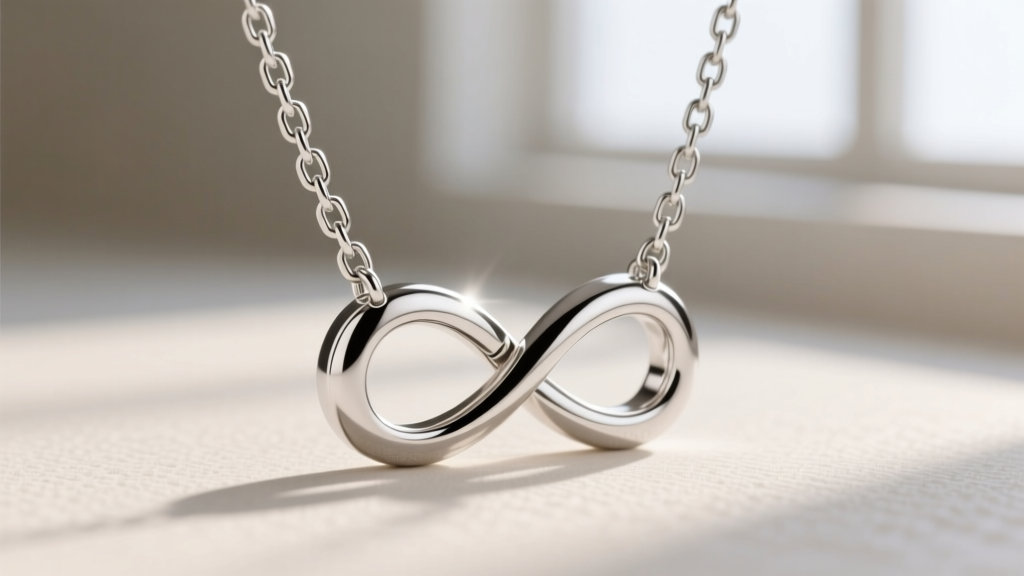
The double infinity necklace is a staple in symbolic jewelry, representing boundless connection and eternity. However, from a metallurgical and structural standpoint, the double infinity design presents unique manufacturing challenges. Unlike simple geometric pendants, the double infinity motif requires precise weight distribution, specialized casting techniques, and careful consideration of friction points where the two loops intersect or layer. Whether the design features two interlocking 3D loops or a flat, layered 2D silhouette, the structural integrity of the piece depends entirely on the precision of its execution.
When evaluating a double infinity necklace, expert jewelers look beyond the aesthetic finish. They assess the sprue mark removal, the porosity of the cast metal, the Vickers hardness of the chosen alloy, and the tensile strength of the paired chain. This guide deconstructs the technical specifications that separate a durable, heirloom-quality double infinity pendant from a mass-produced, easily damaged accessory.
Manufacturing Methods: Lost-Wax Casting vs. Die Striking
The geometry of the pendant dictates its manufacturing method. For interlocking 3D double infinity pendants, lost-wax casting is the industry standard. A 3D CAD model is printed in high-resolution castable resin, attached to a wax sprue, and encased in a plaster-like investment. The wax is burned out in a kiln, and molten metal is injected via centrifugal force or vacuum. This method allows for the complex undercuts required for interlocking loops.
Conversely, layered 2D double infinity pendants (where one infinity symbol sits flat against another) are often die-struck. Die striking involves pressing a sheet of metal between two hardened steel dies under immense pressure. This process compresses the metal's grain structure, resulting in a denser, harder pendant that is highly resistant to bending. However, die striking cannot produce true 3D interlocking links without secondary assembly.

Metal Alloys and Hardness Ratings (Vickers Scale)
The choice of metal profoundly impacts the wear resistance of a double infinity necklace, particularly at the friction points where the loops rub together. Jewelers measure metal hardness using the Vickers Hardness (HV) scale. According to the Gemological Institute of America (GIA), alloying pure gold with metals like copper, silver, and zinc drastically alters its mechanical properties.
| Metal Alloy | Vickers Hardness (HV) | Structural Pros & Cons for Infinity Loops |
|---|---|---|
| 14k Yellow Gold | ~135 - 150 HV | Excellent hardness; resists deformation at friction points. Ideal for interlocking loops. |
| 18k Yellow Gold | ~110 - 125 HV | Softer and more prone to scratching at the intersection. Requires thicker casting. |
| 950 Platinum | ~120 - 140 HV (Work-hardens) | Displaces rather than loses metal when scratched. Extremely durable for high-friction joints. |
| 925 Sterling Silver | ~60 - 75 HV | Too soft for thin, interlocking loops. Prone to bending and rapid wear at the joints. |
The Interlocking Solder Challenge
If a double infinity pendant is cast as two separate pieces and assembled later, the jeweler faces a critical soldering challenge. Traditional torch soldering applies broad heat, which can easily melt the adjacent metal or fuse the moving joint, locking the interlocking loops together permanently. To prevent this, master jewelers utilize laser welding. Laser welders focus a concentrated beam of light to melt a microscopic dot of filler metal, closing the final link without transferring heat to the rest of the pendant. This ensures the infinity loops remain articulate and fluid.
Chain Pairing: Gauge, Link Type, and Tensile Strength
A double infinity pendant typically weighs between 3.5 grams and 8.0 grams, depending on the metal and dimensions. Pairing it with an inadequate chain is a primary cause of jewelry loss. The chain must possess sufficient tensile strength to support the pendant's dynamic load (the sudden force applied when the necklace is snagged).
- Cable Chain (0.8mm - 1.0mm): Features uniform oval links. A 1.0mm 14k gold cable chain offers roughly 6 lbs of tensile strength. Suitable for lightweight (under 4g) layered infinity pendants.
- Box Chain (1.0mm - 1.5mm): Composed of square, interlocking links. A 1.2mm box chain provides superior structural rigidity and can withstand up to 12 lbs of force. Highly recommended for heavier, solid 3D interlocking infinity pendants.
- Rope Chain (1.5mm - 2.0mm): Twisted links that reflect light brilliantly. While visually striking, the twisted joints can be weak points if the gauge is too thin. Stick to 1.8mm or thicker for heavy pendants.
Clasp Mechanics and Failure Points
The clasp is often the weakest link in any necklace assembly. For a double infinity necklace, avoid spring ring clasps. The internal spring mechanism in a spring ring is highly susceptible to heat damage during manufacturing and easily fails under tension. Instead, insist on a cast or stamped lobster clasp. A standard 5x12mm lobster clasp features a robust internal spring and a thicker wire gauge, providing a secure closure that will not easily deform when subjected to the weight of a double infinity pendant.
Maintenance and Structural Inspection
Because the double infinity design inherently creates friction between the two loops, routine maintenance is non-negotiable. Over time, the constant rubbing can cause localized thinning of the metal, a phenomenon known as friction wear.
"When inspecting interlocking infinity pendants, I always check the inner curves of the loops with a 10x loupe. If the metal has thinned by more than 20% of its original gauge, the piece requires laser reinforcement before it snaps." — Senior Bench Jeweler
To maintain the piece, avoid ultrasonic cleaners if the pendant features micro-pave diamonds along the infinity curves, as the high-frequency vibrations can loosen the friction-set stones. Instead, use a mild dish soap solution and a soft-bristled brush to remove sebum and cosmetic buildup from the crevices. For further technical guidelines on jewelry maintenance and metal fatigue, refer to the manufacturing standards published by the Manufacturing Jewelers and Suppliers of America (MJSA).
Summary of Technical Specifications
When purchasing or designing a double infinity necklace, prioritize 14k gold or platinum for optimal hardness, ensure the chain gauge exceeds 1.0mm with a lobster clasp, and verify that any interlocking joints were assembled using precision laser welding rather than traditional torch soldering. By focusing on these metallurgical and structural details, you ensure the necklace remains a lasting symbol of eternity, rather than a fragile liability.


