Sunflower Diamond Necklace: A Technical Buyer's Guide
Explore the technical anatomy of a sunflower diamond necklace. Learn about melee grading, prong settings, metal durability, and pricing tiers.

The Architectural Blueprint of a Sunflower Pendant
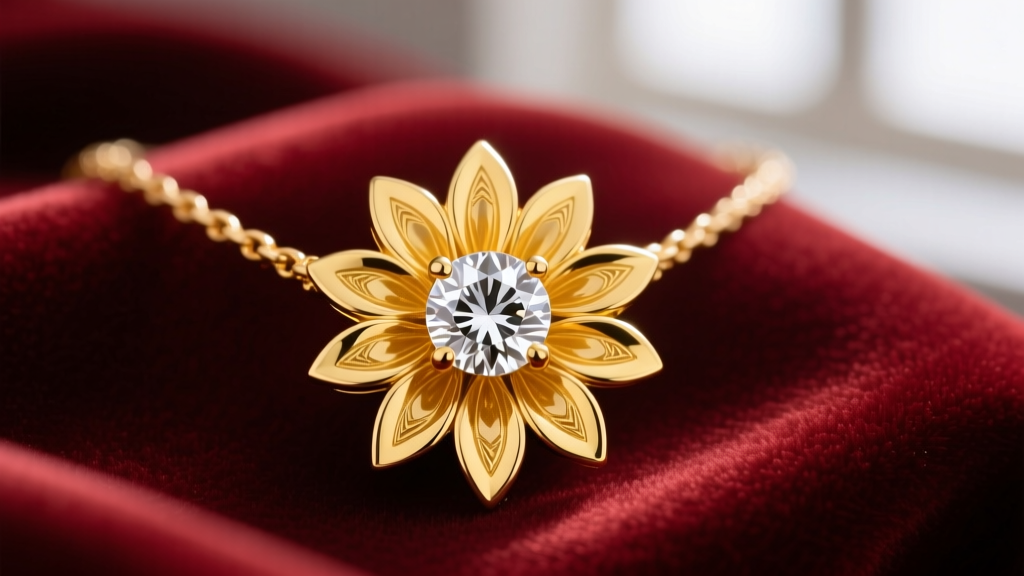
When evaluating a sunflower diamond necklace, most consumers focus solely on the total carat weight (TCW) and the immediate visual sparkle. However, as a domain expert in jewelry engineering, I look at the structural geometry, facet alignment, and metallurgical choices that dictate both the brilliance and the longevity of the piece. A true sunflower motif requires a precise ratio between the center stone (representing the pistil/stamen) and the surrounding melee diamonds (the ray florets).
Center Stone vs. Melee Petals: Carat Weight Distribution
The most common retail trap in floral jewelry is the inflated TCW marketing tactic. A necklace advertised as a '1.00ct Sunflower' might feature a meager 0.15ct center stone surrounded by 0.85ct of low-grade melee. For a balanced, aesthetically pleasing sunflower diamond necklace, the center stone should account for at least 40% to 50% of the total carat weight. A standard technical specification for a high-quality 0.75ct TCW piece involves a 0.35ct round brilliant center surrounded by ten 0.04ct melee petals.
Furthermore, the cut of the melee diamonds is critical. According to the Gemological Institute of America (GIA), melee diamonds under 0.02ct are often 'single-cut' (featuring only 17 or 18 facets). While single-cut melee is cheaper to produce, it lacks the fire and scintillation of 'full-cut' melee (57 or 58 facets). For the petals of a sunflower pendant to mimic the brilliance of a larger solid stone, full-cut melee is an absolute necessity, even if it increases the manufacturing cost by 15% to 20%.
Light Performance and Facet Alignment
The spatial arrangement of the petals dictates light return. If the pavilion facets of the melee diamonds are angled too steeply toward the center stone, they will create a 'dead zone' or light leakage shadow around the center diamond's girdle. Expert jewelers set the petal melee at a slight outward tilt (approximately 5 to 8 degrees) to maximize edge-to-edge brilliance and create the illusion of a continuous, unified floral face.
Metal Alloys and Prong Durability
The metal chosen for a sunflower diamond necklace must balance aesthetic warmth with tensile strength. The delicate prongs securing the outer petals are highly susceptible to shear stress, especially since pendants rest on the sternum and are prone to friction against clothing.
| Metal Alloy | Purity | Vickers Hardness (HV) | Prong Durability & Best Use |
|---|---|---|---|
| 14K White Gold | 58.5% | ~130 HV | High tensile strength; excellent for ultra-thin shared prongs securing small melee. |
| 18K Yellow Gold | 75.0% | ~115 HV | Softer, richer color; requires slightly thicker prongs, which can obscure tiny petals. |
| Platinum (950) | 95.0% | ~110 HV | Dense and malleable; prongs won't wear away but can bend under heavy impact. |
For a sunflower design with ten or twelve distinct, delicate petals, 14K white gold or platinum is technically superior. Platinum's malleability means it holds diamonds securely without snapping, though it requires periodic re-tipping if bent. The American Gem Society (AGS) frequently notes that while 18K gold offers a premium color, its lower hardness makes it a risky choice for intricate micro-pave or shared-prong floral motifs subjected to daily wear.
Setting Techniques: Securing the Petals
Shared Prong vs. Bezel Settings
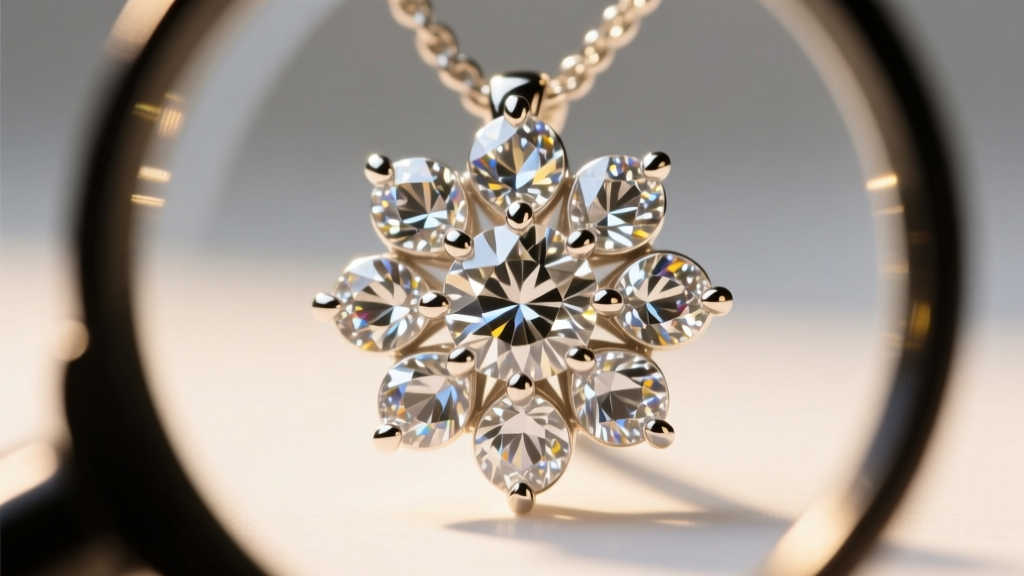
The setting technique defines both the security and the light performance of the sunflower diamond necklace. Bezel settings, where a thin rim of metal surrounds the entire girdle of each petal, offer maximum security. However, a full bezel blocks approximately 15% to 20% of light entry from the crown, significantly dulling the sparkle of small melee stones.
Instead, expert bench jewelers utilize shared prong settings or micro-pave techniques for the petals. In a shared prong layout, a single V-shaped or rounded metal bead secures the edges of two adjacent melee diamonds. This minimizes the metal footprint, allowing maximum light penetration from the top and sides. The failure mode to watch for in shared prongs is 'catching'—if the prong is not filed perfectly flush, it will snag on silk or knitwear, eventually lifting the prong and losing a petal diamond.
Chain Pairing and Bail Engineering
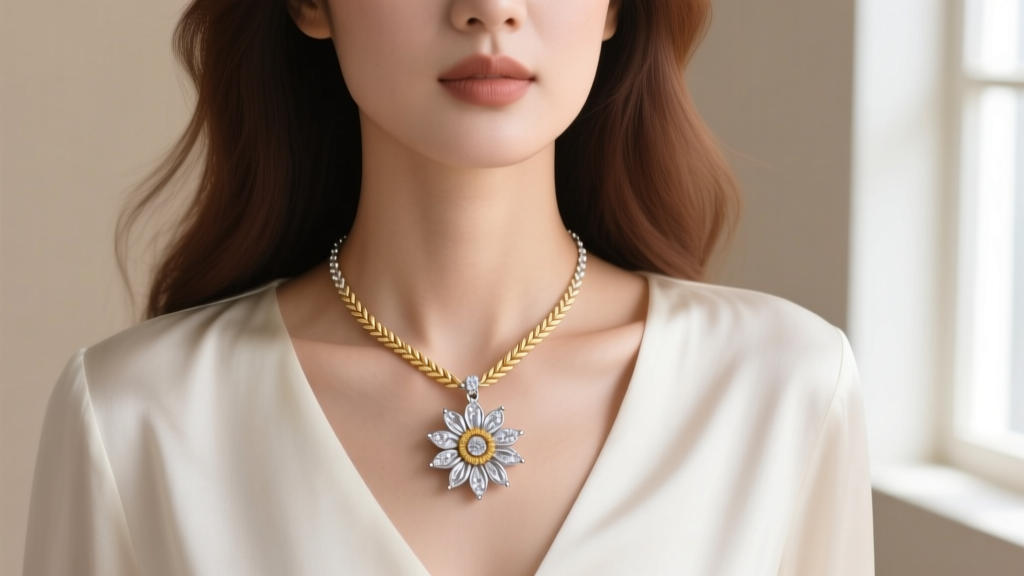
A frequent oversight in buying floral pendants is ignoring the physics of the bail and chain. A sunflower pendant is inherently top-heavy and wide. If suspended from a standard loop bail on a thin, round 0.8mm cable chain, the pendant will constantly flip upside down, hiding the diamond face against the wearer's skin.
- The Bail: Opt for a 'hidden bail' or a 'weighted European bail' soldered to the back of the pendant. This shifts the center of gravity backward, forcing the sunflower face to lay flat against the sternum.
- The Chain Gauge: Avoid delicate chains under 1.0mm. A 0.50ct TCW sunflower pendant weighs roughly 2.5 to 3.5 grams. To support this weight and resist kinking, a 1.2mm to 1.5mm box chain or wheat chain is structurally required. Wheat chains, with their woven, directional links, offer superior tensile strength and resist the rotational torque that causes cable chains to twist.
Pricing Tiers and Value Assessment
Understanding the pricing matrix of a sunflower diamond necklace prevents overpaying for poorly engineered pieces. Prices fluctuate based on the center stone's 4Cs, the melee quality, and the precious metal weight.
Expert Appraisal Tip: Always request the TCW breakdown. If a jeweler cannot tell you the exact carat weight of the center stone separate from the melee petals, walk away. Transparency in carat distribution is the hallmark of a reputable dealer.
- Tier 1 (Entry-Level / Fashion): 0.25ct TCW, 14K Gold, Single-cut melee, I1-I2 clarity center. Price Range: $600 - $1,200.
- Tier 2 (Mid-Range / Fine): 0.50ct TCW, 18K Gold or Platinum, Full-cut melee, SI1 clarity center. Price Range: $2,200 - $3,800.
- Tier 3 (High-End / Investment): 1.00ct+ TCW, Platinum, Ideal-cut center (VS1+), precision-matched full-cut melee. Price Range: $5,500 - $9,500+.
Maintenance and Failure Modes
The intricate crevices of a sunflower diamond necklace make it a magnet for lotions, dead skin, and cosmetic dust, which rapidly degrade light return. While ultrasonic cleaners are excellent for solid solitaire pendants, they are a known failure mode for shared-prong melee settings. The high-frequency vibrations can fracture microscopic inclusions in the melee diamonds or shake loose poorly set petal stones.
For safe, technical maintenance, use a thermal steam cleaner or a manual soak in a mild, ammonia-free degreasing solution followed by gentle agitation with an extra-soft baby toothbrush. Have a professional jeweler inspect the shared prongs under 10x magnification every six months to check for metal fatigue and prong lift, ensuring your sunflower diamond necklace remains structurally sound and optically brilliant for decades.


