Necklace Queen Jewelry Troubleshooting: Fix Tarnish & Broken Chains
Solve common Necklace Queen jewelry issues. Learn expert fixes for faded gold vermeil, snapped 0.9mm chains, and bent personalized pendants.

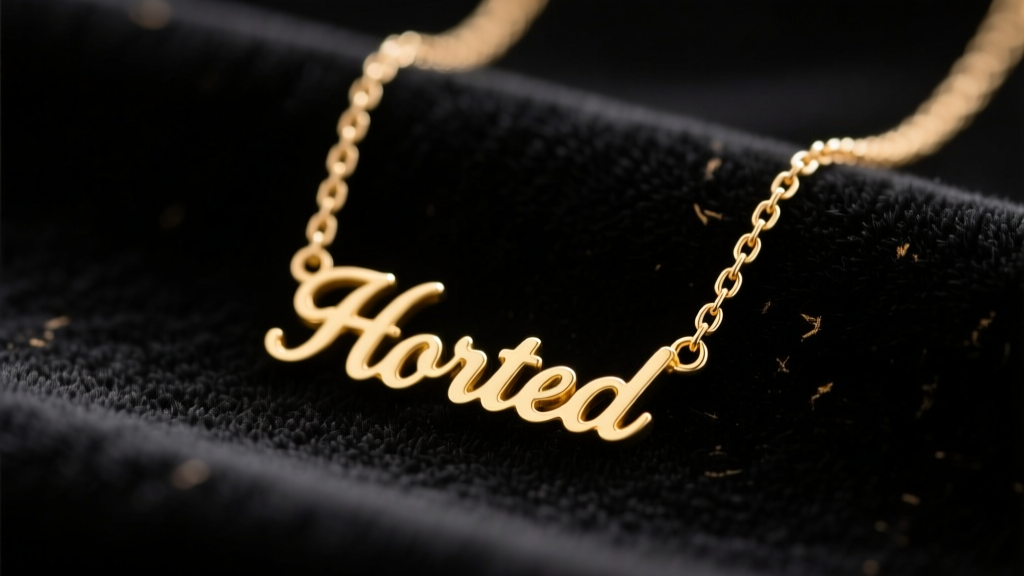
The Viral Appeal and Common Wear-and-Tear Issues
Necklace Queen has dominated social media feeds by offering highly personalized, affordable nameplates, initial pendants, and delicate chain necklaces. However, the very manufacturing techniques that keep these viral pieces accessible also introduce specific structural vulnerabilities. When you are dealing with 18k gold vermeil over 925 sterling silver, 0.9mm cable chains, and stamped brass or silver nameplates, standard jewelry repair advice often falls short. This comprehensive troubleshooting guide dives deep into the metallurgy and mechanics of these specific viral necklaces, providing actionable, expert-level solutions for the most common failures.
The Metallurgy of Viral Jewelry: Why the Gold Fades
The most frequent complaint regarding Necklace Queen’s gold-toned pieces is premature tarnishing or the gold layer rubbing off entirely to reveal a brassy or silvery underlayer. To troubleshoot this, we must first understand the plating standards.
Flash Plating vs. True Vermeil
According to the Federal Trade Commission Jewelry Guides, true gold vermeil requires a base of 925 sterling silver plated with at least 2.5 microns of 10k, 14k, or 18k gold. Many viral jewelry brands utilize flash plating (less than 0.5 microns) over brass to cut costs. When the microscopic gold layer wears away from friction against the collarbone, the underlying metal reacts with the sulfur and acidity in human sweat, resulting in rapid oxidation and green or black tarnish. The Gemological Institute of America (GIA) notes that skin pH levels heavily influence the degradation rate of electroplated jewelry, meaning a piece might last years on one person but fade in weeks on another.
Troubleshooting Faded Gold: The Restoration Matrix
Once the gold layer has physically worn away, no amount of polishing will bring it back. Polishing an already bald spot will only remove more of the surrounding microscopic gold. You must choose between DIY color-matching and professional restoration.
| Restoration Method | Best For | Estimated Cost | Longevity |
|---|---|---|---|
| Gold Leaf Wax Rubbing (DIY) | Small, localized bald spots on the back of pendants | $15 - $25 | 1 - 3 Months |
| Professional Electroplating | Entire chain and pendant restoration | $65 - $120 | 1 - 3 Years |
| Brush Plating (Pen Plating) | Targeted repair on intricate nameplate lettering | $45 - $80 | 6 - 12 Months |
If you opt for professional electroplating, request a minimum of 2.5 microns of 18k yellow gold to ensure the repair meets true vermeil standards and resists daily friction.
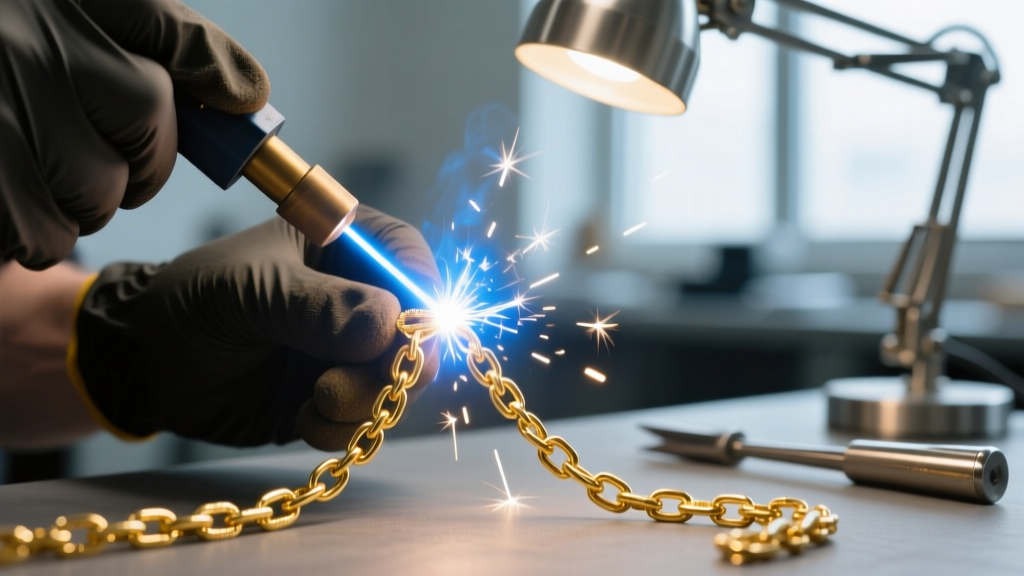
Rescuing Snapped 0.9mm Cable Chains
Necklace Queen typically utilizes delicate 0.9mm to 1.2mm cable or rope chains to maintain a dainty aesthetic. While elegant, these thin gauges are highly susceptible to snapping when snagged on clothing or pulled.
Why Torch Soldering Destroys Delicate Links
Do not take a snapped 0.9mm chain to a traditional jeweler who relies exclusively on butane or oxy-acetylene torch soldering. Gold and silver are exceptional thermal conductors. When a jeweler applies a torch to a 0.9mm link, the heat travels instantly to the adjacent links, melting them into a solid, unusable glob of metal before the solder even flows. Furthermore, the high heat will instantly burn off the gold plating, leaving a massive, unrepairable dark scar on the chain.
The Laser Welding Solution
The only permanent, cosmetically sound fix for a micro-chain is Nd:YAG laser welding. As detailed by jewelry manufacturing experts at Rio Grande, laser welders deliver a highly focused pulse of light energy that melts the metal in a fraction of a millisecond. The heat-affected zone is microscopic, meaning the link next to the weld remains completely cool and intact. A skilled laser technician can fuse a 0.9mm cable chain link using a microscopic wire of matching karat gold filler, preserving both the structural integrity and the surrounding plating.
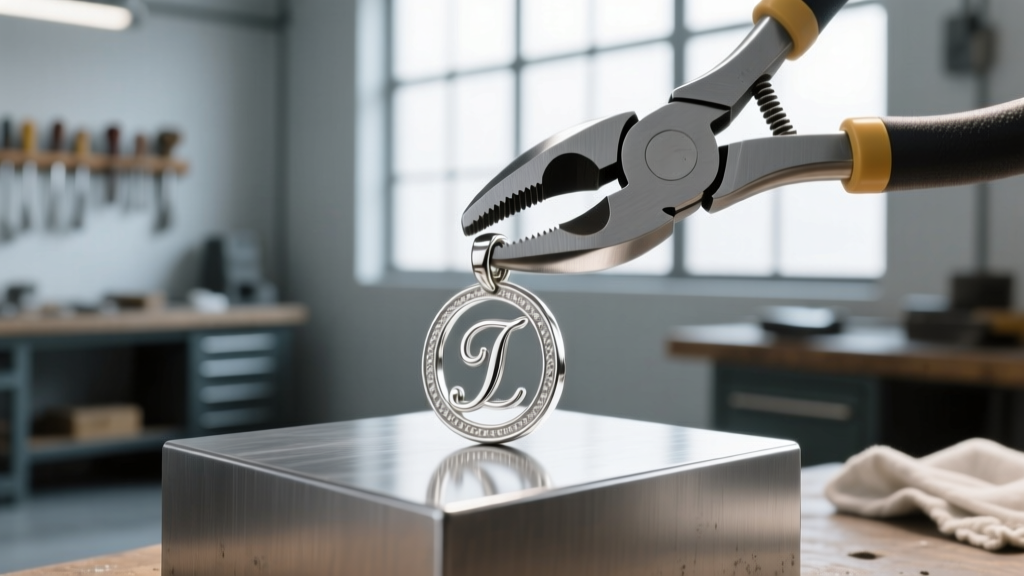
Flattening Bent Stamped Nameplates and Initials
Personalized nameplates are stamped from flat sheets of metal, usually ranging from 0.6mm to 0.8mm in thickness. Because they are wide and thin, they act like levers; if the chain snags, the torque will easily bend the nameplate along its horizontal axis. Attempting to bend it back with your fingers will result in a wavy, distorted piece that catches the light unevenly.
The Acrylic Block Method
To safely flatten a bent nameplate without marring the polished surface or cracking the solder joints where the jump rings attach:
- Place the necklace on a highly polished steel bench block.
- Cover the nameplate with a piece of thick, clear acrylic or a specialized nylon bench block.
- Using a rawhide mallet or a hammer with nylon-jaw pliers, gently tap the acrylic directly over the bent area.
- The acrylic distributes the force evenly across the surface, pushing the metal back into a flat plane without leaving tool marks or hammer dents on the gold or silver finish.
Fixing Stuck 5mm Lobster Clasps
The standard 5mm lobster clasp used on most viral dainty necklaces contains a tiny internal steel spring and a microscopic pivoting lever. These frequently fail in two ways: the lever becomes stuck in the open position, or the clasp refuses to snap shut securely.
Lubrication and Tension Adjustment
If the lever is stuck, do not force it with a fingernail, as the internal steel spring will snap. Instead, apply a single drop of synthetic watch oil or a dry PTFE lubricant directly into the seam of the lever using a fine needle. Work the lever back and forth gently until the oil penetrates the pivot pin. If the clasp closes but fails to "click" or stay shut, the internal spring has lost its tension. Using a pair of fine-tipped tweezers, gently pry the lever outward by a fraction of a millimeter to increase the spring tension. If the spring is entirely broken, the 5mm clasp must be snipped off and replaced with a slightly more robust 7mm stainless steel or solid gold lobster clasp to prevent future failures.
The Preventative Care Framework for Viral Jewelry
Troubleshooting is reactive; proper maintenance is proactive. To extend the lifespan of your Necklace Queen pieces, implement this strict wear-and-care protocol:
- The "Last On, First Off" Rule: Always put your necklace on after applying perfumes, lotions, and hairsprays. The alcohol and volatile organic compounds (VOCs) in cosmetics rapidly degrade the 2.5-micron gold layer.
- Friction Mapping: Avoid wearing long pendants that rest directly on the sternum if you wear rough textiles like wool or sequins. The micro-abrasions will sand away the gold plating in weeks.
- Ultrasonic Warning: Never put gold vermeil or plated brass nameplates into an ultrasonic cleaner. The high-frequency cavitation bubbles will literally blast the thin gold layer off the base metal. Stick to a mild dish soap and a baby-soft toothbrush for cleaning.
- Storage Isolation: Store each necklace individually in an anti-tarnish ziplock bag with a silica gel packet. Storing multiple delicate chains together guarantees micro-tangles that lead to link deformation and snapping.
By understanding the specific material limitations and structural engineering of viral personalized jewelry, you can effectively troubleshoot issues, execute precise repairs, and keep your favorite daily-wear pieces looking pristine for years to come.


