Styling a Sweater with Necklace: Technical Expert Guide
Master the art of pairing a sweater with necklace. Discover technical insights on chain weaves, metal grades, and fabric friction to prevent snagging.

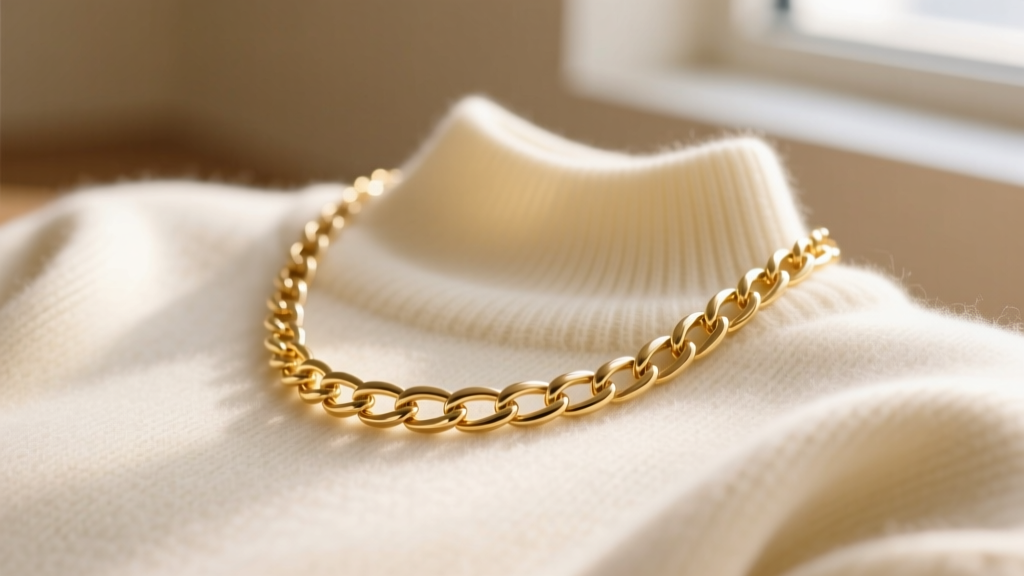
The Intersection of Textile Physics and Metallurgy
Successfully styling a sweater with necklace pairings requires more than just an eye for color coordination; it demands a fundamental understanding of textile physics and metallurgical friction. When metal meets knitwear, you are introducing a high-density, rigid surface to a matrix of delicate, microscopic fibers. The wrong combination will result in shredded cashmere, distorted necklines, and permanent tarnish transfer. This technical guide deconstructs the mechanics of pairing necklaces with knitwear, providing actionable parameters for chain weaves, pendant weights, and metal grades to preserve both your jewelry and your garments.
Fiber Micro-Structure and Chain Friction Coefficients
Animal-based fibers like cashmere, merino wool, and mohair are not smooth cylinders. Under a microscope, they reveal overlapping cuticle scales that point toward the tip of the fiber. These scales are designed to trap air and provide insulation, but they also act as microscopic hooks. When a chain necklace with high surface friction moves against these fibers, the scales catch in the crevices of the metal links, leading to pilling, micro-abrasions, and eventually, structural failure of the yarn.
Conversely, synthetic blends (acrylic, polyester) lack these scales but are highly susceptible to triboelectric charging (static electricity). A metal necklace worn over a synthetic sweater can act as a static magnet, aggressively attracting lint, dust, and pet hair to the immediate vicinity of the chain.
Chain Weave Engineering: Compatibility Matrix
Not all chain weaves are created equal. The surface topography of a chain dictates its friction coefficient against knitwear. Below is a technical compatibility matrix for pairing specific chain weaves with varying sweater gauges and fiber types.
| Chain Weave | Surface Topography | Friction Level | Best Sweater Compatibility | Fibers to Avoid |
|---|---|---|---|---|
| Box Chain | Flat, interlocking geometric plates | Low | Fine-gauge cashmere, silk-blend knits | None (highly versatile) |
| Cable Chain | Uniform oval links with moderate gaps | Medium | Mid-gauge merino, cotton-blend sweaters | Mohair, angora (fibers catch in gaps) |
| Rope Chain | Twisted, highly textured spiral links | High | Heavy chunky knits, thick cotton hoodies | All fine animal fibers (will shred) |
| Snake Chain | Overlapping directional metal bands | Severe | Leather, bare skin only | All knitwear (acts like a rasp) |
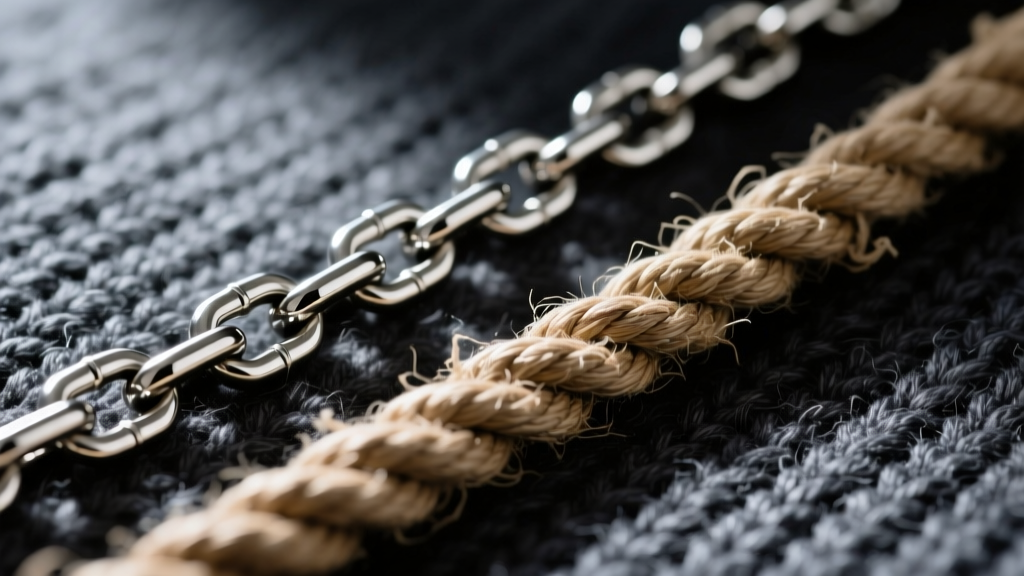
As noted by experts at Jewelers Mutual, maintaining the integrity of both your jewelry and your wardrobe requires matching the smoothness of the metal to the delicacy of the fabric. For ultra-fine 14-to-19-micron cashmere, a polished box chain or a solid herringbone chain is mandatory. The flat surface allows the chain to glide over the fiber cuticles without engaging them.
Pendant Weight and Center of Gravity
The mass of your pendant directly impacts the structural integrity of the sweater's neckline. A heavy pendant creates a pendulum effect, concentrating kinetic energy and downward tension on a single point of the collar. Over time, this leads to irreversible neckline stretching, particularly in ribbed crewnecks and delicate V-necks.
Weight-to-Fabric Tension Thresholds
- Under 5 Grams: Safe for all necklines, including fine-gauge cashmere and wide boat-necks. The fabric's natural elasticity can support this weight without distortion.
- 5 to 15 Grams: Suitable for mid-weight merino and cotton blends. Requires a chain with a wider surface area (e.g., 2mm to 3mm width) to distribute the load across more yarn threads.
- Over 15 Grams: Reserved exclusively for heavy, chunky knits, turtlenecks, or structured wool-blend cardigans. The rigid ribbing of a turtleneck provides the necessary tensile strength to support a heavy geometric or gemstone pendant without sagging.
The Turtleneck Threshold: Bail Sizing and Length
When styling a turtleneck, the physical dimensions of the jewelry hardware become critical. A standard pendant bail (the loop that connects the pendant to the chain) typically has an inner diameter (ID) of 2mm to 3mm. This is insufficient for a ribbed turtleneck, as forcing a small bail over the thick collar will stretch and snap the yarn.

For turtleneck styling, you must select pendants with an oversized bail (minimum 5mm ID) or utilize a specialized clip-on bail. Furthermore, the chain length must be scaled to the wearer's torso to ensure the pendant rests on the sternum rather than the floating ribs. A 28-inch to 32-inch chain is the technical standard for turtlenecks, allowing the pendant to hang freely and create a vertical line that elongates the silhouette without pulling the collar downward.
Metallurgy and Tarnish Transfer on Light Knits
One of the most devastating failures in sweater-and-necklace styling is tarnish transfer. Sterling silver (925) contains 7.5% copper, which reacts with sulfur compounds in the air and human perspiration to form silver sulfide—a black, powdery corrosion. When a tarnished silver chain rubs against a white or cream-colored cashmere sweater, this black dust embeds itself into the porous animal fibers, creating stubborn, dark stains that are nearly impossible to remove without professional textile conservation.
According to the Gemological Institute of America (GIA), regular polishing and proper storage are essential to prevent silver sulfide buildup. However, when pairing silver with light-colored knitwear, prevention is superior to maintenance. To eliminate the risk of tarnish transfer entirely, opt for the following metallurgical alternatives:
- Rhodium-Plated Silver: A microscopically thin layer of rhodium (a platinum-group metal) seals the silver, providing a brilliant, tarnish-proof barrier that is entirely safe for white cashmere.
- 14k or 18k Gold: The high gold content and alloy composition resist oxidation, making yellow and rose gold inherently safe for all light textiles.
- PVD-Coated Stainless Steel: Physical Vapor Deposition (PVD) creates a molecular bond between the steel and a titanium nitride coating, resulting in a highly durable, non-reactive surface that will never bleed onto your garments.
Troubleshooting Snags and Static Cling
Even with meticulous planning, snags can occur. If a chain catches a thread in your sweater, never pull the chain away forcefully. This will break the fiber and leave a permanent hole. Instead, lay the garment flat, use a fine sewing needle to gently tease the caught loop of yarn back through to the inside of the sweater, and massage the surrounding threads to redistribute the tension.
For static cling issues with synthetic blend sweaters, avoid using standard anti-static sprays directly on the garment, as the chemicals can degrade certain synthetic dyes. Instead, lightly mist a microfiber cloth with a 50/50 mixture of distilled water and white vinegar, and wipe down the outside of the sweater before putting it on. This neutralizes the triboelectric charge, allowing your necklace to lay flat and repel ambient dust. For further insights on preserving delicate textiles, the Cashmere and Camel Hair Manufacturers Institute (CCMI) recommends avoiding harsh chemical interactions near luxury fibers, reinforcing the need for metallurgically stable jewelry choices.
Final Technical Takeaways
Mastering the aesthetic of a sweater with necklace styling is an exercise in material science. By respecting the micron count of your fibers, selecting low-friction chain weaves like the box chain, calculating the grammatical load of your pendants, and choosing non-reactive metal grades, you elevate your style while preserving the structural integrity of your most valuable garments and jewelry pieces.


