Ankh Necklace Guide: Metallurgy, Proportions, and Chain Pairing
Discover the technical details of choosing an ankh necklace. Expert insights on metal grades, loop-to-shaft proportions, and chain pairing for daily wear.

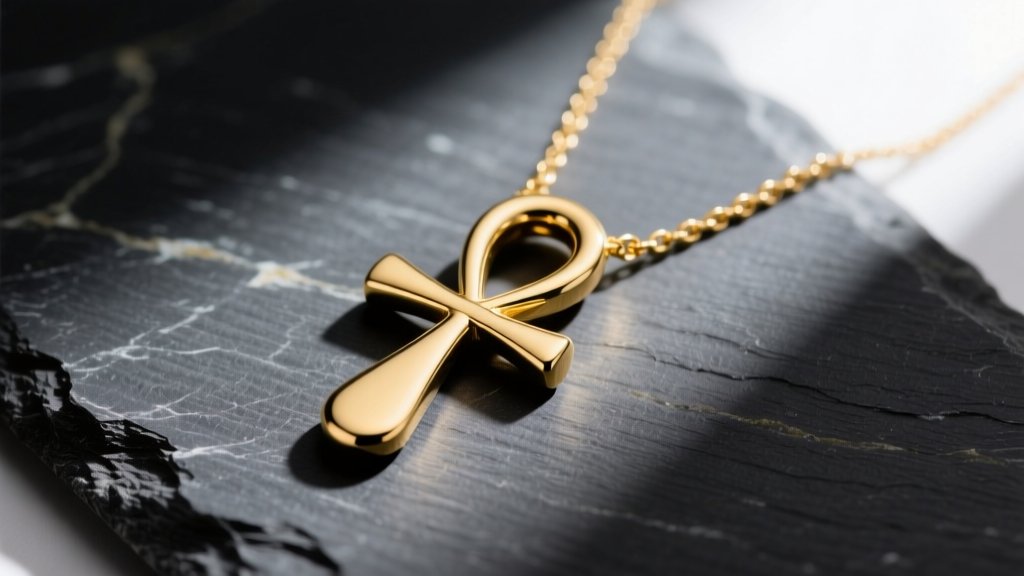
The ankh, historically known as the crux ansata or "key of life," is one of the most enduring symbols in jewelry design. However, translating this ancient Egyptian hieroglyph into a durable, modern pendant requires precise metallurgical and structural considerations. Many mass-market ankh necklaces fail prematurely due to poor loop-to-shaft ratios, micro-porosity in casting, or improper chain pairing. This technical deep dive explores the engineering, material science, and ergonomic specifications required to select or design an ankh necklace that withstands daily wear while maintaining historical and aesthetic integrity.
The Anatomy of an Ankh: Proportions and Structural Integrity
The structural viability of an ankh pendant relies heavily on its geometric proportions. A poorly proportioned ankh is not only visually unbalanced but also prone to stress fractures at the junction points.
Historical vs. Modern Proportions
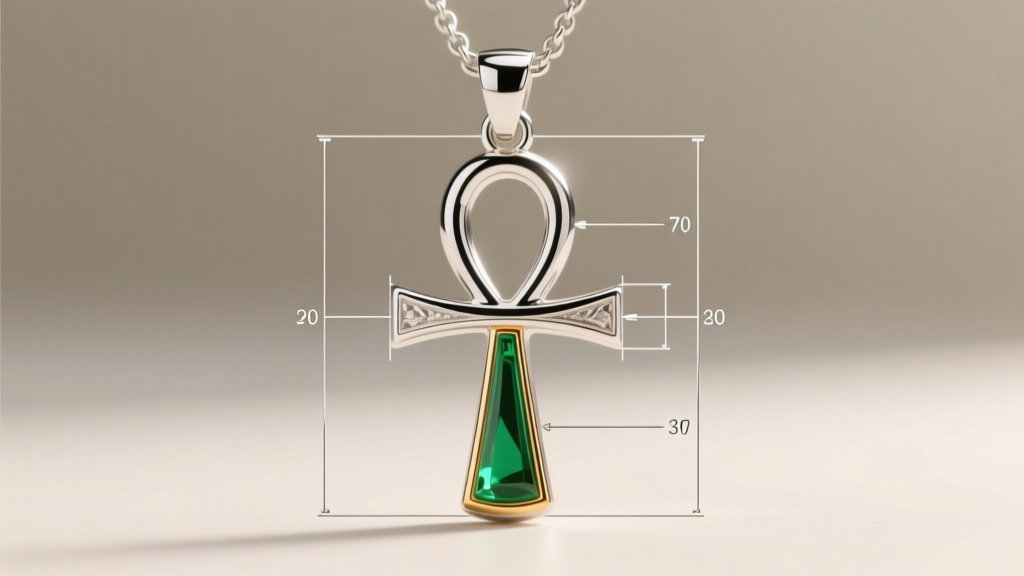
In authentic Egyptian artifacts, the ankh features a teardrop or oval-shaped loop (the ansata), not a perfect circle. The crossbar is typically positioned roughly one-third of the way down from the apex of the total height. Modern stylized versions often use a perfectly circular loop, which alters the center of gravity and causes the pendant to flip forward when worn on longer chains.
For optimal visual balance and structural distribution, the ratio of the loop's outer height to the lower shaft's length should ideally fall between 1:1.5 and 1:1.8. The crossbar width should extend no more than 1.5 times the width of the vertical shaft to prevent lateral snagging.
Manufacturing Methods: Cast vs. Die-Struck
The manufacturing method dictates the tensile strength of the ankh's thinnest points—specifically the crossbar and the apex of the loop.
- Investment Casting: Most commercial ankhs are cast. If the sprue placement and cooling gradients are poorly managed, micro-porosity can develop inside the thin crossbar, leading to spontaneous snapping under tension.
- Die-Striking: Stamping an ankh from a sheet of precious metal compresses the crystalline grain structure. A die-struck 14k gold ankh possesses up to 30% higher tensile strength than its cast counterpart, making it vastly superior for the delicate crossbar and loop.
Metallurgy and Material Grades: What to Look For
Because the ankh features protruding, narrow elements (the crossbar), the Vickers hardness (HV) of the chosen metal is critical. Soft metals will bend upon impact with hard surfaces.
| Metal / Alloy | Vickers Hardness (Approx.) | Tarnish / Corrosion Resistance | Ideal Use Case | Price Range (Standard 25mm) |
|---|---|---|---|---|
| 999 Fine Silver | 25 HV | High | Display only; too soft for daily wear crossbars. | $40 - $70 |
| 925 Sterling Silver | 65 HV | Moderate (requires polishing) | Standard daily wear; prone to bending if under 2mm thick. | $60 - $120 |
| Argentium Silver (960) | 75 HV | Exceptional (Germanium alloy) | High-end daily wear; resists firestain and sulfur tarnish. | $90 - $160 |
| 14k Yellow Gold (585) | 140 HV | Excellent | Heirloom daily wear; optimal hardness for thin loop structures. | $350 - $600 |
| 18k Yellow Gold (750) | 120 HV | Excellent | Luxury wear; slightly softer, requires thicker gauge casting. | $600 - $1,100 |
| Grade 5 Titanium (Ti-6Al-4V) | 340 HV | Impervious | Active lifestyles; lightweight but difficult to resize/repair. | $80 - $150 |
The Problem with White Gold Rhodium Plating
If purchasing a white gold ankh, be aware that the rhodium plating will wear off the high-friction areas first—specifically the inner curve of the top loop where the chain rubs. This exposes the pale yellow underlying alloy. For a maintenance-free white metal ankh, platinum or palladium are vastly superior choices, as their color is intrinsic and will not wear away.
Bail Design and Chain Pairing Mechanics
The interaction between the chain and the ankh's top loop is the most common point of mechanical failure in this jewelry style.
Expert Warning: Never thread a stainless steel or titanium chain directly through a sterling silver or gold ankh loop. The disparity in hardness will cause the harder chain to act as a file, rapidly eroding the inner surface of the precious metal loop through galvanic and friction wear.
Direct Threading vs. Soldered Bails
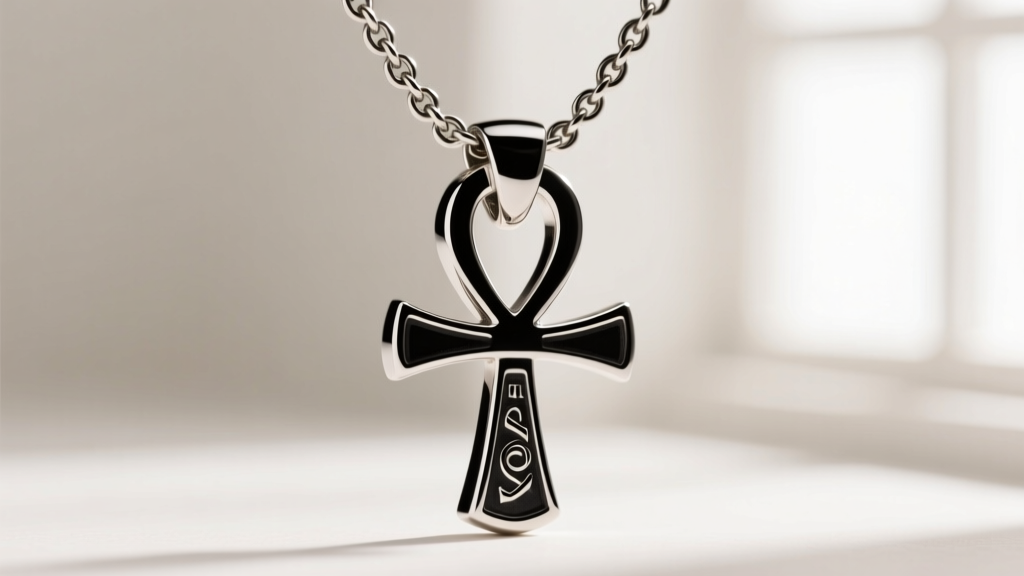
Authentic historical representations often show the chain passing directly through the loop. If you prefer this aesthetic, you must adhere to strict pairing rules:
- Chain Thickness: The chain must be no thicker than 2.5mm to allow free movement without binding.
- Chain Style: Use smooth cable or round box chains. Avoid curb, Figaro, or rope chains, as their flat or twisted edges will aggressively scour the inner loop.
- Matching Metals: Always pair identical or softer metals (e.g., a 14k gold chain through a 14k gold loop) to ensure uniform wear rates.
For maximum durability, opt for an ankh with a soldered jump-ring bail attached to the top of the loop, or a hidden bale cast into the back of the loop. This preserves the structural integrity of the ankh itself and allows you to use heavier, more complex chains without risking the pendant.
Sizing, Weight, and Ergonomics
The physical dimensions of an ankh necklace dictate how it interacts with clothing and the wearer's center of gravity. Ankhs are top-heavy due to the wide crossbar; selecting the correct gram weight is essential for comfort.
Weight and Dimension Classes
- Micro (10mm - 15mm | 1g - 2.5g): Best suited for 16-inch choker or princess-length chains (0.8mm - 1.0mm thick). Ideal for layering or subtle, everyday wear under collared shirts.
- Standard (20mm - 30mm | 3g - 7g): The most versatile size. Pairs perfectly with 18-inch to 22-inch chains (1.5mm - 2.5mm thick). Sits comfortably on the sternum without flipping.
- Statement (40mm+ | 10g+): Requires heavy-duty chains (3.0mm+ rope or Cuban links). Due to the pendulum effect of the long shaft, these must be worn on shorter chains (18-inch max) to prevent excessive swinging and neck strain.
Authentication and Hallmark Verification
Because the ankh is a popular motif in both fine jewelry and cheap tourist souvenirs, verifying the metallurgical claims of the piece is mandatory. Never rely solely on a seller's description; inspect the piece for standardized hallmarks.
According to the Gemological Institute of America (GIA), legitimate precious metal jewelry should bear a purity stamp (e.g., 925, 14k, 750) and, in many jurisdictions, a maker's mark or trademark. For pieces originating in or imported to the UK, the Assay Office London mandates a full traditional hallmark, which includes the sponsor's mark, the fineness mark, and the Assay Office mark (such as the leopard's head for London).
When inspecting a vintage or artisan ankh necklace, use a 10x jeweler's loupe to examine the stamp. A genuine stamp is struck into the metal with a steel punch, resulting in clean, sharp, and deeply recessed characters. Laser-engraved or shallow, blurry stamps on cast silver are frequent indicators of counterfeit or misrepresented alloys. By prioritizing structural proportions, precise metallurgy, and mechanical chain compatibility, you can secure an ankh necklace that serves as both a historically respectful talisman and a masterclass in jewelry engineering.


