Mastering Necklace Layers: Technical Guide to Anti-Tangle Chains
Master the mechanics of necklace layers. Learn chain weave physics, metal hardness scales, and exact length ratios to prevent tangling.

The Physics of Chain Entanglement
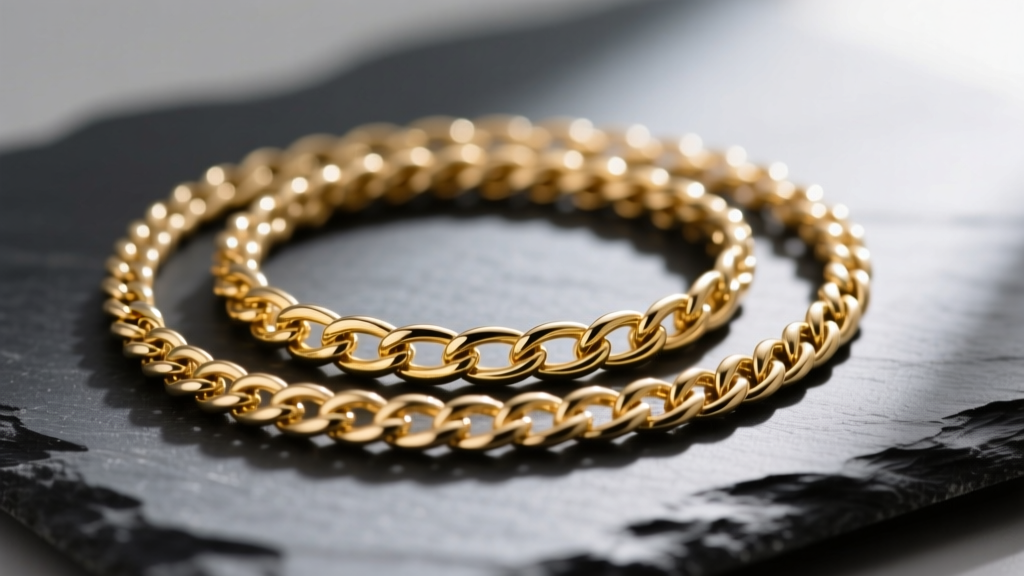
When constructing necklace layers, the primary adversary is not aesthetic mismatch, but topology. The tangling of layered chains is a documented physical phenomenon governed by flexural rigidity and link geometry. According to extensive research on the spontaneous knotting of agitated strings, flexible rods shorter than 18 inches (46 cm) rarely form complex knots. However, jewelry chains are not uniform rods; they are segmented assemblies with varying degrees of articulation.
A standard cable chain possesses high flexural rigidity along the plane of its links but extreme flexibility perpendicular to it. When multiple cable chains are layered, their open oval links act as microscopic hooks. As the wearer moves, kinetic energy causes the chains to oscillate, and the open links self-thread into one another. To engineer tangle-free necklace layers, we must manipulate chain weaves, length differentials, and metal friction coefficients to neutralize this mechanical interlocking.
Optimal Length Ratios for Necklace Layers
The most common failure in layered stacks is an insufficient length drop, which forces chains into the same kinetic oscillation plane. The golden rule of layering is a minimum 2-inch (5 cm) differential between adjacent chains. This ensures the chains rest on different anatomical curves of the clavicle and sternum, reducing physical contact points by up to 70%.
| Layer Position | Base Length | Minimum Drop | Optimal Chain Weave | Max Pendant Weight |
|---|---|---|---|---|
| Layer 1 (Choker) | 14" - 15" | N/A | Snake, Herringbone | 3 grams |
| Layer 2 (Princess) | 16" - 17" | 2 inches | Box, Bead | 8 grams |
| Layer 3 (Matinee) | 18" - 20" | 2-3 inches | Rope, Wheat | 15+ grams |
| Layer 4 (Opera) | 24" - 28" | 4+ inches | Cable, Figaro | 25+ grams |
By adhering to these specific length ratios, the pendulum effect of the longer layers operates at a different frequency than the shorter, tighter layers, effectively cancelling out the synchronization that leads to knotting.
Chain Weave Compatibility Matrix
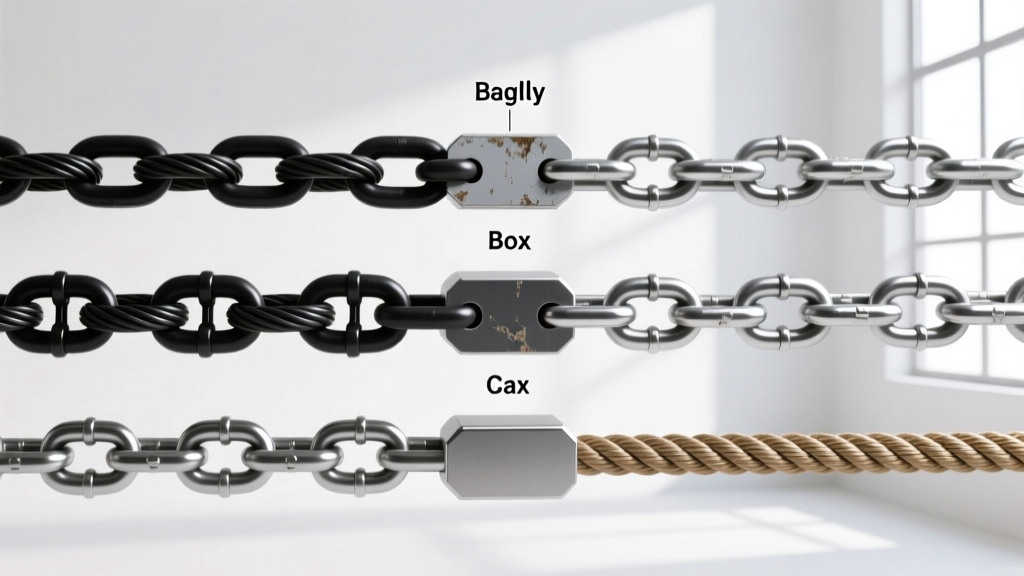
Not all chain weaves can coexist peacefully. The surface topology of the metal dictates the friction coefficient between layers. Pairing the wrong weaves guarantees entanglement and accelerated abrasive wear.
Low-Friction Pairings (Safe for Layering)
- Snake Chain + Box Chain: Snake chains feature a continuous, smooth tubular surface with virtually no open gaps. When paired with a box chain (which has flat, flush surfaces and right-angle corners), the two weaves slide past each other without mechanical interlocking.
- Herringbone + Wheat Chain: Herringbone lies completely flat against the skin, acting as a frictionless barrier. A wheat chain, with its tightly woven, directional loops, will glide over the herringbone without catching.
- Bead Chain + Rope Chain: The spherical nodes of a bead chain present a convex surface that cannot be penetrated by the complex, twisted grooves of a rope chain.
High-Risk Pairings (Guaranteed Tangling)
- Cable + Cable: Layering two open-link cable chains is the fastest way to create a permanent knot. The open oval links will inevitably thread through one another.
- Figaro + Rope: The elongated links in a Figaro chain act as wide gates, while the twisted grooves of a rope chain act as barbs. Once they intersect, kinetic movement pulls the knot tighter.
- Curb + Curb: The flat, interlocking links of curb chains create high surface friction. When layered, they act like velcro, binding together and twisting the metal out of its natural lay-flat orientation.
Metallurgy and Hardness in Layered Stacks
Beyond geometry, the metallurgical composition of your necklace layers dictates their longevity. When two metal surfaces rub together continuously, the harder metal will act as an abrasive against the softer metal. This is measured using the Vickers Hardness (HV) scale.
According to data from the Gemological Institute of America (GIA), the hardness of gold alloys varies significantly based on karatage and alloy mix. Pure 24k gold is exceptionally soft (~25 HV). Standard 18k yellow gold sits around 125 HV, while 14k yellow gold is harder, at approximately 140 HV, due to the higher proportion of copper and zinc.
Platinum 950, while having a similar Vickers hardness to 18k gold (~110-130 HV), possesses a much higher density and tensile strength. If you layer an 18k gold chain with a heavy platinum pendant or a platinum chain, the platinum's density and work-hardening properties will slowly abrade the 18k gold links at the friction points. Over a period of 12 to 18 months of daily wear, this can reduce the wire gauge of the gold links by up to 15%, leading to catastrophic structural failure and chain breakage. Always layer chains of identical karatage and alloy, or use a physical spacer to separate dissimilar metals.
Hardware and Clasp Tension Specifications
The hardware used to secure necklace layers is often the weakest point in the assembly. The Jewelers of America notes that clasp failure accounts for a majority of lost jewelry claims. When layering, the cumulative weight and kinetic drag of multiple chains place uneven stress on the clasps.
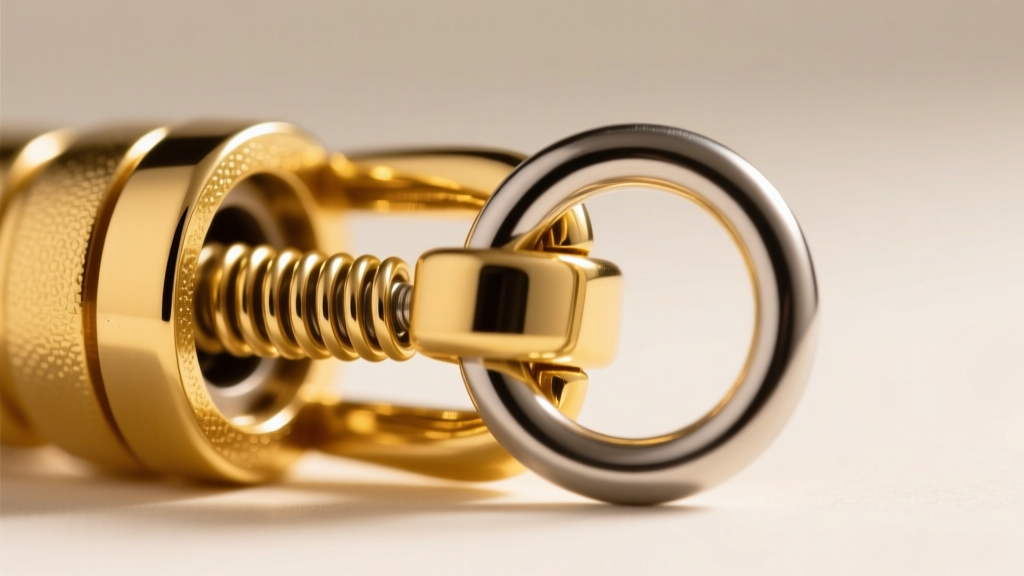
- Spring Ring Clasps: Rated for a maximum static load of 5-8 grams. These are suitable only for the innermost, lightest layer (e.g., a 14-inch snake chain). The internal spring mechanism is highly susceptible to fatigue when subjected to the lateral pull of multiple layers.
- Lobster Clasps: Rated for 10-20 grams. The elongated lever and heavier internal spring provide superior resistance to lateral torque. Use these for your middle (princess) layers.
- Parrot / Hook Clasps: Rated for 25+ grams. These rely on a heavy-gauge wire hook and a mechanical safety catch. They are mandatory for the outermost, heaviest layers featuring large pendants.
Furthermore, ensure the jump rings connecting the clasp to the chain are soldered shut or constructed from a heavy gauge (minimum 18-gauge wire). An unsoldered jump ring will easily pull apart under the asymmetric tension created by three or more layered chains.
Troubleshooting Common Layering Failures
Even with perfect length ratios and compatible weaves, environmental factors and body mechanics can disrupt your necklace layers. Here is a technical troubleshooting framework for common issues:
- Issue: Chains migrate to one side of the neck.
Solution: This occurs when the center of gravity is offset by a heavy pendant. Counterbalance the stack by adding a smaller, denser metal bead or charm to the back of the chain, directly opposite the pendant, or utilize a specialized layering clasp that locks multiple chains into a single, centralized anchor point at the nape of the neck. - Issue: Fine hairs catching in the chains.
Solution: This is exclusively a problem with rope, wheat, and herringbone weaves, which feature microscopic overlapping metal scales. Switch to laser-cut box chains or tubular snake chains, which possess a continuous, gap-free surface topology that prevents hair penetration. - Issue: Skin discoloration or green tinting.
Solution: Layering traps sweat, sebum, and cosmetic products between the metal and the skin, accelerating the oxidation of copper alloys in 10k or 14k gold. Clean the layers weekly in an ultrasonic bath with a mild ammonia-free solution to remove the lipid buildup that acts as an electrolyte for galvanic skin reactions.
Expert Insight: True mastery of necklace layers requires treating the stack as a single mechanical system. By aligning chain geometry, respecting metallurgical hardness scales, and engineering precise length differentials, you transform a chaotic tangle of metal into a stable, enduring architectural display.


