How to Tell if a Necklace is Real Gold: Expert Testing Guide
Learn how to tell if a necklace is real gold with expert testing methods. Discover hallmark guides, acid tests, and density checks for authentic jewelry.

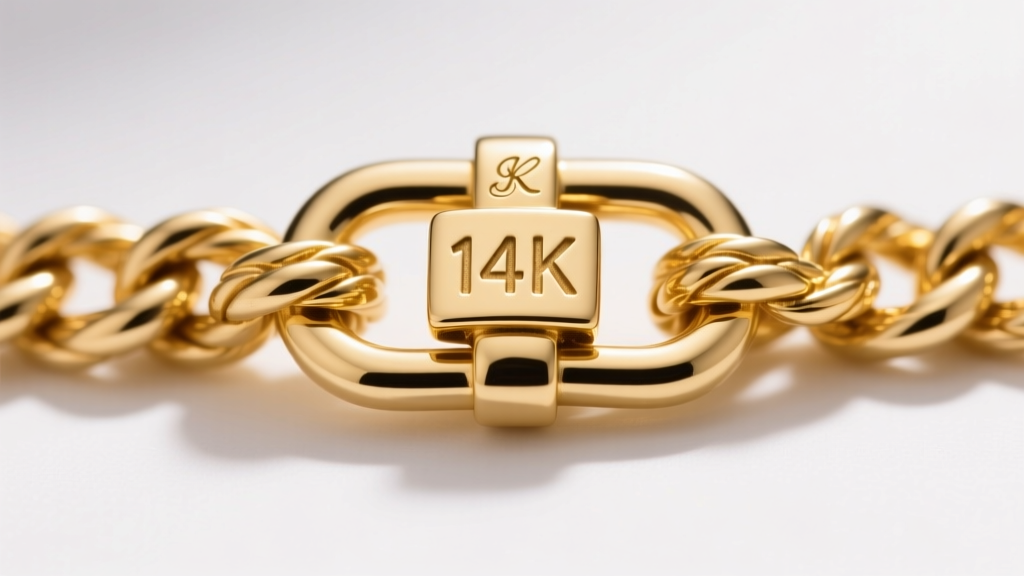
Determining the authenticity of a gold necklace requires moving beyond superficial visual inspections. Counterfeit manufacturing techniques, such as tungsten-core plating and advanced electroforming, can easily deceive the untrained eye. As a domain expert in metallurgical jewelry verification, I rely on a systematic approach combining hallmark analysis, non-destructive physical testing, and chemical verification. This guide details the exact technical protocols used to definitively answer how to tell if a necklace is real gold.
Decoding Gold Hallmarks and Stamps
The first step in authentication is examining the hallmark. However, a stamp is merely a claim of purity, not absolute proof, as counterfeiters frequently stamp base metals with fake karat marks. According to the Federal Trade Commission's Jewelry Guides, any karat quality mark applied in the United States must be accompanied by a registered maker's mark (trademark) to ensure accountability.
US Karat Marks vs. European Millesimal Fineness
Understanding the numerical stamps is critical for identifying the expected alloy composition:
- 10K (417): 41.7% pure gold. The minimum legal threshold to be sold as "gold" in the US. Highly durable due to high copper/silver alloy content.
- 14K (585): 58.5% pure gold. The industry standard for everyday chain necklaces, offering an optimal balance of tensile strength and rich color.
- 18K (750): 75.0% pure gold. Standard for high-end pendants and luxury chains. Softer and more prone to scratching.
- 22K (916) & 24K (999): 91.6% and 99.9% pure gold, respectively. Rarely used for structural chain links due to extreme malleability; mostly reserved for specific cultural jewelry or investment pieces.

When inspecting the clasp or the jump ring of a pendant, use a 10x or 20x triplet jeweler's loupe. Authentic stamps are laser-engraved or struck with steel punches, resulting in crisp, clean edges. Blurry, shallow, or unevenly spaced stamps are immediate red flags indicating post-production counterfeit altering.
Non-Destructive At-Home Testing Methods
Before resorting to chemical tests, utilize non-destructive physical properties to narrow down the material composition.
The Neodymium Magnet Test
Gold is diamagnetic, meaning it slightly repels magnetic fields rather than attracting them. To perform this test accurately, you must use a strong Neodymium N52 magnet. Weak ceramic fridge magnets lack the flux density to detect small amounts of ferromagnetic metals hidden in low-karat alloys.
Crucial Technical Caveat: The internal spring mechanism inside a lobster clasp or spring ring is almost always made of steel. Therefore, the clasp will stick to the magnet. You must drape the chain links themselves over the magnet. If the chain links cling or show magnetic drag, the necklace contains iron, nickel, or cobalt and is not solid gold.
The Unglazed Ceramic Streak Test
This test relies on the Mohs hardness scale. Pure gold has a hardness of 2.5 to 3, while pyrite (fool's gold) and brass are significantly harder. By dragging the chain across an unglazed porcelain plate (which has a hardness of about 7), you can observe the streak left behind.
- Real Gold: Leaves a distinct, shiny golden-yellow streak.
- Pyrite/Brass: Leaves a black, dark green, or brown streak.
Warning: This is a micro-destructive test. It will leave a permanent scratch on the gold chain. Only perform this on an inconspicuous link or the back of a pendant.
Advanced Technical Verification: Acid and Electronic Testing
For definitive verification without relying on surface-level stamps, jewelers use chemical and electrical conductivity tests.
Nitric Acid and Aqua Regia Testing
Acid testing exploits the nobility of gold. Gold does not react to nitric acid on its own, but the alloy metals (copper, silver, zinc) do. Never apply acid directly to the jewelry. Instead, rub the necklace against a black basalt testing stone to leave a microscopic metallic streak, then apply the acid to the streak.
| Testing Solution | Target Karat | Authentic Reaction | Base Metal Reaction |
|---|---|---|---|
| Nitric Acid (10K/14K) | 10K - 14K | Streak remains intact; slight darkening for 10K | Streak dissolves rapidly; turns milky (silver) or green (copper) |
| Aqua Regia (18K+) | 18K - 22K | Streak turns bright orange/yellow and remains visible | Streak dissolves instantly with effervescence |
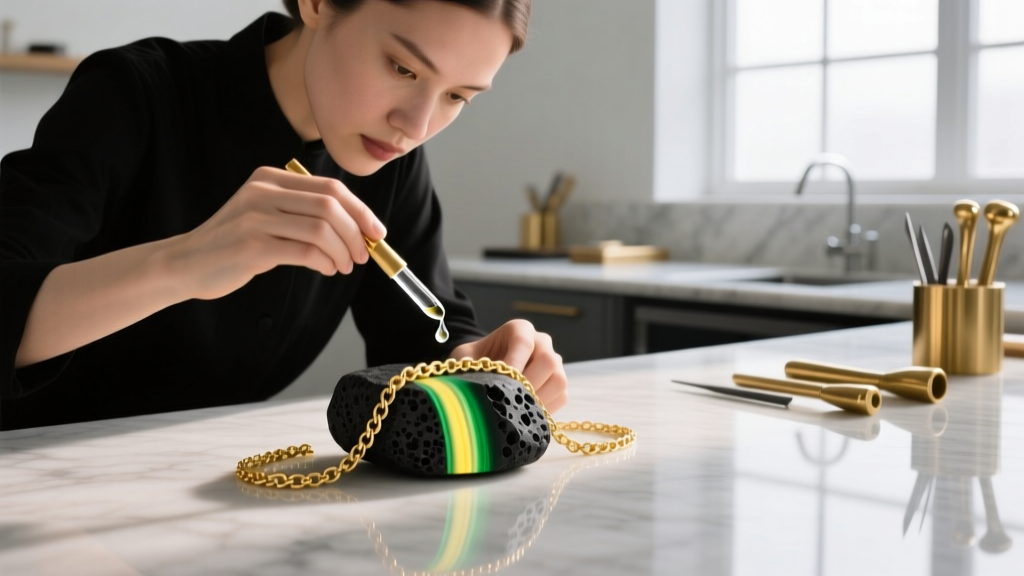
If the necklace is heavily gold-plated over a base metal, the acid will eat through the microscopic plating layer and react violently with the underlying brass or copper, turning the streak green within seconds.
Electronic Gold Testers
Electronic testers measure the electrical conductivity and resistance of the metal. Devices like the Tri-Gold Tester use a conductive gel and a testing wand to send a microcurrent through the chain. Because every gold alloy has a specific electrical signature based on its exact copper-to-silver ratio, these machines can accurately differentiate between 10K, 14K, and 18K gold, and will flag platinum or tungsten anomalies.
The Density and Specific Gravity Test
If you are dealing with a heavy, solid gold chain (such as a Cuban link) and want to ensure it doesn't have a tungsten core, the Archimedes Specific Gravity (SG) test is highly effective. Tungsten has a density of 19.25 g/cm³, which is nearly identical to pure gold (19.32 g/cm³), but it differs vastly from alloyed gold.
Calculating SG at Home
- Weigh the dry necklace on a precise digital jewelry scale (record as Weight in Air).
- Suspend the necklace in distilled water using a fine nylon thread, ensuring it is fully submerged but not touching the beaker's sides or bottom (record as Weight in Water).
- Calculate the loss of weight: Weight in Air - Weight in Water.
- Divide the Weight in Air by the loss of weight to get the Specific Gravity.
Expected SG Ranges: 10K Gold = 11.0 to 11.6 g/cm³ | 14K Gold = 12.9 to 14.6 g/cm³ | 18K Gold = 15.2 to 15.9 g/cm³. If your 14K chain yields an SG of 19.0, it is likely a tungsten-core counterfeit.
Red Flags: Plated, Filled, and Vermeil
Understanding the terminology of gold alternatives prevents costly mistakes. The London Assay Office and international hallmarking conventions strictly regulate these terms:
- Gold Plated (GP or HGE): A microscopic layer of gold (usually less than 0.5 microns) electroplated over brass or copper. It will wear off quickly, revealing the base metal.
- Gold Filled (GF): A mechanical bonding process where a thick sheet of gold (legally required to be at least 5% of the total weight) is heat-bonded to a brass core. Stamped as "1/20 14K GF".
- Gold Vermeil: Must have a Sterling Silver (925) base and be plated with at least 2.5 microns of 10K gold or higher. If the base metal is not silver, it cannot legally be called vermeil.
When to Consult a Professional Gemologist
If the necklace features complex hollow links, intricate soldering, or if you suspect advanced tungsten-core counterfeiting, at-home tests may yield inconclusive results. In these scenarios, take the piece to a certified gemologist or a reputable precious metals refinery equipped with an XRF (X-ray Fluorescence) spectrometer.
XRF technology fires X-rays into the metal and measures the fluorescent emission spectrum, providing a non-destructive, exact elemental breakdown down to 0.01% accuracy. This is the only foolproof method to verify the exact karat weight and detect internal lead or tungsten inclusions without melting or cutting the chain. For high-value investment pieces or antique estate jewelry, XRF verification is an indispensable final step.


