The Three Little Birds Necklace: Casting & Chain Guide
Explore the technical craftsmanship behind the three little birds necklace, from 925 silver casting shrinkage to optimal chain gauges and clasp mechanics.

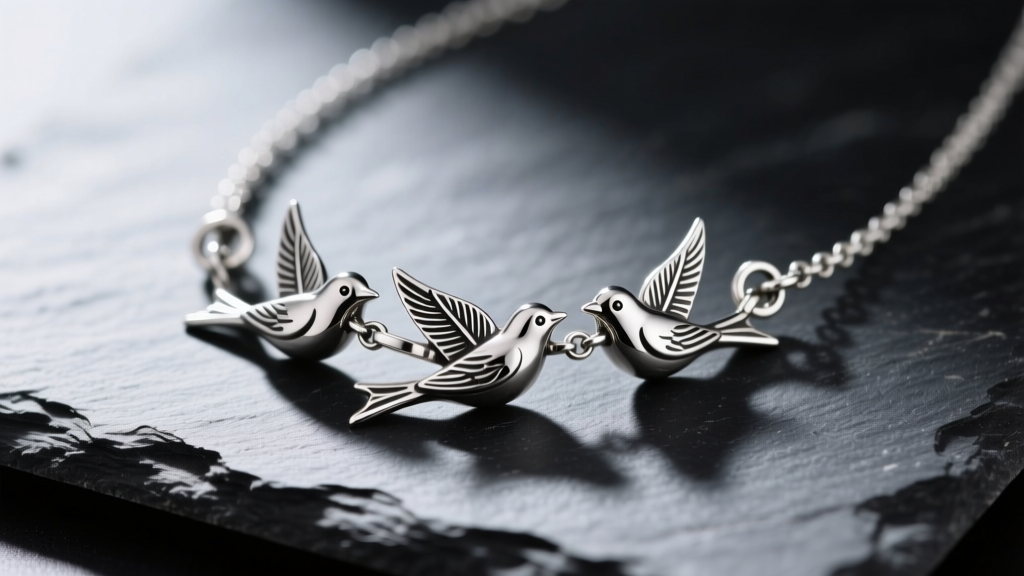
The Metallurgy of Miniature Avian Motifs
The "three little birds necklace" is far more than a sentimental nod to nature or a classic reggae anthem; it presents a unique set of structural and metallurgical challenges for bench jewelers. Unlike a single, centralized pendant that hangs plumb from a bail, a multi-motif horizontal design requires precise weight distribution, specialized casting techniques, and rigorous chain engineering to prevent warping and breakage.
When manufacturing a high-quality three little birds necklace in 925 sterling silver, the alloy composition (92.5% silver, 7.5% copper) dictates the casting parameters. According to the Gemological Institute of America (GIA), the addition of copper increases hardness but also introduces oxidation risks during the melting phase. To achieve the intricate feather barbs and delicate beaks typical of avian motifs, jewelers must account for casting shrinkage.
Casting Shrinkage and Detail Preservation
Sterling silver shrinks by approximately 1.5% to 2.0% upon cooling in a vulcanized rubber mold. For a 15mm bird charm, this means the master model must be scaled up by a factor of 1.02x in CAD software. Modern jewelers utilize castable wax-like resins on DLP 3D printers, achieving a resolution of 50 microns. This ensures that the microscopic textures of the birds' wings are preserved before the metal is even poured. If the sprue (the channel through which molten metal flows) is attached too close to a delicate wingtip, it can cause localized porosity or shrinkage cavities, ruining the structural integrity of the piece.
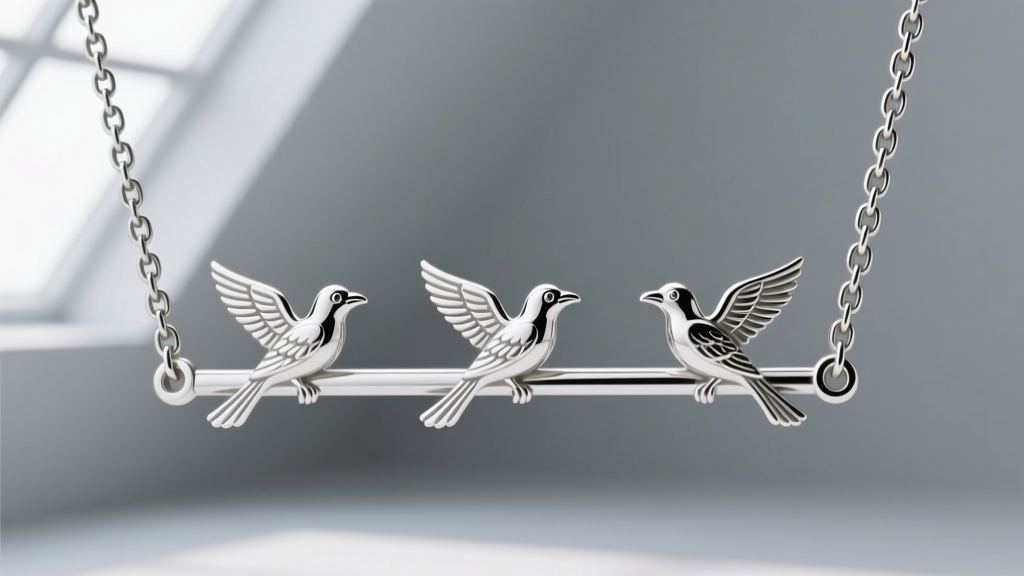
Chain Selection and Tensile Requirements
The most common failure mode for a three little birds necklace is not the pendant itself, but the chain snapping under lateral tension. Because the three birds are often linked together or mounted on a horizontal bar spanning 1.5 to 2.5 inches, the necklace experiences outward pulling forces rather than simple downward gravity.
A standard 0.9mm cable chain is entirely insufficient for this geometry. The lateral pull can cause the oval links to distort, eventually leading to metal fatigue and chain failure. Instead, structural rigidity must be prioritized. Below is a technical breakdown of chain styles and their suitability for horizontal multi-motif pendants.
| Chain Style | Wire Gauge (mm) | Tensile Yield (lbs) | Lateral Rigidity | Best Application |
|---|---|---|---|---|
| Standard Cable | 0.8 - 1.0 | 12 - 18 | Low | Single lightweight charms only |
| Rolo | 1.2 - 1.5 | 25 - 35 | Medium | Horizontal multi-bird spans |
| Wheat (Spiga) | 1.0 - 1.2 | 30 - 40 | High | Heavy, wide three-bird bars |
| Box | 1.2 - 1.5 | 20 - 28 | Very High | Rigid geometric bird mounts |
As noted by manufacturing experts at Rio Grande, selecting a chain with interlocking or multi-directional links (like Wheat or Box chains) distributes lateral stress across multiple planes, drastically reducing the risk of deformation.
Clasp Mechanics and Bail Engineering
Attaching the chain to the birds requires careful consideration of the bail or jump ring mechanics. In a three-bird configuration, the outer birds often serve as the primary suspension points, or a single central bail is used on a horizontal connecting bar.
Soldering vs. Laser Welding for Delicate Joints
Traditional torch soldering poses a severe risk to miniature bird motifs. The melting point of 925 sterling silver is approximately 893°C, but the extremities of a bird charm (beaks, tail feathers) are so thin that they act as heat sinks, rapidly absorbing thermal energy and melting or warping before the solder at the bail joint flows.
To circumvent this, expert fabricators use Nd:YAG laser welding. By setting the laser to 25-35 Joules with a 3.0ms pulse width and a 0.6mm spot size, a jeweler can instantly fuse an 18-gauge jump ring to a 1mm thick bird silhouette. The heat-affected zone (HAZ) is limited to less than 0.5mm, ensuring zero thermal distortion to the surrounding feather details.
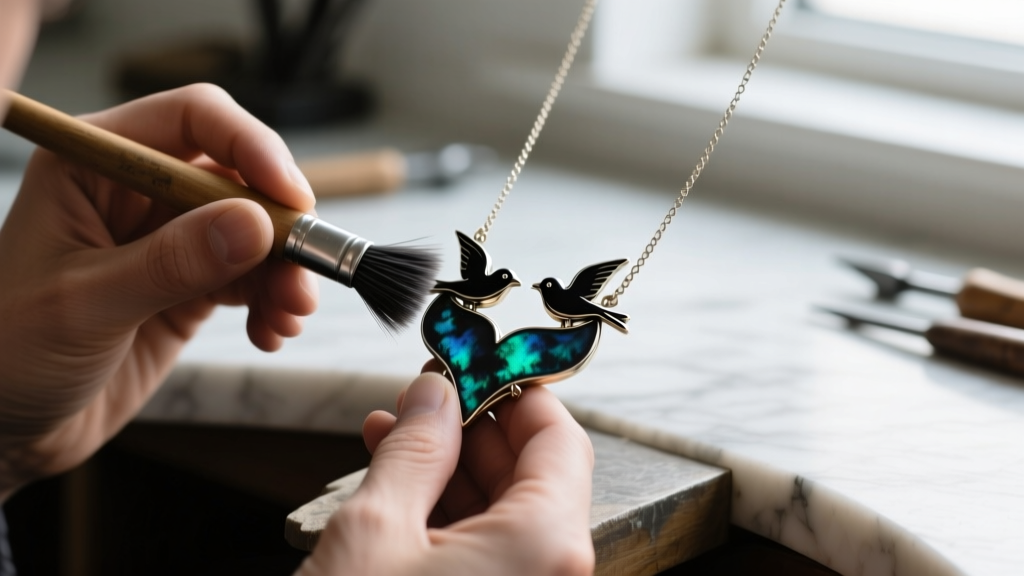
Patina and Surface Finishing Techniques
To give the three little birds necklace depth and highlight the micro-textures of the feathers, a controlled oxidation process is required. This is typically achieved using Liver of Sulfur (potassium sulfide). The chemical reaction between the sulfur and the copper in the sterling silver creates a layer of black copper sulfide. The concentration of the solution and the temperature of the water dictate the speed and depth of the patina. A cold, highly diluted solution allows the jeweler to build the oxidation slowly, ensuring the dark patina penetrates the deepest recesses of the feather barbs without completely blackening the surface.
For a more permanent and stable black finish that resists UV fading, some master jewelers opt for tellurium-based compounds like Black Max. While more toxic and requiring stringent ventilation protocols, tellurium oxide bonds more aggressively with the silver matrix, providing a deep, charcoal-grey patina that will not rub off on the wearer's skin or clothing over time.
"The contrast between the dark, oxidized recesses and the highly polished high-points is what gives a miniature bird motif its lifelike, three-dimensional appearance on such a small scale."
After oxidation, the piece is tumbled in a rotary barrel with stainless steel shot and burnishing compound to work-harden the silver. Finally, a fiberglass scratch brush or a polishing cloth infused with jeweler's rouge is used to selectively remove the black patina from the high points—the tops of the wings, the beaks, and the bellies—leaving the recesses dark and the edges bright.
Market Pricing and Authenticity Verification
When evaluating a three little birds necklace in the current market, consumers should understand the pricing tiers based on manufacturing methodology and verify authenticity using a 10x jeweler's loupe to locate the microscopic "925" hallmark, usually stamped on the back of the central bird or the connecting jump ring.
- Mass-Produced / Die-Struck ($30 - $60): Often made from base metals with thin silver plating. Details are usually stamped rather than cast, resulting in flat, lifeless feather textures. Prone to rapid wear and chain kinking.
- Cast Commercial Jewelry ($80 - $150): Solid 925 sterling silver cast from rubber molds. Good detail, but bails may be torch-soldered with visible excess solder, and chains are often lightweight cable styles to cut costs.
- Bench-Made / Artisan Fabrication ($250 - $600+): Features CAD-optimized models, 3D printed high-resolution wax masters, laser-welded bails, and premium wheat or rolo chains. The finishing involves hand-applied patinas and selective polishing.
Ultimately, a well-engineered three little birds necklace is a triumph of miniature metallurgy. By paying attention to the chain geometry, welding techniques, and finishing processes, you can ensure the piece remains a durable, wearable heirloom rather than a fragile novelty.


