Three String Pearl Necklace Buying Guide: What to Look For
Discover what to look for in a three string pearl necklace. Learn about pearl grades, stringing materials, clasp types, and pricing in our expert guide.

The Anatomy of a Multi-Strand Pearl Necklace
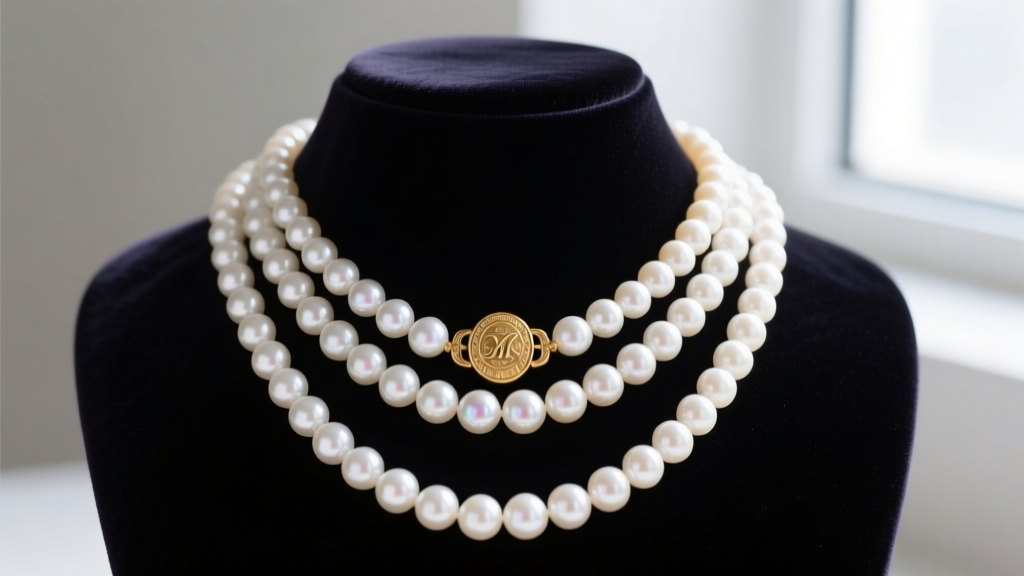
A three string pearl necklace is a masterclass in layered elegance, but constructing a piece that drapes flawlessly requires precise engineering. Unlike single-strand necklaces, a multi-strand design must account for the varying circumferences of the neck and the gravitational pull of three separate pearl strands. When shopping for this specific style, you are not just buying pearls; you are investing in the structural integrity of the stringing and the mechanics of the clasp. According to the Gemological Institute of America (GIA), the value of a multi-strand pearl piece is heavily dictated by the uniformity of the pearls across all three strands and the quality of the assembly. A poorly constructed three-strand necklace will twist, bunch at the clasp, or cause the inner strand to choke the wearer while the outer strand sags awkwardly.
Expert Insight: The hallmark of a high-end three string pearl necklace is the 'cascade effect.' The inner strand should sit snugly at the collarbone (usually 16 inches), while the middle and outer strands drop at precise 1.5-inch intervals to prevent the pearls from overlapping and tangling.
Selecting the Pearl Variety: A Comparative Breakdown
The first major decision in your buying journey is selecting the cultured pearl type. Because you are purchasing three full strands, the cost multiplier is significant compared to a single-strand piece. Therefore, understanding the price-to-luster ratio is critical. Below is a comparative breakdown of the most common pearl varieties used in three-strand designs, reflecting current 2026 market valuations.
| Pearl Variety | Origin | Typical Size Range | Luster Profile | Estimated Price (3-Strand) |
|---|---|---|---|---|
| Freshwater | China | 6.0mm - 9.0mm | Soft, satiny, pastel overtones | $250 - $800 |
| Akoya | Japan / Vietnam | 6.0mm - 9.5mm | Sharp, mirror-like, high contrast | $1,200 - $4,500 |
| Tahitian | French Polynesia | 8.0mm - 13.0mm | Deep, dark, peacock/aubergine overtones | $3,500 - $12,000+ |
| White South Sea | Australia / Indonesia | 9.0mm - 15.0mm | Satin, luxurious, heavy nacre | $8,000 - $25,000+ |
For a classic, brilliant white aesthetic, Akoya pearls remain the gold standard. Look for 'Hanadama' certification, which guarantees the highest grade of luster and a minimum nacre thickness of 0.4mm per side. If you are on a stricter budget, high-grade 'gem' freshwater pearls (often marketed as Edison or metallic freshwater pearls) offer incredible luster at a fraction of the cost of Akoya, though they will lack the perfectly round precision of saltwater varieties.
Stringing Materials: Silk vs. Synthetic Wire
The material holding your three string pearl necklace together dictates its lifespan. There are two primary methods used by master jewelers today:
Traditional Hand-Knotted Silk
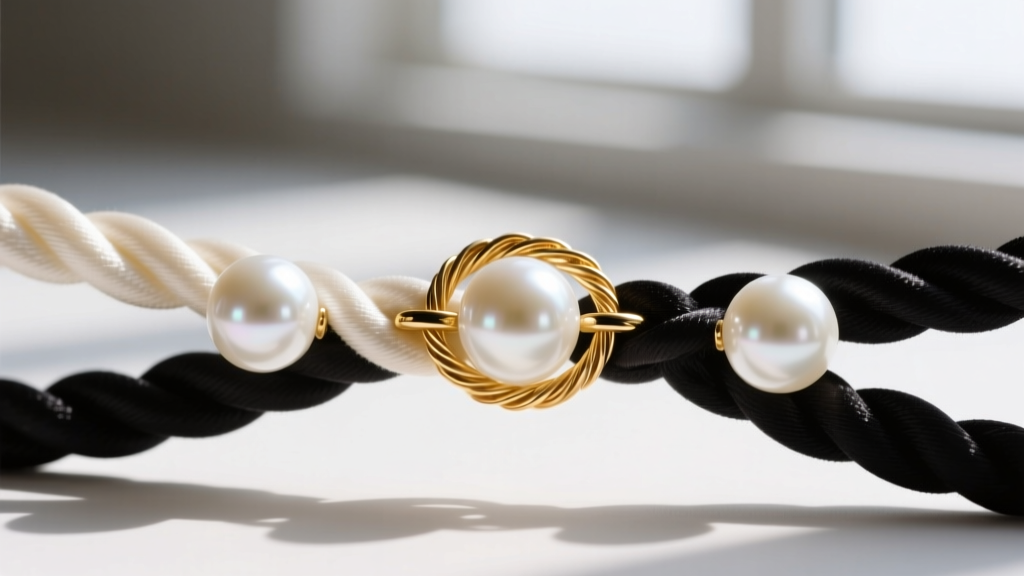
Authentic, high-end pearl necklaces are strung on 100% silk thread. For a three-strand necklace featuring 7mm pearls, jewelers typically use Griffin Size 4 or Size 6 silk thread. The silk is hand-knotted between every single pearl. This serves two purposes: it prevents the pearls from rubbing against each other (which degrades the nacre over time), and if the necklace snaps, you only lose one pearl rather than all three strands spilling onto the floor. Furthermore, the ends of the silk must be protected by French wire (gimp)—a tiny, coiled metal spring that prevents the clasp from sawing through the silk thread.
Modern Synthetic Beading Wire
Some contemporary jewelers use multi-strand synthetic wires, such as Beadalon Soft Flex (0.019-inch diameter, 49-strand stainless steel). While wire is virtually unbreakable and eliminates the need for French wire, it is generally considered a hallmark of lower-end or costume jewelry when used with fine pearls. Wire does not allow the necklace to drape as fluidly as silk, and it cannot be knotted between pearls without damaging the wire's structural integrity. If you are investing over $1,000 in a three string pearl necklace, insist on hand-knotted silk.
Clasp Mechanics for Three-Strand Security
A standard lobster claw or spring ring clasp is entirely inadequate for a three string pearl necklace. The combined weight and torsional stress of three strands will cause a single-loop clasp to twist, eventually bending the jump ring and risking a catastrophic drop. When inspecting a multi-strand piece, look for the following clasp architectures:
- Multi-Strand Tube Clasp: A cylindrical clasp that slides together and locks with a magnetic or friction-fit mechanism. It features three separate internal rings to anchor each strand independently, distributing weight evenly.
- Three-Strand Tongue Clasp: A classic, highly secure box clasp where a folded piece of metal (the tongue) compresses and clicks into a receiving box. For three strands, the box will be wider and feature three distinct attachment loops.
- Safety Catches (Figure-8): Regardless of the primary clasp type, a high-quality three-strand necklace must feature at least one, preferably two, 'figure-8' safety catches. These are small wire loops that hinge over a button on the opposite side of the clasp, providing a secondary failsafe if the primary locking mechanism fails.
Sizing, Spacing, and the 'Cascade' Effect
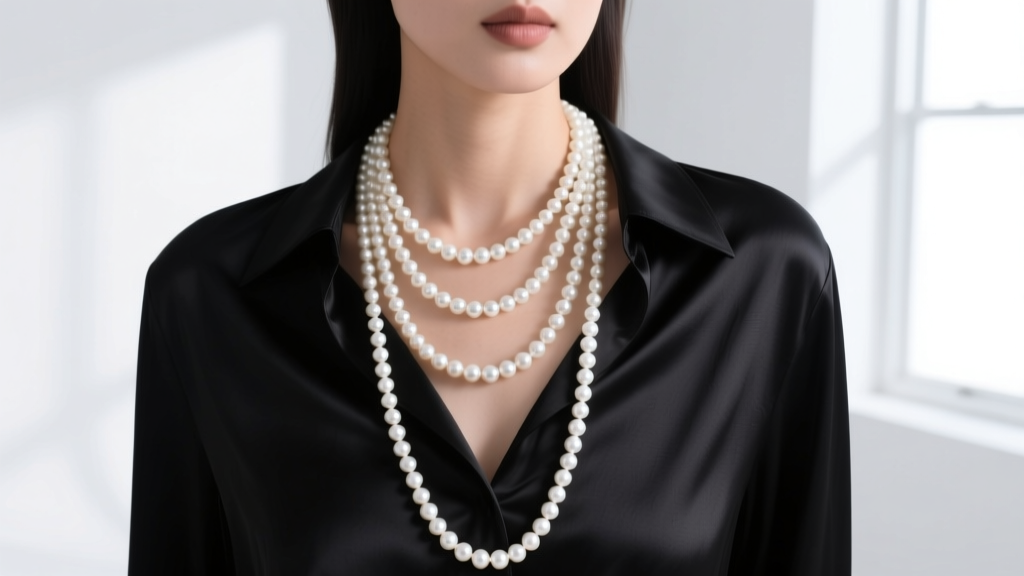
The geometry of a three string pearl necklace requires mathematical precision. If all three strands are cut to the exact same length, they will bunch together, hide the pearls, and create an uncomfortable, thick collar. To achieve the coveted 'cascade' or 'bib' effect, the strands must be graduated in both length and, often, pearl size.
Length Graduation: The inner strand should measure 16 inches (choker length), the middle strand 17.5 inches (princess length), and the outer strand 19 inches (matinee length). This 1.5-inch differential ensures the pearls nest perfectly without tangling.
Size Graduation: In premium bespoke designs, the pearl sizes are also graduated to enhance the visual flow. A common specification is using 6.0mm - 6.5mm pearls for the inner strand, 7.0mm - 7.5mm for the middle, and 8.0mm - 8.5mm for the outer strand. This draws the eye downward and flatters the neckline. When evaluating a piece, lay it flat on a table; the three strands should form three distinct, non-overlapping concentric arcs.
Authentication and Price Expectations
When purchasing a multi-strand pearl necklace, the risk of encountering heavily treated or imitation pearls increases, as the sheer volume of pearls required makes high-quality stock expensive to source. The American Gem Society recommends always verifying the nacre quality. For Akoya pearls, request a certificate that guarantees a minimum nacre thickness; anything less than 0.3mm will eventually peel or flake, especially on the inner strand which experiences the most friction against the skin.
Perform the 'tooth test' by gently rubbing the pearls against the biting edge of your front teeth. Genuine cultured pearls will feel distinctly gritty or sandy due to the microscopic crystalline structure of the nacre, while glass or plastic imitations will feel perfectly smooth. Finally, scrutinize the drill holes. High-quality pearls are drilled cleanly with minimal chipping at the exit point. If you notice flaking, uneven holes, or a visible line of demarcation between a coating and a bead core, walk away. A genuine, well-constructed three string pearl necklace is an heirloom investment that, when properly cared for and stored flat to prevent silk stretching, will retain its structural beauty and luster for generations.


