Tilly Necklace Care: Ultimate Cleaning & Maintenance Guide
Learn expert care, cleaning, and maintenance tips for your Tilly necklace. Protect gold vermeil, untangle chains, and prevent tarnish safely.


The Anatomy of a Tilly Necklace: Materials & Vulnerabilities
The Tilly necklace has cemented its place as a modern jewelry staple, celebrated for its delicate cable chain and signature textured coin pendant. However, maintaining its lustrous finish requires a nuanced understanding of its material composition. Most authentic Tilly-style necklaces are crafted from 18k gold vermeil over a 925 sterling silver base. According to the Federal Trade Commission (FTC) Jewelry Guides, true gold vermeil must feature a gold layer of at least 2.5 microns thick. This is significantly more durable than standard flash plating (which is often under 0.5 microns), but it still requires specialized care to prevent the gold layer from wearing away and exposing the silver beneath.
The chain itself is typically a 1.0mm to 1.2mm delicate cable chain. While elegant, this gauge possesses a tensile strength of roughly 2 to 3 pounds. Applying excessive force during cleaning or storage can easily cause micro-fractures in the wire loops or permanently distort the circular geometry of the links, leading to weak points that eventually snap. Furthermore, the textured face of the coin pendant traps microscopic debris, skin oils, and environmental pollutants in its grooves, necessitating a targeted cleaning approach that standard jewelry wipes simply cannot achieve.
The Chemistry of Tarnish and Vermeil Degradation
To properly care for your Tilly necklace, you must understand the enemy: silver sulfide (Ag2S). When the sterling silver base is exposed to hydrogen sulfide in the ambient air, a chemical reaction occurs, resulting in the black or yellowish tarnish we see on neglected jewelry. While the 2.5-micron gold layer acts as a barrier, microscopic pores and everyday wear can create micro-fissures where sulfur reaches the silver base. Once tarnish forms beneath the gold layer, it causes a localized dark spot that cannot be polished away without stripping the gold entirely.
This is why preventative maintenance and pH-balanced cleaning are non-negotiable. Using harsh, alkaline cleaners or acidic home remedies (like lemon juice or undiluted vinegar) can etch the copper alloys present in the 18k gold mixture, leaving the pendant looking dull and permanently cloudy.
Step-by-Step Cleaning Routine for Textured Pendants
Forget commercial jewelry dips and ultrasonic machines. The Gemological Institute of America (GIA) consistently warns against ultrasonic cleaners for plated and textured metals, as the high-frequency cavitation (often operating at 40,000 Hz) can literally shake the microscopic gold layers off a vermeil piece if the adhesion layer is compromised, and it will aggressively polish down the high points of your Tilly coin's matte texture.
Instead, follow this expert-approved, low-impact cleaning protocol:
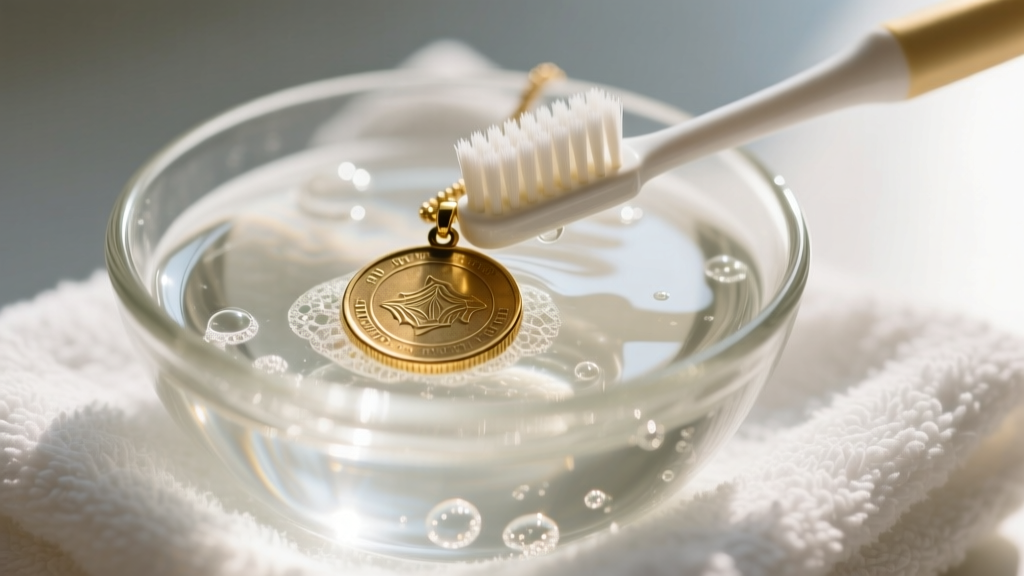
- Prepare the Solution: Mix one cup of distilled water (never tap water, as the chlorine and dissolved minerals can leave hard water spots) with three drops of a pH-neutral, non-citrus dish soap. Citrus-based soaps contain citric acid, which can degrade the silver base if it reaches a micro-fissure.
- The Soak: Submerge the necklace for exactly 3 to 5 minutes. Do not exceed this time, as prolonged moisture exposure can weaken the microscopic tension springs inside the lobster clasp.
- Targeted Agitation: Use an extra-soft baby toothbrush. Critical Technique: Brush strictly parallel to the engraved grooves of the coin pendant. Brushing in circular motions or against the grain will create micro-scratches across the vermeil, dulling the reflective finish.
- The Rinse and Dry: Rinse briefly under a slow stream of lukewarm distilled water. Pat dry with a lint-free microfiber cloth, then lay flat on a paper towel to air-dry completely for 30 minutes before storage. Never blow-dry or use heat, as rapid thermal expansion can cause the gold layer to micro-crack.
Cleaning Agents & Safety Matrix
Not all cleaning methods are created equal. Use this matrix to ensure you never accidentally strip the vermeil or damage the sterling silver core of your Tilly necklace.
| Cleaning Agent / Method | 18k Gold Vermeil Safety | 925 Sterling Silver Safety | Notes & Risks |
|---|---|---|---|
| Ultrasonic Cleaner | ❌ Avoid | ⚠️ Use with caution | Cavitation strips vermeil and dulls textured coin details. |
| Baking Soda Paste | ❌ Avoid | ✅ Safe | Abrasives act like sandpaper on 2.5-micron gold layers. |
| Mild Dish Soap (pH 7) | ✅ Safe | ✅ Safe | Best daily/weekly maintenance method for all components. |
| Commercial Silver Dip | ❌ Avoid | ✅ Safe | Thiourea-based chemicals will instantly ruin the gold finish. |
| Polishing Cloths (Treated) | ⚠️ Avoid on Pendant | ✅ Safe on Chain | Jeweler's rouge in cloths will slowly polish away the vermeil. |
Untangling Delicate Cable Chains Without Breakage
The 1.2mm cable chain of a Tilly necklace is notoriously prone to knotting, especially when stored loosely in a jewelry box. Pulling at a knot causes the wire loops to elongate by up to 15%, resulting in permanent kinking. When a kinked chain is worn, it catches on clothing and eventually snaps.
The Cornstarch Method: Lay the tangled necklace flat on a dark velvet pad or a piece of cardboard. Generously dust the knot with cornstarch or baby powder. The fine powder acts as a dry lubricant, reducing the friction coefficient between the metal links. Take a single sewing needle or a straight pin and gently work the center of the knot outward. The powder allows the links to slide past one another without the metal-on-metal biting that causes kinks. Once untangled, use a soft, dry brush to remove the excess powder from the links and the clasp mechanism.

Long-Term Storage & Anti-Tarnish Strategies
How you store your Tilly necklace when it is not being worn dictates how often you will need to deep-clean it. The Silver Institute emphasizes that controlling humidity and sulfur exposure is the key to preserving silver-based jewelry.
- Ditch the Cardboard Boxes: Cardboard and certain wood finishes off-gas sulfur compounds that accelerate tarnishing. Never store your necklace in its original retail box long-term.
- Use Pacific Silvercloth: Invest in a Pacific Silvercloth pouch. This specialized cotton is embedded with microscopic silver particles that act as a sacrificial anode, absorbing hydrogen sulfide from the air before it can reach your necklace's sterling silver base.
- Silica Gel Packets: Always drop a fresh, indicating silica gel packet into your storage pouch. Keeping the relative humidity inside the pouch below 40% effectively halts the electrochemical reactions that cause tarnish.
- The Clasp Protocol: Always store the necklace with the lobster clasp unfastened. Leaving it fastened puts continuous, low-grade tension on the microscopic spring inside the clasp, eventually causing it to lose its "snap" and fail to close securely.
Expert Styling Tip: Always practice the "Last On, First Off" rule. Your Tilly necklace should be the very last thing you put on after applying perfumes, lotions, and hairspray, and the first thing you take off when you get home. The alcohol and emollients in cosmetics are the leading cause of premature vermeil degradation.
Conclusion
Caring for a Tilly necklace is less about aggressive polishing and more about microscopic preservation. By respecting the 2.5-micron gold vermeil layer, utilizing pH-neutral cleaning agents, and employing dry-lubricant untangling techniques, you ensure that the intricate texture of the coin pendant and the structural integrity of the delicate cable chain remain pristine. Implement these professional maintenance strategies, and your necklace will retain its boutique-quality brilliance for years to come.


