The Titanium Health I Necklace: Material Science & Properties
Explore the material science behind the titanium health i necklace. Compare grades, biocompatibility, and therapeutic properties for daily wear.

The Metallurgical Appeal of Titanium in Wellness Jewelry
When consumers, biohackers, and athletes search for a titanium health i necklace, they are typically investigating ionic, magnetic, or negative-ion therapy jewelry. While the therapeutic efficacy of embedded magnets or germanium ions remains a subject of ongoing holistic debate, the chassis material itself—titanium—is an undisputed heavyweight in materials science. Titanium is not merely a lightweight alternative to stainless steel; it is a highly specialized transition metal with unique crystalline structures, unparalleled biocompatibility, and specific magnetic permeability traits that make it the ultimate housing for wellness wearables.
Unlike traditional fashion jewelry, a health-focused necklace must endure constant contact with human skin, sweat, sebum, and varying environmental temperatures. The human body is a corrosive environment for lesser metals. Sweat contains lactic acid, urea, and sodium chloride, which can rapidly degrade standard alloys, leading to oxidation, structural failure, and severe contact dermatitis. Titanium, however, thrives in this environment due to its spontaneous passivation process. In this comprehensive guide, we dissect the exact material properties, grading systems, and physics that define the modern titanium health i necklace, separating metallurgical fact from marketing fiction.
Paramagnetism: The Hidden Physics of Therapeutic Necklaces
The most critical, yet frequently overlooked, property of titanium in the context of magnetic therapy jewelry is its paramagnetic nature. Many wellness necklaces utilize embedded Neodymium-Iron-Boron (NdFeB) rare-earth magnets, which generate localized magnetic fields intended to interact with the body's bio-magnetic environment. The casing material dictates how these magnetic fields behave.
If a necklace is machined from 316L surgical stainless steel, the material is ferromagnetic. Ferromagnetic metals act as a magnetic shield, absorbing and redirecting the magnetic flux lines through the metal itself rather than allowing them to project outward toward the skin. This creates a Faraday cage effect, neutralizing the therapeutic intent of the embedded magnets. Titanium, conversely, is paramagnetic. Its magnetic permeability is nearly identical to that of a vacuum (relative permeability μr ≈ 1.00018). This means a titanium casing allows the magnetic flux from embedded NdFeB magnets to pass through the metal unimpeded, projecting the magnetic field directly into the adjacent tissue. For any magnetic health i necklace to function as intended by its designers, a paramagnetic housing like titanium is not just a luxury; it is a strict physical requirement.
Titanium Grades: ASTM F67 vs. ASTM F136
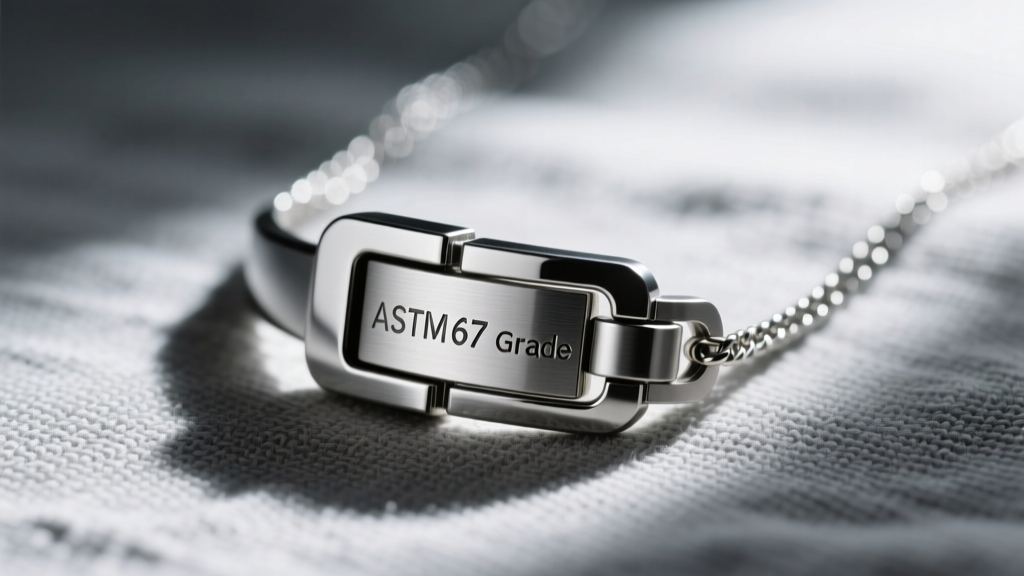
Not all titanium is created equal. The jewelry industry frequently uses the term 'titanium' as a catch-all, but material scientists and metallurgists categorize it by strict ASTM (American Society for Testing and Materials) standards. When evaluating a premium titanium health i necklace, you must look for specific grade certifications, usually laser-engraved on the clasp or the interior of the pendant housing.
Commercially Pure (CP) Titanium: ASTM F67
CP Titanium is categorized into Grades 1 through 4, based on the concentration of interstitial elements like oxygen, nitrogen, and iron. Grade 1 is the purest, softest, and most ductile. It possesses the highest corrosion resistance and the best biocompatibility. High-end health necklaces utilize Grade 1 or Grade 2 CP Titanium because it is entirely free of alloying metals like nickel, aluminum, or vanadium. According to the ASTM F67 standard, this unalloyed titanium is the benchmark for surgical implants and long-term dermal contact, ensuring zero risk of heavy metal leaching.
Titanium Alloys: ASTM F136 (Ti-6Al-4V ELI)
Grade 5 titanium (Ti-6Al-4V) is an alloy containing 6% aluminum and 4% vanadium. While it boasts a significantly higher tensile strength and Vickers hardness than CP titanium, it is generally avoided in premium wellness jewelry. The ELI (Extra Low Interstitial) variant, governed by ASTM F136, is safer, but the presence of vanadium and aluminum introduces variables that purists avoid for continuous 24/7 skin contact. A genuine health i necklace should prioritize CP Grade 1 or 2 for the main body and clasp to guarantee absolute hypoallergenic performance.
Material Comparison Matrix: Titanium vs. Alternatives
To understand why titanium dominates the therapeutic jewelry sector, we must compare its physical and chemical properties against common alternatives. The table below outlines the critical metrics that impact durability, skin safety, and magnetic efficacy.
| Material | Density (g/cm³) | Nickel Content | Magnetic Permeability | Vickers Hardness (HV) |
|---|---|---|---|---|
| CP Titanium (Grade 1) | 4.51 | 0% | Paramagnetic | 120 |
| 316L Stainless Steel | 8.00 | 10% - 14% | Ferromagnetic | 150 |
| Pure Copper | 8.96 | 0% | Diamagnetic | 50 |
| Tungsten Carbide | 15.60 | Varies (Cobalt binder) | Weakly Magnetic | 1500+ |
As the data illustrates, titanium offers an unmatched strength-to-weight ratio. At 4.51 g/cm³, it is nearly half the weight of stainless steel, making it ideal for heavy, multi-magnet health necklaces that would otherwise cause cervical strain or discomfort during sleep. Furthermore, while copper is also non-magnetic, its extreme softness (50 HV) and tendency to oxidize into green copper chlorides make it unsuitable for modern, high-tech wellness wearables.

Biocompatibility and the Titanium Dioxide Layer
The hypoallergenic nature of a titanium health i necklace is not due to the raw metal itself, but rather the microscopic oxide layer that forms instantly upon exposure to oxygen. Within milliseconds of being machined, titanium reacts with atmospheric oxygen to form a dense, stable layer of titanium dioxide (TiO2). This passive film is only a few nanometers thick, yet it is virtually impervious to biological fluids.
According to a comprehensive NIH review on titanium biocompatibility, this TiO2 layer prevents the underlying metal ions from migrating into the epidermis. This is in stark contrast to 316L stainless steel, which, despite being labeled 'surgical,' contains up to 14% nickel. Over time, the friction of a necklace against the skin, combined with the acidic pH of human sweat, can breach the passive layer of steel, releasing nickel ions. As noted in research on nickel contact dermatitis, nickel allergy affects up to 20% of the global population, manifesting as erythema, pruritus, and blistering. Titanium completely bypasses this biological hazard, making it the only safe choice for individuals with compromised skin barriers or known metal hypersensitivities.
Durability, Maintenance, and Surface Finishes
While titanium is highly resistant to corrosion, it is not entirely immune to environmental factors, particularly when subjected to specific chemical agents. The Vickers hardness of Grade 1 titanium (120 HV) means it is relatively soft compared to tungsten or hardened steel. It will accumulate micro-scratches over years of daily wear. However, these scratches are purely cosmetic and do not compromise the structural integrity or the biocompatibility of the oxide layer.
Cleaning Protocols for Health Necklaces
Maintaining a titanium health i necklace requires specific care to preserve both the metal and any embedded therapeutic elements. Ultrasonic cleaners, while excellent for diamond jewelry, can sometimes loosen the epoxy resins used to seal embedded neodymium magnets or germanium nodes within the titanium links. The optimal cleaning protocol involves the following steps:
- Routine Cleaning: Use a solution of warm distilled water and a few drops of pH-neutral dish soap. Agitate gently with a soft-bristled toothbrush to remove sebum and dead skin cells from the link crevices.
- Disinfection: Isopropyl alcohol (70% or higher) is perfectly safe for titanium and will not degrade the TiO2 layer. It is highly effective for sanitizing the necklace after intense athletic exertion.
- Chemicals to Avoid: Never expose titanium to hydrofluoric acid or highly concentrated chloride solutions (like undiluted bleach). Chloride ions can cause localized pitting corrosion in titanium, a phenomenon known as crevice corrosion, which can compromise the waterproof seals of magnetic housings.
Clasp Mechanics and Structural Integrity
The weakest point of any chain necklace is the clasp. In premium titanium wellness jewelry, manufacturers utilize specialized folding safety clasps or custom-machined barrel clasps with integrated O-rings. Because titanium cannot be easily soldered using traditional jewelry torches (it requires an inert argon atmosphere for TIG or laser welding), the engineering of the clasp joints is a hallmark of quality. High-end brands use precision CNC-machined interlocking joints secured by titanium tension pins, ensuring that the clasp can withstand the high tensile loads generated by the weight of a multi-magnet necklace without catastrophic failure.
Final Verdict: Is the Titanium Health I Necklace Right for You?
The decision to invest in a titanium health i necklace ultimately bridges the gap between holistic wellness practices and rigorous materials engineering. If your primary goal is to wear embedded magnets or ionic nodes continuously, 24 hours a day, through showers, workouts, and sleep, titanium is objectively the superior housing material. Its paramagnetic properties ensure that therapeutic fields are not stifled, its biocompatibility guarantees zero allergic reactions, and its featherlight density prevents physical fatigue. While the initial cost of CNC-machined, ASTM-certified titanium jewelry is higher than stamped stainless steel alternatives, the long-term durability, biological safety, and functional physics make it an indispensable asset in the modern wellness wardrobe.


