Titanium vs Stainless Steel Necklace: A Material Comparison
Compare titanium and stainless steel necklace materials. Discover which hypoallergenic metal offers the best durability, weight, and value for daily wear.

The Metallurgy of Everyday Wear
When selecting a durable, everyday necklace, precious metals like gold and silver often take the spotlight. However, for those seeking unmatched tensile strength, corrosion resistance, and modern aesthetics, alternative metals have become the standard. In 2026, the debate between titanium and stainless steel remains at the forefront of industrial and fashion jewelry design. Both materials offer exceptional longevity, but their atomic structures, weight profiles, and failure modes are vastly different. Understanding these metallurgical distinctions is critical before investing in a piece meant to withstand decades of continuous wear.
Titanium Necklace Alloys: Grade 2 vs. Grade 5
Titanium is renowned for its incredible strength-to-weight ratio. A titanium necklace will feel remarkably light against the skin—approximately 45% lighter than an identical steel chain. However, not all titanium jewelry is created equal. Manufacturers typically rely on two distinct grades:
Commercially Pure (Grade 2)
Grade 2 titanium is unalloyed and highly malleable. With a Vickers hardness (HV) of roughly 150, it is easy for jewelers to cut, solder, and resize. It is the most hypoallergenic option available, as it contains zero alloying elements that could trigger contact dermatitis. The trade-off is that Grade 2 chains are more susceptible to surface scratching and link deformation under heavy tensile stress.
Aerospace Grade (Grade 5 / Ti-6Al-4V)
Alloyed with 6% aluminum and 4% vanadium, Grade 5 titanium boasts a Vickers hardness of 350, making it more than twice as hard as Grade 2. This is the material used in aerospace components and high-end automotive valves. A Grade 5 titanium necklace will resist surface abrasions beautifully, but it is notoriously difficult to resize or repair if a link snaps, often requiring specialized laser welding equipment.
Stainless Steel Necklace Grades: 316L vs. 304
Stainless steel provides a satisfying, substantial heft that many jewelry wearers prefer. Its density (roughly 8.0 g/cm³) gives it a premium, heavy drape. The 'stainless' property comes from a minimum of 10.5% chromium, which forms a passive oxide layer on the surface to prevent rust. Yet, the specific alloy grade dictates its true performance.
The 316L Surgical Standard
The 'L' stands for low carbon, which prevents carbide precipitation during welding. More importantly, 316L contains 2-3% molybdenum. This addition drastically increases resistance to pitting corrosion from chlorides, meaning a 316L stainless steel necklace can survive daily exposure to sweat, saltwater, and chlorinated pools without degrading. It is the undisputed standard for high-quality alternative metal jewelry.
The 304 Budget Alternative
Often found in fast-fashion or budget jewelry, 304 stainless steel lacks molybdenum. While it performs well in dry environments, prolonged exposure to the acidic pH of human sweat or saltwater will eventually cause micro-pitting and surface rust. If you are buying a chain for daily, never-take-it-off wear, 304 steel is a structural liability.
Data-Driven Comparison: Titanium vs. Stainless Steel
To move beyond subjective preferences, here is a direct metallurgical and economic comparison between the top-tier versions of both metals (Grade 5 Titanium vs. 316L Stainless Steel) based on a standard 20-inch, 3mm rope chain.
| Property | Titanium (Grade 5) | Stainless Steel (316L) |
|---|---|---|
| Density (Weight) | 4.43 g/cm³ (Lightweight) | 8.00 g/cm³ (Heavy) |
| Vickers Hardness | 350 HV | 160 HV |
| Tensile Strength | 950 MPa | 515 MPa |
| Corrosion Resistance | Exceptional (Impervious) | Excellent (Resists Chlorides) |
| Average Retail Price | $85 - $160 | $25 - $45 |
| Resizability | Extremely Difficult | Moderate (Requires TIG/Laser) |
Real-World Failure Modes and Chain Mechanics
Every metal fails differently under the mechanical stress of daily wear. Understanding these failure modes helps you choose the right chain style and clasp mechanism.
Tensile Strength and Clasp Stress
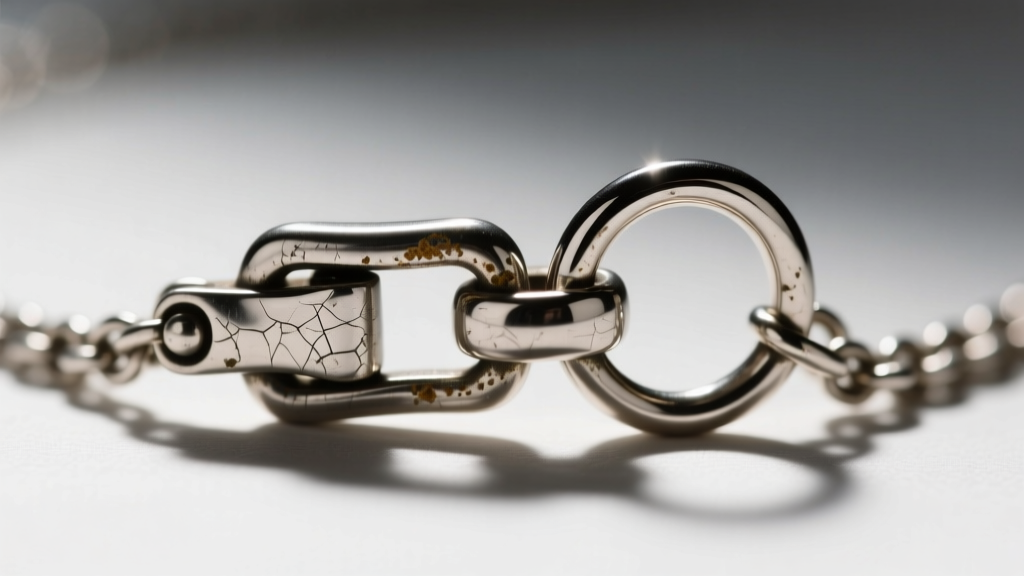
Titanium's immense tensile strength (950 MPa) means the chain links themselves will almost never snap under normal human force. However, the weak point in any titanium necklace is the jump ring connecting the clasp. Because titanium work-hardens rapidly and cannot be easily soldered with traditional torches, manufacturers often use mechanical closures. If the jump ring is not perfectly flush, it will slowly pull apart over years of wear. Stainless steel, while having lower overall tensile strength, is easily laser-welded, allowing for seamless, permanently closed jump rings that eliminate this specific failure point.
Surface Scratching and Polishing Limits
A 316L stainless steel necklace will accumulate micro-scratches within the first few months of wear, resulting in a patina that dulls its initial mirror finish. Fortunately, steel is soft enough to be polished back to a high shine using a standard jeweler's rouge. Grade 5 titanium, conversely, resists scratching far better. But when it does scratch, the hardened surface makes traditional buffing nearly impossible; it usually requires professional re-sanding or bead-blasting to restore a uniform finish.
The Hypoallergenic Reality: Nickel Leaching
The most common reason consumers abandon traditional metals for alternative ones is contact dermatitis. According to the Mayo Clinic's guidelines on nickel allergies, even trace amounts of nickel can trigger severe skin reactions in sensitized individuals.
While 316L stainless steel is often marketed as 'hypoallergenic' or 'surgical steel,' it actually contains between 10% and 14% nickel. In high-quality 316L, the nickel is tightly bound within the chromium-oxide crystal lattice, preventing it from leaching into the skin. However, if the steel is subjected to harsh chemicals or physical abrasion that breaks the passive oxide layer, nickel ions can be released.
Titanium, on the other hand, contains absolutely zero nickel. It is completely biocompatible and is the exact metal used in surgical bone pins and pacemakers. For individuals with severe, medically documented nickel allergies, a commercially pure (Grade 2) titanium necklace is the only 100% guaranteed safe option. For those with mild sensitivities, high-quality 316L stainless steel is generally well-tolerated and aligns with the strict limits set by the EU REACH Nickel Directive for prolonged skin contact.
Final Verdict: Choosing Your Daily Driver
The choice between a titanium and stainless steel necklace ultimately depends on your sensory preferences, budget, and biological sensitivities.
- Choose Titanium if: You prioritize a lightweight, barely-there feel, engage in high-sweat or marine activities, have severe metal allergies, or prefer a modern, matte-grey aesthetic that resists scratching.
- Choose Stainless Steel (316L) if: You prefer the substantial, heavy drape of traditional precious metals, want a highly reflective mirror finish, are on a stricter budget, or want a chain that can be easily polished and repaired by a local jeweler.
Regardless of your choice, always verify the exact alloy grade with the manufacturer. A necklace is only as durable as its weakest link, and in the realm of alternative metals, the specific chemical composition dictates its lifelong performance.


