The Trade Bead Necklace Renaissance: 2026 Style Guide
Explore the 2026 trade bead necklace renaissance. Learn to authenticate vintage Krobo and Venetian glass beads, master layering, and source ethically.

The Return of Heritage: Why Trade Beads are Dominating 2026
In an era where the fashion industry is aggressively pivoting away from micro-trends and mass-produced resins, the trade bead necklace has emerged as a cornerstone of sustainable, high-impact styling in 2026. Far from being mere bohemian souvenirs, authentic trade beads are historical artifacts. Originally manufactured in Venice, Bohemia, and later West Africa, these beads were once used as global currency. Today, they are being reclaimed by contemporary jewelers and style archivists who value their unmatched visual weight, tactile density, and profound historical resonance. According to the Metropolitan Museum of Art, the exchange of glass beads for goods dates back centuries, embedding a rich narrative of global commerce into every strand. This guide decodes the anatomy, authentication, and modern styling frameworks of the trade bead necklace for the discerning collector.
The Anatomy of Authentic Trade Beads
To understand the styling potential of a trade bead necklace, one must first understand the intense craftsmanship required to create them. The market is currently dominated by two primary historical categories, each with distinct material properties:
1. Krobo Powder Glass Beads (Ghana)
Authentic Krobo beads are not blown or kiln-cast in the traditional sense. They are created using a powder glass technique where finely ground recycled glass is packed into termite-clay molds. A cassava stem is inserted to create the drill hole, and the molds are fired in an open kiln at approximately 800°C to 1000°C. The result is a porous, matte-finish bead with a distinct, earthy texture. Because the cassava stem burns away during firing, authentic vintage Krobo beads feature irregular, slightly tapered drill holes—a key identifier of handcrafted origin.
2. Venetian Chevron and Millefiori Beads (Italy)
Originating from Murano, these beads represent the pinnacle of European glassmaking. The Victoria and Albert Museum notes that Venetian glassmakers developed the 'millefiori' (thousand flowers) technique by fusing multi-colored glass canes. The highly coveted Chevron bead is constructed by layering molten glass in a star-shaped mold, typically creating 4 to 7 concentric layers of red, white, and blue glass, which is then ground at the ends to reveal the intricate star pattern. These beads are exceptionally dense, smooth, and carry a high-glass luster that modern plastic imitations simply cannot replicate.

2026 Trend Analysis: The Mixed-Media Heritage Look
The styling of the trade bead necklace in 2026 has evolved past the predictable 'festival' or 'boho-chic' aesthetics. The current high-fashion directive is Mixed-Media Heritage—the deliberate juxtaposition of ancient, heavy artisanal elements with ultra-modern, precision-machined metals.
- The Asymmetrical Layer: Stylists are pairing a 24-inch matinee strand of 15mm matte Krobo beads with an 18-inch 14k solid gold paperclip chain. The visual friction between the porous, earthy glass and the high-polish, geometric gold links creates a sophisticated, museum-worthy aesthetic.
- The Hardware Upgrade: Traditional cotton or leather cords are being replaced by oxidized sterling silver clasps, architectural toggle closures, and 18k gold vermeil end-caps. Elevating the findings transforms the necklace from an ethnic artifact into a luxury statement piece.
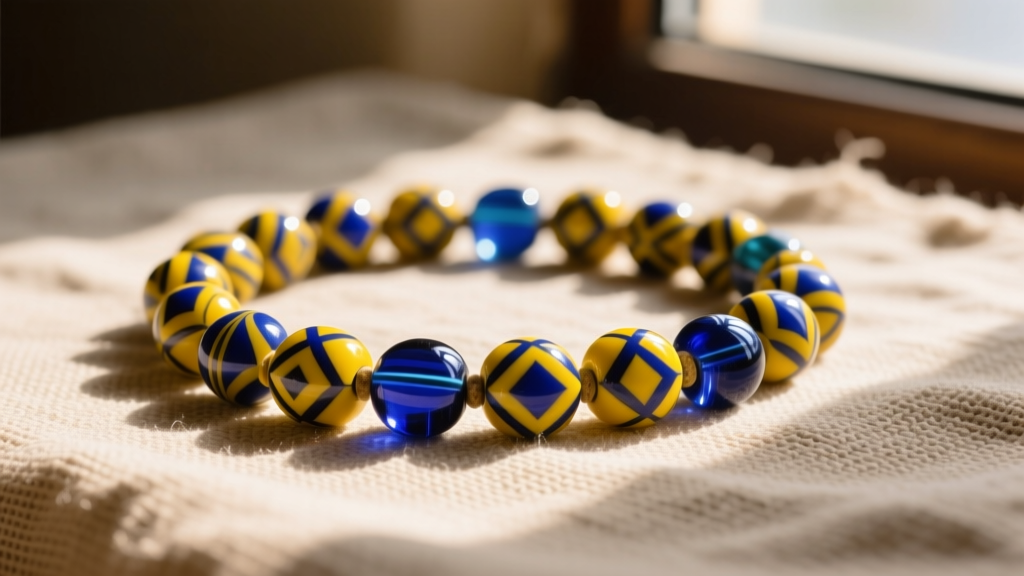
- Color Blocking with Monochromatic Glass: Instead of multicolored strands, 2026 trends favor monochromatic vintage strands—such as deep cobalt blue Venetian glass or mustard-yellow Krobo beads—worn against stark, tailored garments like oversized white poplin shirts or charcoal wool blazers.
Authentication vs. Imitation: A Buyer's Matrix
As demand for authentic trade bead necklaces has surged, the market has been flooded with high-quality resin and molded-plastic imitations from overseas manufacturers. Protecting your investment requires a rigorous physical inspection. Use the following matrix to evaluate potential purchases:
| Diagnostic Feature | Authentic Vintage Glass | Modern Resin/Plastic Imitation |
|---|---|---|
| Weight & Density | Exceptionally heavy. A 24-inch strand of 15mm beads will weigh 180g–250g. | Noticeably light. Same strand weighs under 60g. |
| Temperature to Touch | Cool to the touch initially; takes time to warm to body temperature. | Room temperature immediately; feels 'warm' or neutral. |
| Drill Hole Edges | Irregular, slightly chipped, or tapered (especially Krobo powder glass). | Perfectly uniform, sharp, and machine-drilled. |
| Seam Lines | No vertical mold seams. Chevron beads show ground, polished ends. | Faint vertical mold lines visible on the equator of the bead. |
| Market Price (per strand) | $85 – $450+ (depending on age, rarity, and layer count). | $12 – $35 (mass-produced wholesale pricing). |
Structural Engineering: Stringing Heavy Glass
A critical failure point for vintage trade bead necklaces is the stringing material. The sheer tensile stress of a 250-gram glass strand will snap standard silk thread, nylon, or thin cotton cords within months of regular wear. If you are restringing or commissioning a custom trade bead necklace in 2026, you must specify industrial-grade materials.
The industry standard for heavy glass is 49-strand nylon-coated stainless steel beading wire (minimum 0.018-inch or 0.45mm thickness). For a more flexible, draped look, jewelers are turning to braided synthetic sinew, such as Power Pro, which offers immense tensile strength without the rigid memory of steel wire. Furthermore, crimp beads must be upgraded from soft base metals to thick-walled sterling silver or 14k gold-filled crimp tubes, secured with a micro-crimping tool to prevent the wire from sawing through the metal over time.

Styling Frameworks: Necklines and Proportions
The visual weight of a trade bead necklace demands strategic pairing with garment necklines. Because the beads possess a high physical and visual mass, they can easily overwhelm delicate fabrics or clash with busy patterns.
The Choker (16-18 Inches)
Best executed with smaller 8mm-10mm Venetian millefiori beads. This length sits firmly on the collarbone and pairs flawlessly with deep V-necks, scoop necks, or off-the-shoulder tops. It draws the eye upward, acting as a vibrant collar. Avoid wearing choker-length trade beads with high-necked turtlenecks, as the friction will degrade the stringing wire and the visual crowding is unflattering.
The Matinee (20-24 Inches)
The most versatile length for the trade bead necklace. A 22-inch strand of 14mm Krobo beads rests perfectly on the sternum. This length is ideal for layering over crisp, unbuttoned linen shirts, lightweight cashmere crewnecks, or tailored blazers. It provides a central focal point without interfering with the garment's structural lines.
The Opera (28-34 Inches)
Reserved for the boldest styling choices. Opera-length trade bead necklaces are incredibly heavy and should only be worn over structured garments like heavy knitwear or tailored wool coats to support the physical weight. In 2026, the 'double-wrap' technique is popular, where a 34-inch strand is looped twice to create a dense, multi-layered choker effect.
Ethical Sourcing and Pricing Tiers
As the appreciation for the trade bead necklace grows, so does the responsibility to source ethically. The most reputable dealers in 2026 work directly with West African cooperatives, ensuring that the artisans and local historians who curate these vintage strands are compensated fairly. When purchasing, look for dealers who provide provenance, detailing the approximate decade of manufacture and the specific village of origin for African beads. Expect to pay a premium for this transparency. A genuine, ethically sourced strand of vintage 7-layer Venetian Chevrons will command between $250 and $800, while a high-quality, mid-century Krobo powder glass strand typically ranges from $65 to $150. Investing in authentic, well-documented trade beads not only elevates your personal style but preserves a vital piece of global material history.


