Anatomy of a Triple Cross Necklace: Metals, Gauges & Weight
Discover the technical anatomy of a triple cross necklace. Learn about chain gauges, metal grades, weight distribution, and clasp mechanics.


The Engineering Challenge of Multi-Pendant Necklaces
While most consumers evaluate jewelry purely on aesthetics, a triple cross necklace introduces a unique set of structural and kinetic challenges that demand precise engineering. Unlike a single pendant that rests statically against the sternum, three individual crosses create a complex pendulum effect. Every step the wearer takes generates kinetic energy that travels down the chain, causing the pendants to swing, collide, and generate friction. If the jewelry is not manufactured with strict tolerances regarding weight distribution, bail articulation, and chain tensile strength, the piece will rapidly degrade, tangle, or snap.
In this technical deep dive, we deconstruct the anatomy of the triple cross necklace, examining the metallurgy, chain gauges, and mechanical linkages required to produce a piece that survives daily wear in 2026 and beyond.
Metallurgy & Material Grades: What Actually Lasts?
The constant micro-collisions between three crosses mean that the material's surface hardness and structural integrity are paramount. Soft metals will dent, while improperly alloyed metals will suffer from stress fractures at the solder points.
| Material Grade | Vickers Hardness (HV) | Tarnish & Corrosion Resistance | Approx. Cost per Gram |
|---|---|---|---|
| 316L Surgical Steel | 150 - 190 | Exceptional (Molybdenum prevents pitting) | $0.05 - $0.15 |
| 925 Sterling Silver | 60 - 70 (Annealed) | Poor (Copper alloy oxidizes rapidly) | $0.80 - $1.20 |
| 14k Solid Gold (Yellow/White) | 120 - 150 | Excellent (Highly stable alloy mix) | $45.00 - $65.00 |
| Titanium (Grade 5 / Ti-6Al-4V) | 330 - 350 | Flawless (Biocompatible, zero oxidation) | $0.80 - $1.50 |
According to the Gemological Institute of America (GIA), standard 925 sterling silver contains 7.5% copper to provide necessary hardness. However, in a triple cross configuration, the friction between the pendants will quickly wear away any protective rhodium plating, exposing the copper to sweat and oxygen, leading to rapid tarnishing. For buyers seeking the look of silver without the maintenance, 316L stainless steel or Grade 5 Titanium offers vastly superior surface hardness and corrosion resistance.
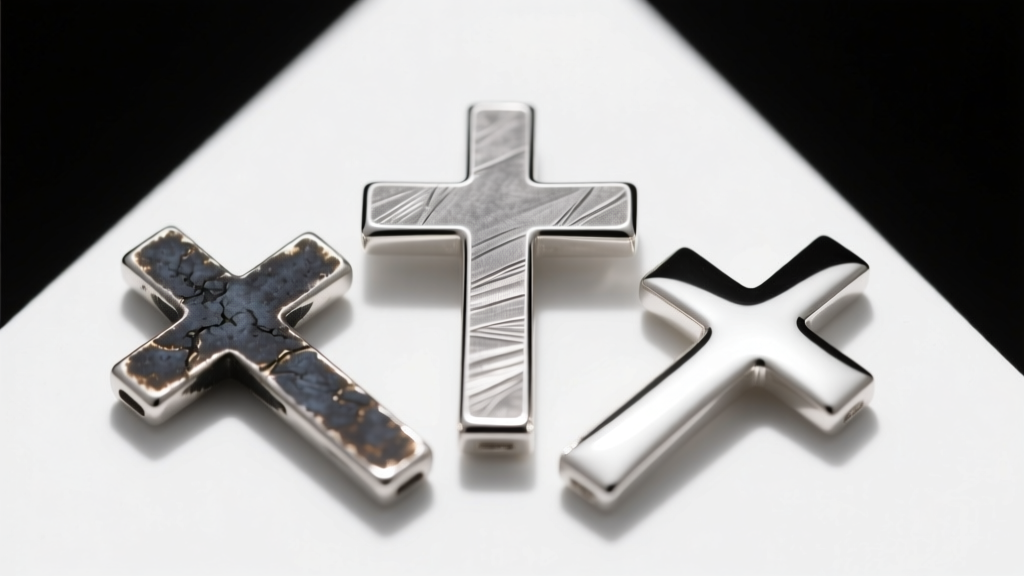
Chain Gauge & Tensile Strength Requirements
The most common point of failure in multi-pendant necklaces is the chain. Fashion jewelry brands frequently utilize 0.8mm to 1.0mm cable chains to minimize material costs. While a 1.0mm chain might support the static weight of three small crosses (roughly 8 to 12 grams), it cannot withstand dynamic torque.
The Fatigue Limit of Micro-Chains
When a triple cross necklace catches on a garment, or when the wearer leans forward and the pendants swing outward, the chain experiences sudden tensile spikes. A standard 1.0mm cable chain has a breaking strength of roughly 8 lbs. However, its fatigue limit—the point at which repeated micro-bending causes work-hardening and snapping—is significantly lower. The constant multi-directional pulling from three independent pendulums accelerates metal fatigue at the chain's solder points.
Recommended Chain Profiles for Triple Pendants
- Box Chain (Minimum 1.5mm): The square, interlocking links distribute torsional stress across four flat planes. This geometry prevents the chain from kinking when the three crosses pull at different angles.
- Wheat / Spiga Chain (Minimum 1.2mm): Featuring four strands of twisted oval links, wheat chains offer immense tensile strength and a fluid drape that accommodates the heavy swing of multiple pendants without tangling.
- Curb Chain (Minimum 2.0mm): The flat, interlocking links lay flush against the skin, providing a high surface-area contact that resists twisting. Ideal for heavier, solid gold triple cross setups.
For comprehensive specifications on chain tensile limits and link geometries, jewelers frequently consult the technical catalogs provided by Rio Grande, a premier jewelry supply authority.
Bail Mechanics & Weight Distribution
The bail—the component that connects the pendant to the chain—is the critical nexus of a triple cross necklace. If all three crosses are hung from a single, oversized jump ring, they will inevitably cluster together, scratch one another, and create an unbalanced center of gravity that forces the chain to twist around the wearer's neck.
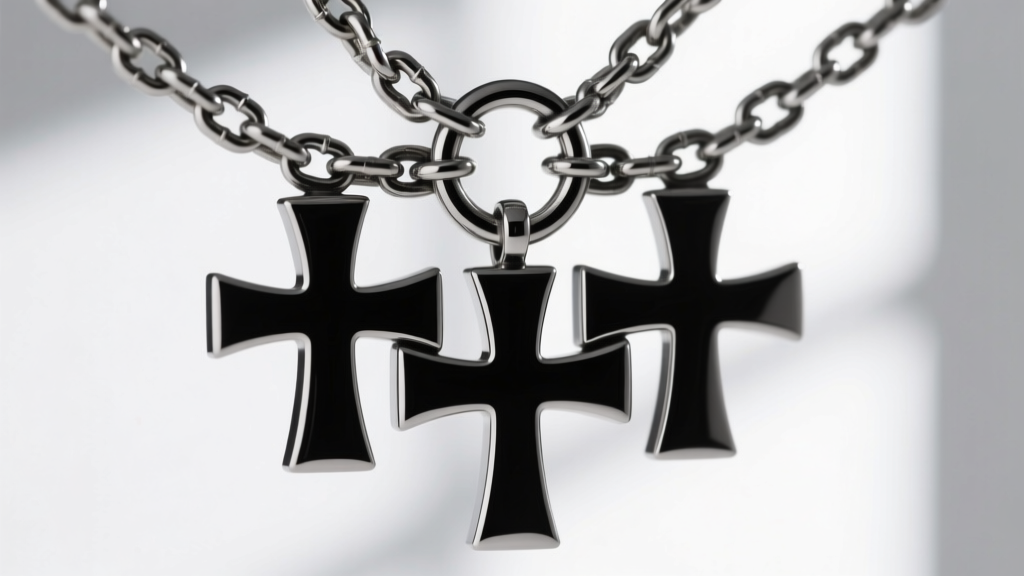
Articulated vs. Fixed Bails
To solve the clustering issue, expert jewelers utilize an articulated multi-loop bail or a fixed horizontal bar bail.
Expert Insight: A properly engineered triple cross necklace features individual, micro-soldered jump rings for each cross, spaced exactly 6mm to 8mm apart on a horizontal stabilizing bar. This guarantees that the pendants remain parallel, preventing the edges from overlapping and causing abrasive wear.
Furthermore, the jump rings connecting the crosses to the bail must be soldered closed. Unsoldered split rings will slowly pry open under the repetitive kinetic stress of three swinging weights, eventually leading to the loss of a pendant.
Clasp Load-Bearing Capacities
The clasp is the final structural bottleneck. Spring ring clasps, while common and inexpensive, rely on a tiny, easily deformed internal spring. They are generally rated for 2 to 3 lbs of continuous tensile force. If a heavy triple cross necklace is subjected to a sudden snag, the torque can easily exceed 5 lbs, bending the spring ring open or snapping the delicate catch mechanism.
For any triple cross necklace weighing over 10 grams, a solid-cast lobster clasp is mandatory. Lobster clasps feature a thicker, lever-actuated internal spring and a wider jaw that locks securely into the end ring. For premium pieces, a box clasp with a figure-eight safety latch provides redundant security, ensuring that even if the primary friction lock fails under dynamic load, the secondary wire latch will prevent the necklace from falling.
Manufacturing Methods: Die-Struck vs. Cast
How the crosses themselves are formed dictates their longevity.
- Lost-Wax Casting: Most mass-market jewelry is cast. Molten metal is poured into a mold created from a wax original. This results in a slightly porous molecular structure. While fine for single pendants, cast crosses in a triple configuration are prone to bending or snapping at the arms if they are struck or caught.
- Die-Striking: Premium crosses are stamped from flat sheets of metal under hundreds of tons of pressure. This compresses the metal's grain structure, aligning the molecules and creating a significantly denser, harder, and more impact-resistant pendant. According to GIA's gold quality factors, the density and structural integrity of the alloy are heavily influenced by the manufacturing process, making die-struck pieces vastly superior for high-impact, multi-pendant wear.
Expert Maintenance & Ultrasonic Cleaning
Maintaining a triple cross necklace requires an understanding of its specific finish. If the crosses feature intentional oxidation (blackened recesses to highlight the engraving or texture), never use an ultrasonic cleaner. The high-frequency cavitation bubbles will strip the oxidized patina from the crevices, leaving the piece looking flat and washed out.
Instead, use a soft-bristled agate brush and a mild, non-ammonia surfactant to clean the high-polish surfaces without disturbing the darkened recesses. For solid 14k gold or plain 316L steel pieces without patina, a brief 3-minute cycle in an ultrasonic cleaner with a specialized jewelry solution will safely dislodge sebum and dead skin cells from the tight linkages of the chain and bail mechanisms, restoring the piece's original factory luster.
Final Verdict on Sourcing
When investing in a triple cross necklace, look past the initial visual appeal. Demand a minimum chain gauge of 1.5mm, verify that the pendant jump rings are soldered, and ensure the clasp is a heavy-duty lobster or box mechanism. By prioritizing structural engineering over mere ornamentation, you secure a piece of jewelry that will endure the physics of daily wear for decades.


