Shark Tooth Necklace Megalodon: Authenticity & Care Troubleshooting
Learn how to authenticate, properly wrap, and preserve your shark tooth necklace megalodon. Expert troubleshooting for fossil care and chain pairing.

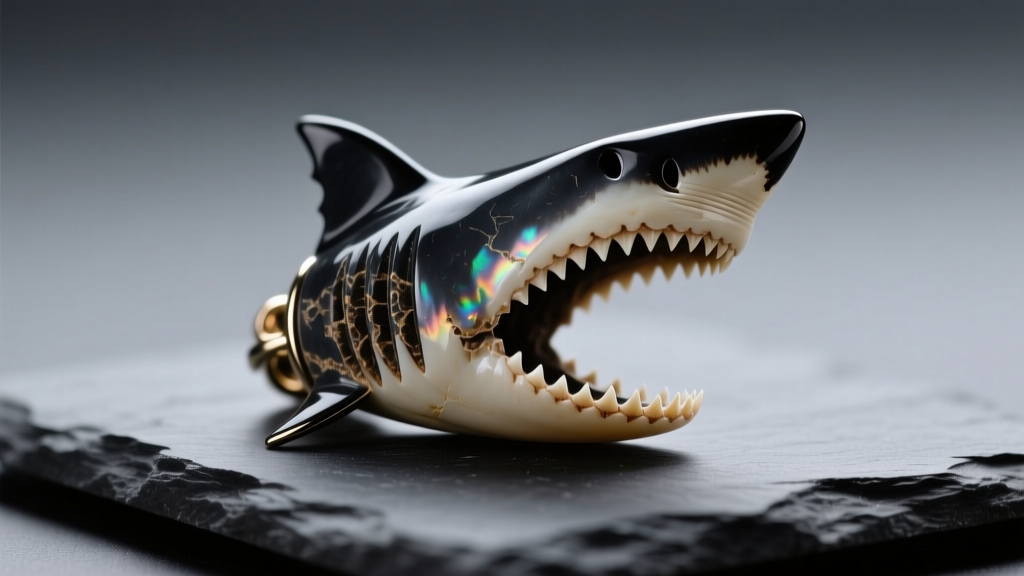
The Authenticity Problem: Spotting Fake Megalodon Teeth
As of 2026, the secondary market for paleontological jewelry has expanded dramatically, bringing a corresponding surge in high-quality counterfeit casts. Troubleshooting a shark tooth necklace megalodon begins with verifying its origin. Genuine Megalodon (Otodus megalodon) teeth are fossilized remains dating back 2.6 to 23 million years, primarily recovered from the Cooper River in South Carolina or the phosphate-rich beds of Morocco. Fakes are typically cast in polyurethane resin or carved from modern whale bone and stained with tea or potassium permanganate.
The UV Light and Heat Pin Tests
The most immediate troubleshooting step for suspected resin casts is the ultraviolet (UV) light test. Under a 365nm UV flashlight, genuine fossilized enamel and root material will appear dull or exhibit patchy, uneven fluorescence due to mineral replacement (often iron oxide or silica). Conversely, modern polyurethane resins and epoxies used in fakes will typically glow with a uniform, bright white or greenish hue.
If the UV test is inconclusive, the heat pin test is the definitive diagnostic tool. Heat a sewing needle with a lighter until it is red-hot, and press it firmly into an inconspicuous area of the tooth's root. A genuine fossil is essentially stone and will not yield to the needle, nor will it emit an odor. A resin fake will melt, allowing the needle to penetrate, and will release an acrid, chemical plastic smell. According to FossilEra, this physical reaction is the most reliable field test for distinguishing carved bone or resin from true permineralized fossils.
Examining the Bourrelet and Serrations
Visual inspection under a 10x jeweler's loupe reveals critical anatomical markers. Real megalodon teeth feature a distinct bourrelet—a raised, textured band of enamel that separates the smooth blade from the porous root. Molded fakes often blur this transition or fail to replicate the micro-texture. Furthermore, genuine megalodon serrations are microscopically irregular and razor-sharp, a result of the shark's natural biology and subsequent fossilization. Cast fakes often exhibit smoothed, uniform serrations where the mold failed to capture the microscopic peaks and valleys of the original tooth.
Structural Troubleshooting: Preventing Bail and Chain Failures
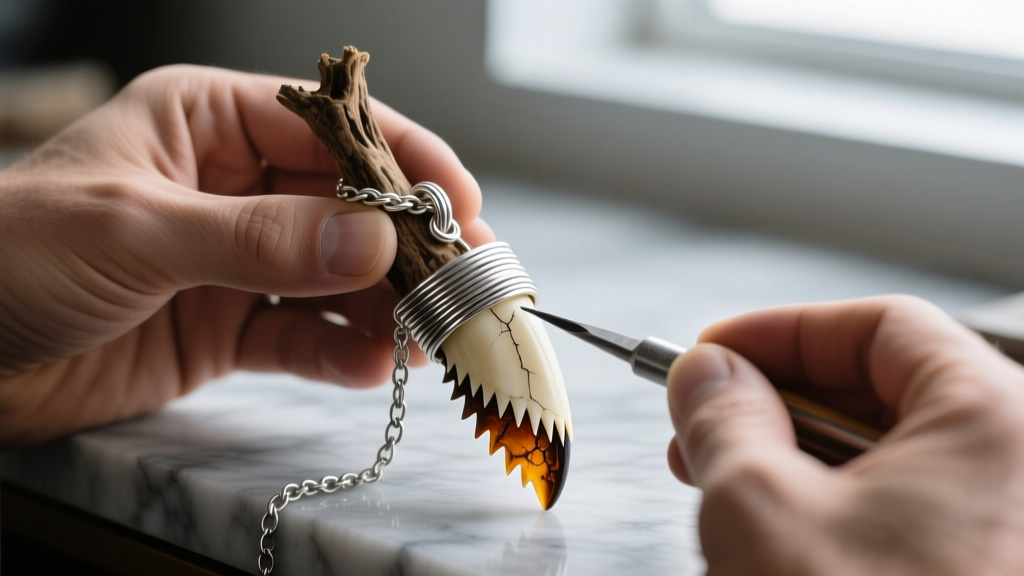
The most common point of failure for a heavy fossil pendant is the hardware. A standard 4-inch megalodon tooth can weigh between 120 and 180 grams, while exceptional 6-inch specimens can exceed 300 grams. Standard jewelry bails and lightweight chains are entirely inadequate for this dynamic load, which multiplies when the wearer bends over or moves abruptly.
Wire Wrapping vs. Glued Bails
Never rely on cyanoacrylate (superglue) or epoxy to attach a metal bail directly to a fossilized root. The root of a megalodon tooth is highly porous and chalky; adhesives will eventually degrade due to exposure to skin oils, sweat (which has a pH between 4.5 and 7.0), and temperature fluctuations, leading to catastrophic detachment.
The only secure method is a custom basket-weave wire wrap that cradles the root and anchors the bail mechanically. For a tooth weighing up to 200 grams, use 18-gauge dead-soft sterling silver or 18-gauge Grade 5 Titanium wire. Titanium is highly recommended for 2026 jewelry trends due to its high tensile strength, lightweight profile, and hypoallergenic properties. For specimens exceeding 250 grams, step up to 16-gauge wire to prevent metal fatigue and wire snapping at the bail loop.
Chain Weight vs. Tooth Size Guide
Pairing the correct chain is critical. Hollow chains will crush under the weight of a megalodon tooth. Always opt for solid-core constructions. Below is a troubleshooting matrix for matching chain specifications to tooth mass:
| Tooth Length | Avg. Weight | Required Chain Type | Min. Chain Width | Clasp Requirement |
|---|---|---|---|---|
| 2.0 - 3.0 inches | 40 - 80g | Solid Rope or Box | 2.0 mm | 12mm Solid Lobster |
| 3.1 - 4.5 inches | 81 - 180g | Solid Wheat or Cuban | 3.0 mm | 15mm Solid Lobster |
| 4.6 - 6.0+ inches | 181 - 350g+ | Solid Figaro or Box | 4.0 - 5.0 mm | Heavy Bolt Ring / 20mm |
Ensure the jump ring connecting the wire-wrapped bail to the chain is soldered closed or made of heavy-gauge split-ring wire. Open, unsoldered jump rings will inevitably pull apart under the pendulum effect of a heavy megalodon tooth.
Preservation and Cleaning: Fixing Cracks and Preventing Decay
While the enamel of a megalodon tooth is highly mineralized and ranks around 5 to 6 on the Mohs hardness scale, the root structure remains fragile and susceptible to spalling (flaking) and environmental degradation. Troubleshooting surface cracks and preventing long-term decay requires museum-grade conservation techniques, not commercial jewelry cleaners.
The Paraloid B-72 Consolidation Method
If the chalky root of your megalodon tooth is shedding sediment or exhibiting micro-cracks, it must be consolidated. The gold standard in paleontological conservation is Paraloid B-72, an ethyl methacrylate copolymer that is entirely reversible and does not yellow over time.
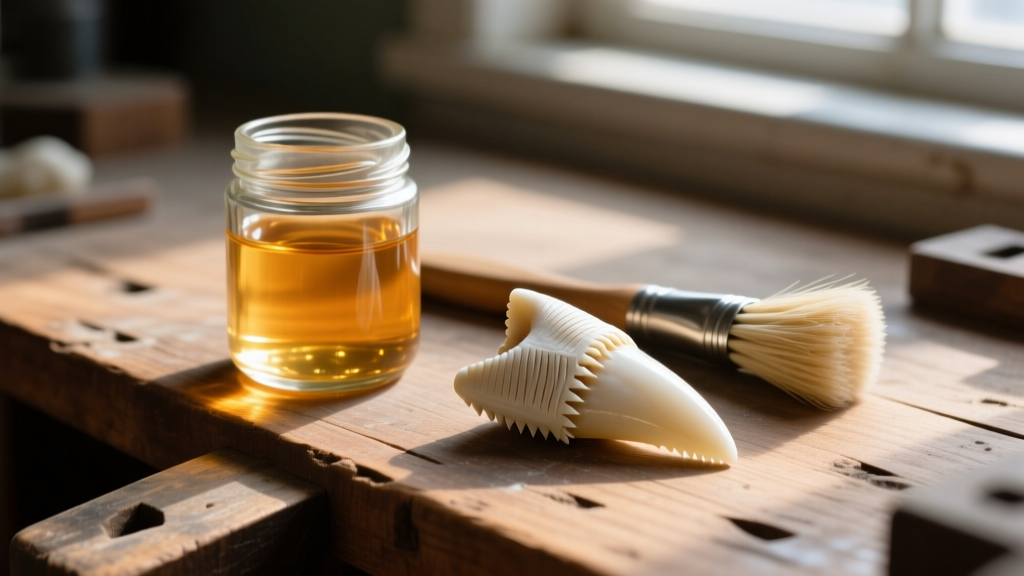
To stabilize a fragile root, dissolve Paraloid B-72 beads in pure acetone to create a 5% to 10% (weight/volume) solution. Using a soft-bristled brush, apply the solution directly to the porous root areas. The acetone acts as a carrier, drawing the acrylic polymer deep into the micro-fissures before evaporating, leaving a hardened, transparent matrix that binds the fossilized sediment together. As noted by conservation guidelines from institutions like the Florida Museum of Natural History, this reversible treatment ensures the fossil remains structurally sound for daily wear without permanently altering its chemical composition.
What NEVER to Use on Fossilized Enamel
When cleaning your shark tooth necklace megalodon, avoid the following common mistakes that cause irreversible damage:
- Ultrasonic Cleaners: The high-frequency cavitation bubbles will aggressively erode the fragile root structure and can shatter the tooth along hidden fault lines.
- Bleach or Hydrogen Peroxide: Harsh oxidizers will strip the natural iron oxide patinas that give the enamel its desirable grey, black, or rust-red hues, leaving it chalky and artificially white.
- Commercial Silver Dips: If the tooth is set in sterling silver, do not submerge the entire piece in chemical silver dips. The acids will eat away at the fossilized root. Instead, use a polishing cloth strictly on the metal wire wrap.
For routine cleaning, simply use a soft, dry microfiber cloth to wipe away skin oils from the enamel. If the tooth becomes heavily soiled, a brief rinse in distilled water (never tap water, which contains chlorine and fluorides) followed by immediate air-drying is sufficient.
Expert Sourcing and Final Considerations
Wearing a piece of prehistoric apex predator history requires a commitment to proper jewelry engineering and paleontological care. By rigorously testing for authenticity, upgrading to heavy-gauge wire wraps and solid-core chains, and utilizing reversible museum consolidants like Paraloid B-72, you can ensure your megalodon pendant survives the modern era just as it survived the Miocene epoch. For deeper reading on the biology and fossilization of these ancient marine giants, the Natural History Museum provides excellent foundational resources on Megalodon anatomy and geological distribution.


