How to Authenticate and Fix a Real Four Leaf Clover Necklace
Discover how to authenticate, preserve, and troubleshoot common issues with a real four leaf clover necklace, from resin yellowing to clover degradation.

The Allure and Fragility of Preserved Botanical Jewelry
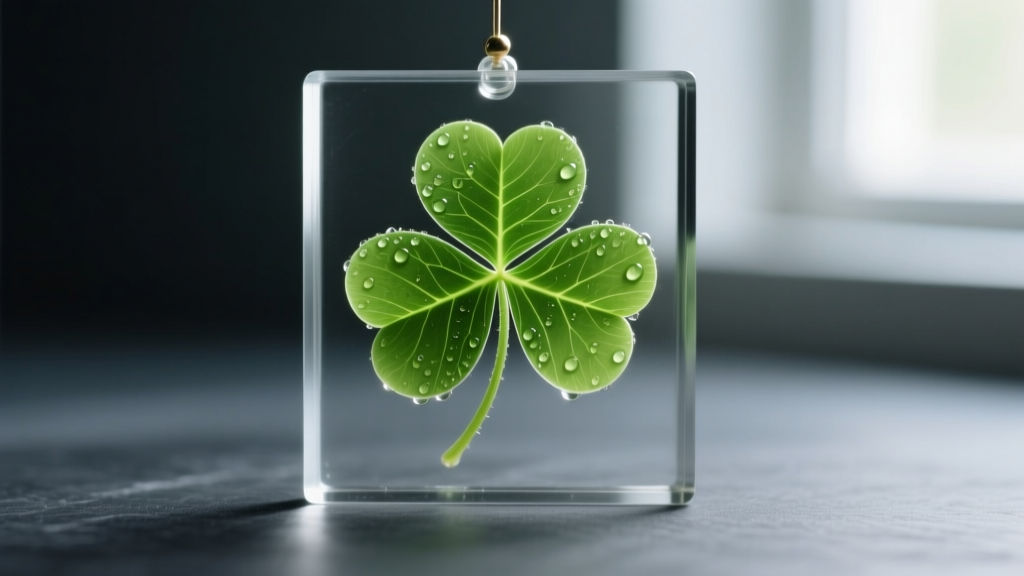
Few pieces of jewelry carry the sentimental and symbolic weight of a real four leaf clover necklace. Representing luck, hope, faith, and love, these botanical pendants are highly sought after. However, preserving organic plant matter inside a wearable medium introduces a unique set of structural and chemical challenges. Unlike traditional gemstones or metals, a preserved clover is a delicate organic inclusion trapped in a synthetic matrix. When problems arise—ranging from polymer degradation to cellular collapse of the plant itself—standard jewelry repair techniques often fail. This comprehensive troubleshooting guide will help you authenticate your pendant, diagnose material failures, and implement expert-level preservation protocols to ensure your botanical jewelry survives for decades.
Problem 1: Is Your Clover Actually Real? (Authentication Guide)
The market is flooded with mass-produced pendants featuring molded plastic, stamped metal, or laser-cut synthetic leaves marketed as 'botanical.' Before attempting any restoration or repair, you must verify that you are dealing with a genuine organic specimen. According to guidelines on organic inclusions discussed by the Gemological Institute of America (GIA), natural botanicals exhibit specific microscopic markers that synthetics cannot perfectly replicate.
Visual Inspection Checklist
Use a 10x jeweler's loupe or a macro lens to examine the pendant. You are looking for organic chaos—the natural imperfections that prove the leaf was once alive.
| Feature | Real Preserved Clover | Fake / Synthetic Clover |
|---|---|---|
| Vein Structure | Continuous, branching micro-capillaries with varying thickness. | Painted on, uniform width, or lacking tertiary veins entirely. |
| Symmetry | Asymmetrical; one leaf is often slightly smaller or misshapen. | Mathematically perfect symmetry; identical leaf proportions. |
| Edge Texture | Slight serration, organic waviness, or microscopic fraying. | Smooth, laser-cut precision, or molded seam lines. |
| Resin Inclusions | Tiny micro-bubbles trapped near the stem; occasional dust mote. | Flawlessly clear, or artificially placed large 'decorative' bubbles. |
Problem 2: Resin Yellowing and Cloudiness
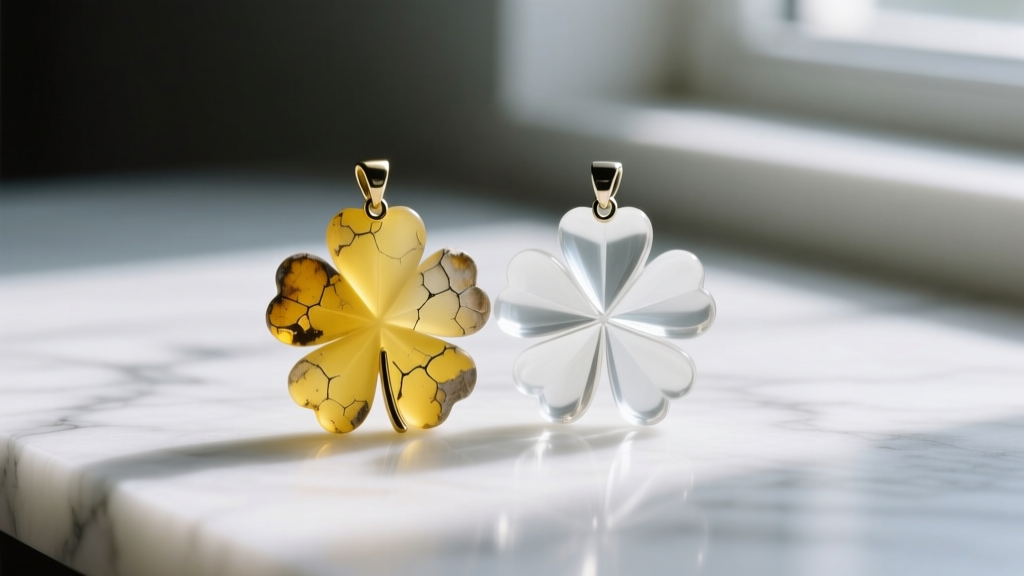
The most frequent complaint from owners of botanical necklaces is the gradual yellowing or 'ambering' of the clear encapsulation. This is not a defect in the clover, but a chemical breakdown of the polymer matrix.
Why UV Stabilizers Fail
Most commercial botanical jewelry is cast in either UV-cured resin or two-part epoxy. UV-cured resins, while fast and cheap for mass production, often lack adequate HALS (Hindered Amine Light Stabilizers) and UVAs (Ultraviolet Absorbers). When exposed to ambient sunlight, the polymer chains undergo photo-oxidation. As noted in ScienceDirect's materials science archives, this degradation creates conjugated double bonds within the polymer, which absorb blue light and reflect yellow. High-grade two-part epoxies (like ArtResin) contain UV blockers that delay this process, but no clear resin is 100% immune to eventual ambering.
Can You Reverse Yellowed Resin?
The hard truth: No. Once the polymer chains have oxidized and yellowed, the chemical change is permanent. Bleaching agents, polishing compounds, and retro-brighting techniques will only degrade the surface integrity of the pendant or damage the bail.
The Solution: Prevention is your only tool. When not wearing your real four leaf clover necklace, store it in a UV-blocking jewelry pouch or a closed drawer. Never leave it on a sunlit vanity or dashboard. If the yellowing is severe and obscures the clover, the only true 'fix' is to have a lapidary or resin artist carefully cut away the old resin, extract the clover (if it survives), and re-encapsulate it in a fresh, museum-grade, non-yellowing epoxy.
Problem 3: The Clover is Crumbling or Fading Inside
If the green pigment of your clover is turning brown, or if the edges appear to be disintegrating into dust inside the sealed pendant, you are witnessing cellular collapse and organic decay.
Moisture Traps and Pigment Loss
Proper botanical preservation requires complete desiccation before encapsulation. Artisans typically use silica gel to draw out moisture over 48 to 72 hours while maintaining the leaf's three-dimensional structure. If a manufacturer air-dries the clovers or rushes the process, microscopic pockets of water remain trapped in the plant's cellular walls. Once sealed in resin, this trapped moisture has nowhere to go. It leads to localized fungal growth, chlorophyll degradation (turning the leaf brown), and eventual crumbling. Furthermore, if the resin was poured at an exothermic temperature exceeding 140°F (60°C), the heat can literally cook the organic matter, causing immediate pigment loss.
Expert Insight: If your clover is fading to a pale yellow-green or brown, the chlorophyll has broken down. This is irreversible. To slow further degradation, keep the necklace strictly away from heat sources and direct UV light, which accelerate the breakdown of remaining organic compounds.
Problem 4: Hardware Failures (Bails and Jump Rings)
Botanical pendants are often paired with flimsy, mass-produced chains and hardware that fail to support the pendant's weight or protect the brittle resin.
Upgrading the Jump Ring and Bail
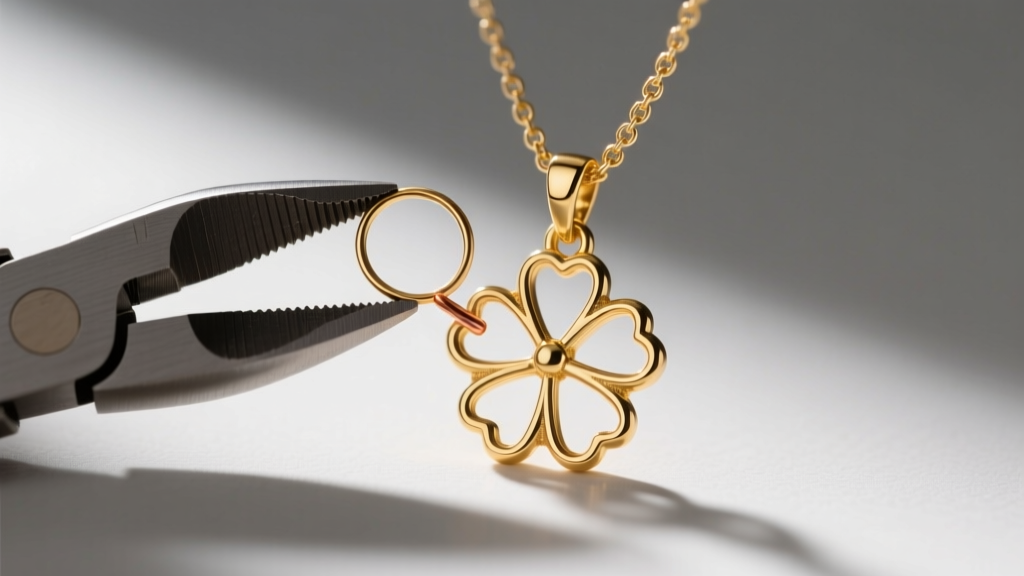
Many imported botanical necklaces utilize 24-gauge or 26-gauge open jump rings. These thin wire rings easily pull apart when snagged on clothing, resulting in a lost pendant. Furthermore, 'pinch bails' (which rely on tiny prongs gripping the resin) often snap off because resin is brittle and cannot withstand lateral torque.
- The Fix: Take your necklace to a local jeweler and request an upgrade to a 20-gauge or 22-gauge soldered jump ring or a split ring. Soldered rings have no seam to pull apart.
- Bail Replacement: If the pendant has a drilled hole at the top, use a heavy-duty soldered loop bail. If it relies on a pinch bail, have a jeweler carefully drill a shallow channel through the top of the resin (using a diamond burr bit with continuous water cooling to prevent melting the resin) and install a secure wire-wrap or soldered bail.
- Chain Selection: Pair the upgraded hardware with a sturdy chain, such as a 1.5mm to 2.0mm box chain or a wheat chain in 14k gold-filled or solid sterling silver, avoiding delicate cable chains that snap under the pendant's weight.
Expert Care and Maintenance Protocol
Maintaining a real four leaf clover necklace requires a different approach than traditional fine jewelry. Never use ultrasonic cleaners, steam cleaners, or harsh chemical dips (like silver polish) on the resin body, as these will cause micro-fractures and clouding. According to JCK Online's jewelry care guidelines, organic and porous materials require gentle, non-abrasive cleaning methods.
To clean the resin, simply wipe it with a dry, lint-free microfiber cloth. If the chain tarnishes, remove the pendant entirely before polishing the metal with a treated jeweler's cloth. By understanding the material science behind your botanical jewelry and proactively upgrading its weakest structural points, you can ensure your symbol of luck remains intact and vibrant for a lifetime.


