Troubleshooting the Necklace Breast Gap and Pendant Flip
Solve the necklace breast gap and pendant flip. Expert troubleshooting for chain lengths, counterweights, and bust-friendly jewelry styling.


The Physics of Jewelry: Why Standard Sizing Fails
Most jewelry buying guides operate on a fundamental flaw: they assume a flat chest. When you introduce bust projection into the equation, the physics of how a chain drapes changes entirely. If you have ever experienced the frustrating 'necklace breast gap'—where a chain hovers awkwardly off the slope of your chest—or dealt with a pendant that constantly flips upside down, you are not alone. This is a mechanical issue, not a styling failure.
When a necklace encounters the apex of a larger bust, gravity and friction compete. The chain is pushed outward, altering the center of gravity and causing lightweight pendants to slide up the chain or flip backward. Troubleshooting this requires moving beyond aesthetic preferences and looking at jewelry engineering, specifically chain profiles, bail types, and weight distribution.
Solving the Pendant Flip Phenomenon
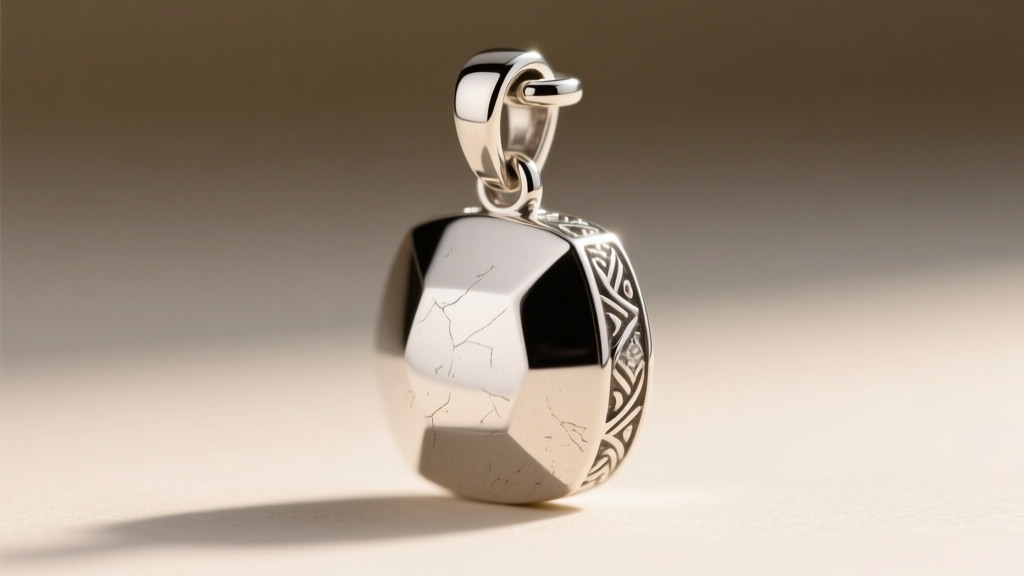
The dreaded pendant flip happens when the bail (the loop connecting the pendant to the chain) has too much mobility, combined with a chain that is forced into a convex curve by the bust. To stop this, you must address the hardware.
1. Switch to a Fixed Bail
Standard movable bails allow the pendant to slide freely to the lowest gravitational point. On a curved surface, that point shifts. A fixed bail—where the pendant is soldered directly to a specific link or uses an integrated, rigid jump ring—forces the pendant to remain perfectly vertical, regardless of the chain's curvature.
2. The Counterweight Technique
If your pendant is heavy (over 5 grams), it will pull the chain forward, creating tension. By adding a 2 to 3-gram decorative counterweight or a heavy lobster clasp at the nape of the neck, you anchor the chain. This prevents the pendant from sliding side-to-side and keeps the clasp hidden at the back. According to the GIA Gem Encyclopedia, understanding the carat weight and metal density of your components is crucial for achieving proper balance in custom jewelry pieces.
Length Mapping: Where Standard Sizes Actually Fall
The jewelry industry relies on standard length categories, but these measurements are based on a mannequin with a 34B bust. For women with a D-cup or larger, an 18-inch chain does not sit at the collarbone; it sits directly at the apex of the breast, leading to the 'cleavage trap' where the pendant disappears. Below is a troubleshooting matrix to help you select the correct length based on actual bust projection.
| Standard Length | Industry Name | Placement on D+ Cup | Troubleshooting Fix |
|---|---|---|---|
| 16 Inches | Choker | Hovers mid-slope (The Gap) | Size up to 18" or use a rigid torque collar. |
| 18 Inches | Princess | Rests on the apex / cleavage | Use only for lightweight pendants (<2g) or layer over a turtleneck. |
| 20 - 22 Inches | Matinee | Rests on the upper sternum | Ideal for heavy pendants; clears the bust line entirely. |
| 24 - 30 Inches | Opera | Falls below the bust line | Best for layering; requires a pendant slide to prevent swinging. |
For definitive sizing standards and manufacturing tolerances, the Jewelers of America provides extensive resources on how chain lengths are measured end-to-end, excluding the clasp, which can add an extra half-inch to your final fit.
Troubleshooting Skin Friction and Material Degradation
The area between and just below the breasts is a high-friction, high-moisture zone. When a 20-inch chain rests on the sternum, it is subjected to sweat, body oils, and constant rubbing. This leads to two major problems: skin irritation and rapid metal degradation.
The Problem with Plated Alloys
Brass or copper-based jewelry with thin gold plating will quickly oxidize when exposed to the slightly acidic pH of human sweat. This results in the notorious 'green skin' effect and can cause contact dermatitis.
The Solution: Hypoallergenic and Solid Metals
To troubleshoot sternum friction, you must upgrade your materials. Look for:
- ASTM F136 Titanium: The gold standard for biocompatibility. It will not react with sweat and is incredibly lightweight.
- 316L Surgical Stainless Steel: Highly resistant to tarnish and moisture, making it ideal for everyday sternum-resting chains.
- Solid 14k or 18k Gold: Unlike plated alternatives, solid gold can be easily polished if micro-scratches occur from friction against clothing or skin.

Chain Profiles That Resist Bunching and Tangling
Not all chains drape the same way over a curved surface. The structural profile of the chain dictates how it will behave when navigating the 'necklace breast gap'.
Expert Tip: Avoid Herringbone and Snake chains if you have a prominent bust. These flat, fluid chains are notorious for kinking and flipping over when they encounter the convex curve of the chest. Once a herringbone chain kinks, the structural integrity is permanently compromised.
Instead, opt for chains with multidimensional links that maintain their orientation:
- Box Chains: The geometric, square links lay flat against the sternum and are highly resistant to flipping. They provide a modern, structured look that anchors heavy pendants beautifully.
- Rope Chains: The twisted, helical structure adds visual weight and texture, preventing the chain from getting 'lost' against the skin or fabric. The twisting motion naturally resists tangling.
- Cable Chains (with thicker gauges): A 2mm to 3mm solid cable chain offers enough rigidity to drape over the bust without collapsing into the cleavage, provided the length is correctly mapped to 20 inches or longer.
Your Quick Troubleshooting Checklist
Before purchasing your next piece, run it through this mechanical checklist to ensure it will complement your proportions without requiring constant adjustment:
- Check the Bail: Is it fixed or highly restricted? If it swings freely, expect it to flip.
- Calculate the Drop: Measure from your collarbone to the desired resting point on your sternum, bypassing the apex of the breast. Add this to your neck circumference to find your true custom length.
- Assess the Weight Ratio: Ensure your pendant is at least 3 times heavier than the chain it hangs on, or use a nape counterweight to anchor it.
- Verify the Alloy: Confirm the metal is solid or surgical-grade to withstand the sternum micro-climate.
By treating jewelry selection as an exercise in physics and ergonomics rather than just aesthetics, you can completely eliminate the necklace breast gap and enjoy pieces that sit flawlessly, hour after hour.


