Troubleshooting a Necklace With a Cross: Chain Breaks and Tangles
Is your cross pendant breaking chains or spinning? Learn expert troubleshooting tips to fix bail wear, tangling, and metal tarnish.


The Mechanical Challenges of Cross Pendants
Owning a necklace with a cross often carries deep personal, cultural, or religious significance. However, from a metallurgical and mechanical engineering standpoint, cross pendants present a unique set of wear-and-tear challenges that standard circular or geometric pendants do not. The asymmetrical weight distribution, the specific kinetic friction points at the bail, and the frequent mixing of dissimilar metals all contribute to a higher failure rate if the jewelry is not properly configured.
As a senior jewelry stylist and repair consultant, I frequently see clients struggling with three primary issues: rapid chain degradation at the bail, persistent pendant spinning, and galvanic tarnishing. This guide provides actionable, expert-level troubleshooting steps to diagnose and resolve these structural vulnerabilities, ensuring your piece remains secure and pristine for decades.
Troubleshooting Chain Breakage and Bail Friction
The most common point of catastrophic failure on a necklace with a cross is the chain link passing through the pendant bail. This phenomenon is known in the jewelry repair industry as the "saw effect."
The Physics of the Saw Effect
When you wear a cross pendant, the pendant swings and shifts with your body's movement. If the inner diameter of the bail is significantly larger than the gauge of the chain, the chain links act like a microscopic file against the interior roof of the bail. Conversely, if the bail is made of a softer metal (like high-karat gold or pure silver) and the chain is a harder alloy (like stainless steel or white gold), the chain will slowly saw through the bail itself. According to repair specialists at Calla Gold Jewelry, friction wear accounts for nearly 40% of all pendant-related chain snaps.

Actionable Fixes for Bail Wear
- Upgrade the Chain Gauge: A standard 0.8mm or 1.0mm cable chain is too thin for most solid metal crosses. Upgrade to a minimum 1.5mm box chain or a 1.2mm rope chain. The thicker links reduce the kinetic play inside the bail, minimizing the filing action.
- Install a UHMWPE Bail Liner: For heirloom crosses with oversized bails, a jeweler can insert a microscopic sleeve of Ultra-High-Molecular-Weight Polyethylene (UHMWPE). This transparent, ultra-durable polymer acts as a frictionless buffer between the metal chain and the gold or silver bail.
- Switch to a Pendant Slide: If the cross has a hidden bail or a fixed top loop that is wearing thin, replace the traditional bail with a weighted pendant slide that distributes the friction across a wider surface area of the chain.
Chain Gauge vs. Pendant Weight Compatibility Matrix
Use the following data table to ensure your chain is structurally rated for the physical mass of your cross pendant. Undersizing your chain is the leading cause of unexpected snap failures.
| Pendant Weight | Minimum Chain Gauge | Recommended Chain Style | Failure Risk if Undersized |
|---|---|---|---|
| Under 3 grams | 0.9mm - 1.1mm | Cable, Bead, or Snake | Low (Kinking) |
| 3 to 8 grams | 1.2mm - 1.5mm | Box, Rope, or Wheat | Medium (Clasp pull-through) |
| 8 to 15 grams | 1.8mm - 2.2mm | Figaro, Curb, or Mariner | High (Link snapping at bail) |
| Over 15 grams | 2.5mm+ | Thick Cuban or Rope | Severe (Bail tearing off pendant) |
Solving the "Spinning Cross" Problem
One of the most frustrating issues when wearing a necklace with a cross is the pendant continuously flipping backward, hiding the face of the cross against the skin. This is not a defect in the jewelry; it is a basic issue of physics and center-of-gravity.
Weight Distribution and Chain Friction
A traditional Latin cross is vertically asymmetrical—the bottom stem is longer and heavier than the top loop. When suspended on a highly polished, low-friction chain (like a snake chain or a smooth box chain), the heavy bottom stem naturally seeks the lowest gravitational point, which often results in the pendant sliding off-center and flipping over.
How to Stabilize an Asymmetrical Pendant
- Introduce Surface Friction: Swap smooth chains for textured alternatives. A 1.5mm Figaro or a twisted rope chain creates micro-friction against the skin and collarbone, anchoring the chain in place and preventing the pendant from sliding laterally.
- Use a Counterweight Clasp: Adding a heavy decorative clasp (such as a solid lobster or a toggle) at the back of the neck acts as a counterbalance, keeping the front of the chain taut and centered.
- The Silicone O-Ring Trick: For a temporary, invisible fix, thread a microscopic, jewelry-grade clear silicone O-ring onto the chain on either side of the bail. This acts as a physical stopper, preventing the cross from sliding more than a few millimeters off-center, effectively eliminating the momentum required for it to flip backward.
Galvanic Corrosion and Mixed-Metal Tarnishing
Tarnish on a necklace with a cross is often misdiagnosed as simple oxidation. In reality, severe blackening or green skin discoloration is usually the result of galvanic corrosion, which occurs when dissimilar metals are coupled in the presence of an electrolyte (human sweat).
The Anode-Cathode Reaction in Jewelry
If you pair a solid sterling silver (925) cross pendant with a gold-plated brass or copper-core chain, you create a galvanic cell. The sweat on your neck acts as the electrolyte. Because silver and copper/brass sit at different points on the galvanic series, an electrical current transfers between them, rapidly accelerating the oxidation of the more anodic metal. This results in aggressive, crusty black tarnish right at the bail connection point, and can permanently ruin the plating on the chain.
To prevent this, the Gemological Institute of America (GIA) and metallurgical experts recommend maintaining homogenous metal pairings. Always pair a sterling silver cross with a solid sterling silver chain, or a 14k gold cross with a solid 14k gold chain. If you must mix metals for aesthetic reasons, ensure the silver pendant is heavily rhodium-plated to create an inert, non-reactive barrier between the two alloys.
When to Seek Professional Laser Welding
If your cross pendant features delicate inlays—such as black onyx, mother-of-pearl, or turquoise—traditional torch soldering is incredibly dangerous. The thermal shock from a jeweler's torch will instantly shatter or scorch these organic and semi-precious stones.
In 2026, the industry standard for repairing broken bails on stone-inlay crosses is laser welding. Laser welders use concentrated pulses of light to fuse metal at a microscopic level without transferring ambient heat to the surrounding gemstones. If the top loop of your cross has snapped off, do not attempt to glue it back on with cyanoacrylate (Super Glue), as this will ruin the porosity of the metal and make future professional welding impossible. Take it to a certified bench jeweler equipped with a laser welder for a permanent, heat-free structural fusion.
For more information on advanced jewelry fabrication and metal properties, consult the Rio Grande Metals Guide, an essential resource for understanding the tensile strength and melting points of various jewelry alloys.
Final Maintenance Checklist
To ensure the longevity of your necklace with a cross, implement this bi-annual maintenance routine:
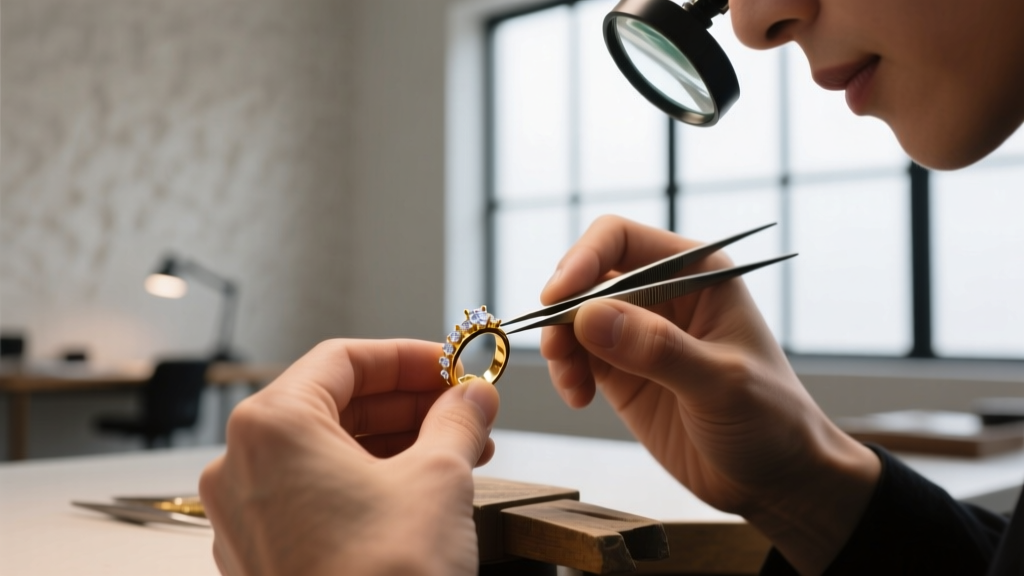
- Inspect the Bail Roof: Use a 10x jeweler's loupe to check the inside roof of the bail for deep grooves. If the metal is worn more than 30% through, have a jeweler apply a laser weld patch before it snaps.
- Check the Jump Ring: Ensure the jump ring connecting the clasp to the chain is flush-closed. A slight gap will catch on the cross pendant during storage, leading to severe tangling.
- Ultrasonic Cleaning Caution: Never put a cross pendant with fracture-filled diamonds, opals, or glued-inlay stones into an ultrasonic cleaner. The high-frequency vibrations will dislodge the stones. Stick to a soft-bristle brush and mild dish soap for safe, effective cleaning.


