Troubleshooting Jewelry Pairings for a Polynesian Necklace Tattoo
Expert troubleshooting for pairing jewelry with a Polynesian necklace tattoo. Solve aesthetic clashes, skin sensitivity, and placement.


The Intersection of Ink and Metal: Unique Challenges
A Polynesian necklace tattoo—often featuring bold blackwork, geometric Koru (spirals), or Niho Mano (shark teeth) patterns across the clavicle and sternum—is a powerful, permanent statement piece. However, from a jewelry styling perspective, this specific type of body art introduces a complex matrix of troubleshooting challenges. Unlike bare skin, which acts as a neutral canvas, a dense tribal collar competes for visual dominance, alters the skin’s physical topography, and changes how the dermis reacts to external metals. Whether you are dealing with a fresh healing tattoo or a years-old blackwork band, pairing necklaces and pendants requires a strategic approach to avoid aesthetic clashing, micro-abrasions, and contact dermatitis.
Resolving Aesthetic Clashes: The Rule of Negative Space
The most common mistake wearers make is treating a Polynesian necklace tattoo like bare skin and layering ornate, highly detailed jewelry over it. Polynesian tribal designs rely heavily on high-contrast negative space and strict geometric symmetry. When you place a complex filigree pendant or a multi-gemstone cluster over these patterns, the visual noise creates a chaotic, unreadable focal point. The jewelry hides the tattoo’s meaning, and the tattoo makes the jewelry look cheap or cluttered.
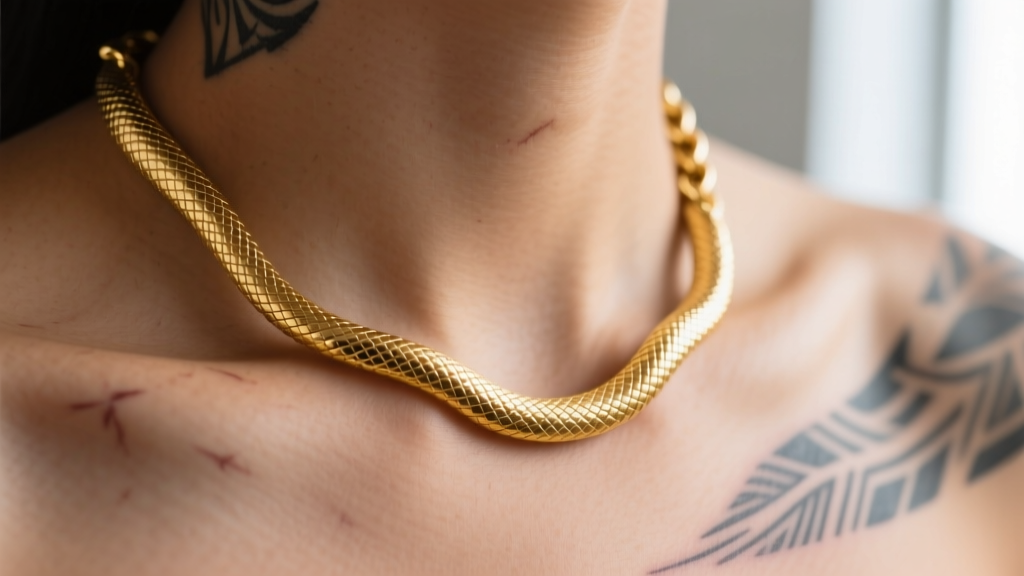
The Troubleshooting Fix: Adopt the rule of architectural minimalism. Opt for solid, unadorned metal torques, micro-polished snake chains, or sleek geometric pendants that mirror the tattoo’s angles without competing with them. A solid 14k gold or titanium collar that sits just above or below the ink boundary frames the blackwork beautifully, allowing the skin and the metal to act as mutual enhancers rather than competitors.
Friction, Snagging, and Skin Topography
Even when fully healed, heavy blackwork tattoos can leave microscopic textural changes in the epidermis. The密集的 packing of carbon-based ink can cause slight raised scarring or altered skin porosity. If you wear a necklace with interlocking links—such as a Cuban chain, rope chain, or Figaro chain—those tiny gaps and joints act like microscopic saws against the tattooed skin. Over time, this friction can cause chronic irritation, hyperpigmentation, or even damage the crisp edges of the ink.
The Troubleshooting Fix: Eliminate links entirely. Switch to seamless jewelry styles that offer a continuous, flush surface against the skin. Omega chains, snake chains, and solid hinged bangles are ideal because they glide over textured skin without catching. If you prefer a chain, ensure it is a box chain with tightly flush links and a high-polish finish to minimize drag.
Metal Reactivity on Ink-Saturated Skin
Tattooed skin is biologically different from virgin skin. When ink is deposited, dermal macrophages (immune cells) engorge themselves with the pigment and remain stationed in the area permanently. This localized immune activity can make the skin hyper-reactive to external allergens, particularly nickel ions. If a low-grade chain causes micro-abrasions on the tattooed collarbone, nickel salts can penetrate the compromised epidermis, triggering allergic contact dermatitis. According to Healthline's dermatological guidelines, this reaction can cause the tattooed area to become inflamed, itchy, and raised, sometimes mimicking an ink allergy.
| Metal Grade | Nickel Release | Friction Profile | Suitability for Tattooed Skin |
|---|---|---|---|
| ASTM F136 Titanium | Zero | Ultra-Smooth (when polished) | Excellent (Ideal for sensitive/healing skin) |
| 18k Solid Gold | Negligible | Smooth | Very Good (Hypoallergenic & non-reactive) |
| Niobium | Zero | Variable | Excellent (Highly biocompatible) |
| 316L Surgical Steel | Low-Moderate | Variable (depends on links) | Fair (Risk of contact dermatitis over time) |
| Brass/Copper Alloys | Variable | Prone to oxidation | Poor (Oxidation reacts poorly with ink macrophages) |
Length Calibration: Bypassing the "Double Choker" Effect
Polynesian necklace tattoos are frequently placed in the choker zone (14 to 16 inches). If you wear a standard 15-inch necklace directly over the tattoo, you create a messy "double choker" effect where the metal cuts awkwardly through the tribal band, obscuring the design and looking visually unbalanced. To solve this, you must apply the 3-Inch Drop Rule: your jewelry should either sit at least 3 inches above the highest point of the tattoo, or 3 inches below the lowest point.
- The Clavicle Band (14-16 inches): If your tattoo sits high on the collarbone, avoid chokers entirely. Opt for a 20-inch princess length that rests in the negative space below the ink, framing the bottom edge of the design.
- The Sternum Drop (18-22 inches): For tattoos that cascade down the chest, use a 24-inch opera length or a deep Y-chain lariat that mirrors the vertical flow of the Enata (human figure) patterns without crossing them horizontally.
- The Full Collar (12-14 inches): A tight tribal neck band requires a 30-inch rope chain or a long pendant that bypasses the collarbone entirely to prevent visual clutter.
Pendant Geometry: Complementing Tribal Motifs
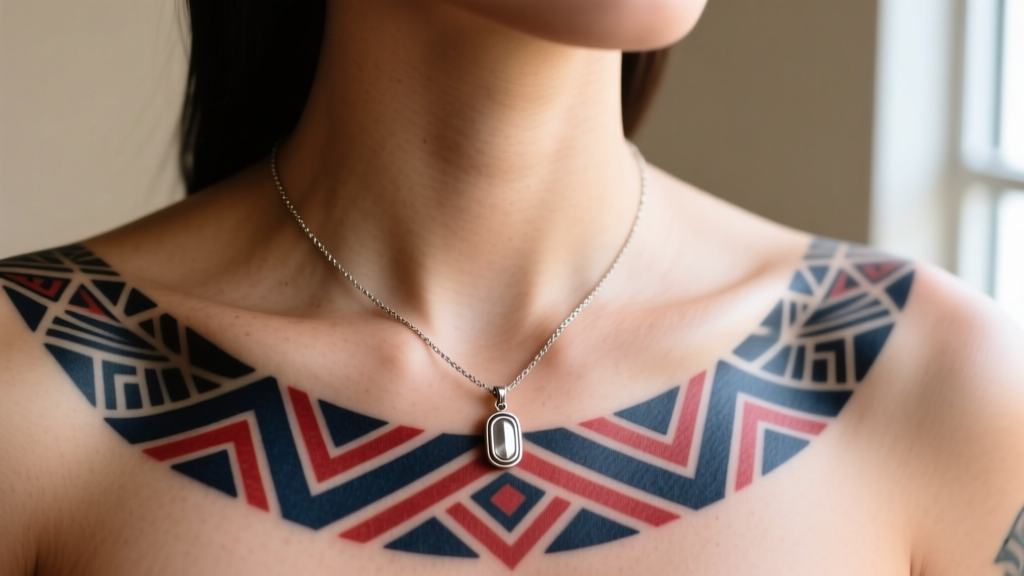
When selecting a pendant to accompany your ink, look to the specific motifs within your tattoo for geometric cues. Polynesian art is deeply symbolic, and matching your jewelry to that symbolism elevates the entire look.
If your tattoo features Niho Mano (shark teeth), which are characterized by sharp, interlocking triangles and zig-zags, choose a pendant with a sharp V-shape or a geometric triangle. The sharp lines of the metal will harmonize with the aggressive, protective energy of the shark teeth motif. Conversely, if your tattoo relies heavily on Koru (spirals) or Unaunahi (fish scales), avoid rigid geometric pendants. Instead, opt for an asymmetrical lariat or a curved, fluid metal drop that mimics the organic, flowing nature of water and new life represented by the spirals.
The Healing Phase: Strict Jewelry Prohibitions
If your Polynesian necklace tattoo is fresh, the troubleshooting protocol is simple: absolute avoidance. The American Academy of Dermatology emphasizes that healing tattoos are essentially open wounds that require meticulous care to prevent infection and ink blowout. During the first 4 to 6 weeks, the skin will weep plasma, scab, and peel. Any metal chain resting on the area will harbor bacteria, trap moisture, and physically rip away scabs, pulling ink out of the dermis and leaving permanent patchiness in your blackwork. Keep the neckline entirely bare, wear loose, breathable cotton clothing, and wait until the skin has fully regenerated its protective barrier before introducing even the highest-grade titanium jewelry back to the area.
Final Thoughts on Ink and Adornment
A Polynesian necklace tattoo is a masterpiece of cultural geometry and personal endurance. By treating your jewelry selection as an exercise in framing rather than layering, you protect both your skin’s health and the visual integrity of the art. Prioritize seamless, hypoallergenic metals, respect the negative space, and let the bold blackwork remain the undisputed focal point of your neckline.


