Troubleshooting Chain & Fit Issues Wearing Mjolnir Necklace
Solve common issues when wearing Mjolnir necklace pendants. Expert fixes for chain breakage, pendant flipping, and clasp sliding.

The Physics of the Hammer: Why Mjolnir Pendants Fail
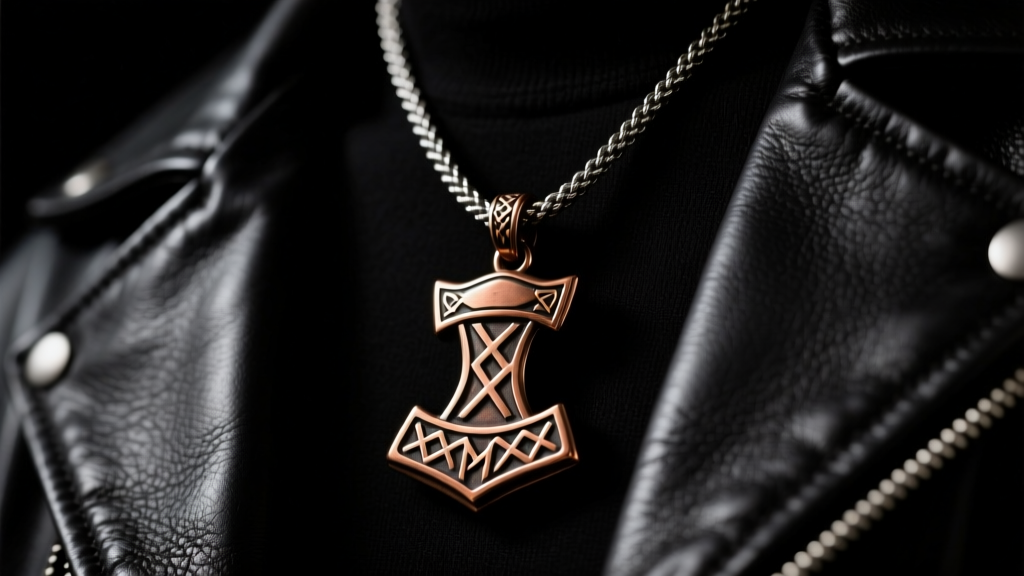
When wearing Mjolnir necklace pendants daily, enthusiasts frequently encounter a unique set of structural and ergonomic failures. Unlike standard geometric or gemstone pendants that sit flush against the sternum, the Mjolnir (Thor’s Hammer) features an inherently top-heavy, off-axis center of gravity. The handle acts as a lever, while the wide hammer head creates a pendulum effect during movement. This specific geometry generates disproportionate shear stress on the chain's weakest link—usually the clasp or the bail. Furthermore, the substantial mass of authentic cast hammers (typically ranging from 25g to over 60g) demands industrial-grade jewelry findings rather than standard commercial chains. This troubleshooting guide dissects the mechanical failures of Viking hammer pendants and provides exact, actionable engineering solutions to ensure your daily wear remains secure, comfortable, and properly oriented.
Chain Breakage: Matching Gauge to Dynamic Load
The most catastrophic failure when sporting heavy historical or Norse-inspired jewelry is chain snapping. Many buyers pair a 40-gram solid bronze or steel hammer with a standard 2.0mm cable chain. While a 2.0mm chain might support 40 grams of static dead weight in a controlled environment, it cannot withstand dynamic load. Walking, jogging, or simply leaning forward creates a whip-like kinetic force that multiplies the pendant's effective mass by up to 400%. Over time, this causes metal fatigue at the solder joints of the chain links.
To prevent catastrophic loss, you must upgrade to chains with multi-directional link structures. According to jewelry manufacturing specifications from Rio Grande, woven chains like the Spiga (wheat) distribute shear force across four interlocking links simultaneously, making them exponentially stronger than single-loop cable chains.
| Chain Type | Minimum Gauge (mm) | Max Safe Pendant Weight | Dynamic Durability |
|---|---|---|---|
| Cable / Curb | 2.5mm | 15g | Low (High Fatigue Risk) |
| Cuban Link | 3.5mm | 35g | Medium (Stiff Drape) |
| Rope Chain | 4.0mm | 50g | High (Can Fray if Snapped) |
| Wheat (Spiga) | 3.0mm - 4.0mm | 65g+ | Very High (Best for Hammers) |
The Fix: Discard any chain under 3.0mm for a Mjolnir pendant. Opt for a 3.5mm or 4.0mm Wheat chain. Crucially, ensure the jump ring connecting the clasp to the chain is soldered closed. An unsoldered jump ring will inevitably pull apart under the pendulum stress of a heavy hammer head.
The Upside-Down Hammer: Fixing Bail Friction
A universally frustrating issue is the pendant flipping upside down, leaving the hammer handle pointing toward your collarbone and the head facing up. This occurs because the bail (the loop the chain passes through) is too wide relative to the chain gauge, allowing the off-center weight of the hammer head to rotate freely until it finds its lowest center of gravity—which, ironically, is often upside down due to the handle's length.
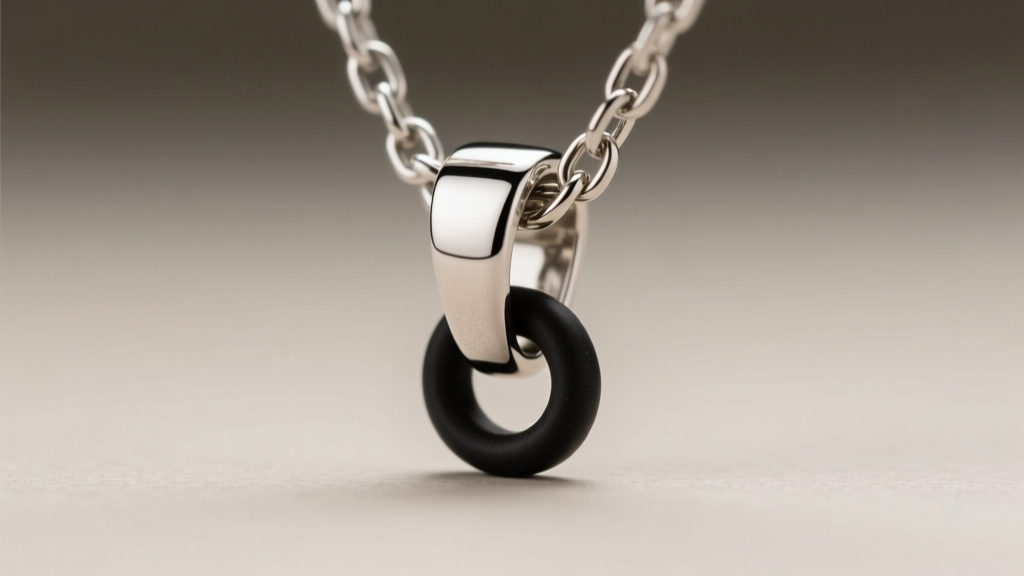
The Fix: You need to introduce friction inside the bail. Do not use glue or permanent adhesives, as these degrade with skin oils and heat. Instead, use a micro silicone O-ring. An AS568-006 silicone O-ring (1/8" Outer Diameter, 3/32" Inner Diameter, 1/64" thickness) is the exact specification required for most standard 4mm-5mm pendant bails. By stretching this O-ring over the top curve of the bail, you create a high-friction rubberized barrier that grips the metal chain. This allows the pendant to move with your body but provides enough resistance to prevent the hammer from doing a full 180-degree flip. Alternatively, if you are having a custom piece cast, request a 'European-style hidden bail' with an integrated interior silicone sleeve, or a wrap-around fixed bail that locks the pendant's orientation permanently.
The Migrating Clasp: Counterweight Solutions
If you frequently look down to find your lobster clasp resting against the side of your neck or right next to the pendant, you are experiencing the sliding clasp problem. The heavy Mjolnir pendant acts as an anchor, pulling the chain downward and forcing the lighter clasp to slide along the nape of your neck to the front of the throat. This is not just an aesthetic annoyance; it places uneven wear on one side of the chain and can cause the clasp to rub against the delicate skin of the neck.
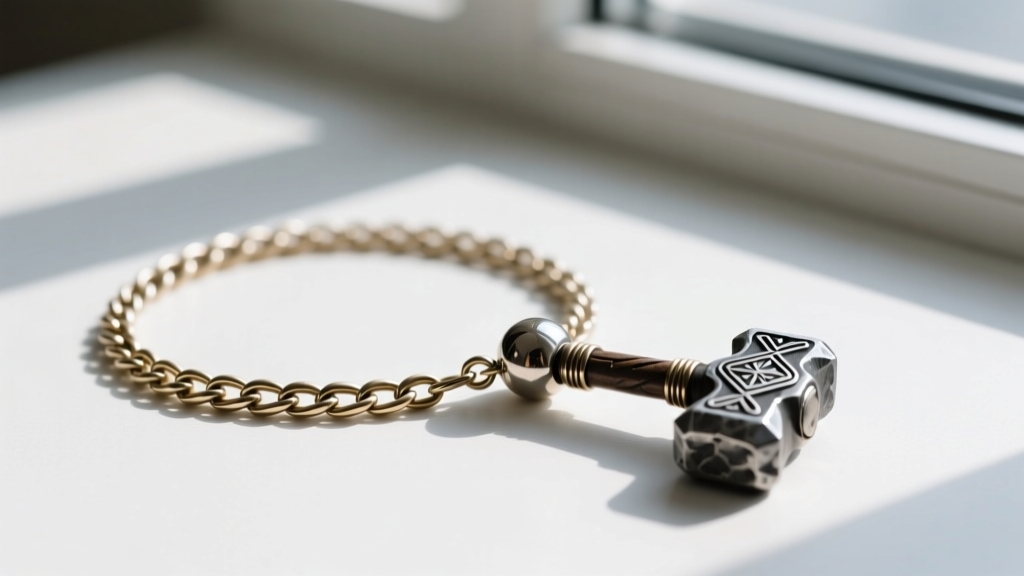
The Fix: You must balance the fulcrum of the necklace. Wholesale findings experts at Halstead frequently recommend counterweighting for heavy, asymmetrical pendants. Purchase a solid stainless steel, tungsten, or sterling silver 'counterweight bead' or 'balance charm' (typically 8mm to 12mm in diameter, weighing roughly 5-8 grams). Thread this bead onto the chain and position it exactly opposite the pendant, at the nape of the neck. Many modern chains designed for heavy pendants now come with a built-in counterweight tag attached directly to the lobster clasp. If your chain lacks this, adding a discrete tungsten bead near the clasp will anchor the back of the necklace, keeping the clasp hidden and the pendant perfectly centered on your sternum.
Metallurgy & Skin Reactions: Decoding 'Surgical Steel'
A frequent troubleshooting complaint involves skin discoloration (the 'green neck' effect) or contact dermatitis after prolonged wear. This is almost always a metallurgy failure disguised by deceptive marketing. Many mass-produced Mjolnir pendants are cast from Zamak (a zinc-aluminum-magnesium-copper alloy) and plated with a microscopically thin layer of silver or gunmetal. Once human sweat—which is highly acidic and rich in chloride salts—wears through the plating, the zinc reacts, causing severe discoloration and rashes.
Even the term 'Surgical Steel' is largely unregulated in the jewelry industry. To ensure biocompatibility and structural integrity, you must verify the exact alloy grade of your pendant and chain.
- 316L Stainless Steel: The minimum acceptable standard. The 'L' stands for low carbon, and this alloy contains 2-3% molybdenum, which specifically prevents chloride pitting and corrosion from human sweat.
- Titanium Grade 5 (Ti-6Al-4V): The ultimate upgrade for sensitive skin and extreme durability. It is 45% lighter than steel but boasts a higher tensile strength, completely eliminating chain drag and skin reactions.
- Solid 925 Sterling Silver: Excellent for detailed, artisan-cast hammers. However, silver is soft. If using a solid silver chain with a heavy steel hammer, the silver bail will act as a sacrificial anode and wear away rapidly due to galvanic friction. Always use a steel chain with a steel or titanium pendant.
The Daily Wear Troubleshooting Checklist
Before committing to daily wear, run your Mjolnir setup through this rapid diagnostic checklist to prevent loss and discomfort:
- The Pull Test: Grip the chain on either side of the bail and pull firmly outward. If the jump ring connecting the clasp shows even a millimeter of separation, it must be soldered closed by a jeweler or replaced with a welded link.
- The Bail Clearance: Ensure the interior diameter of the bail is at least 1.5mm larger than the exterior gauge of your chain to prevent micro-abrasions and metal dust buildup.
- The Orientation Check: Wear the necklace for 10 minutes while moving actively. If the hammer flips, apply the AS568-006 silicone O-ring to the bail.
- The Nape Balance: Check the back of your neck. If the clasp has migrated forward, install a 10mm metal counterweight bead to restore equilibrium.
By treating your Norse jewelry not just as an accessory, but as a mechanical system requiring proper load distribution and material compatibility, you ensure that your Mjolnir remains a permanent, trouble-free fixture of your personal style.


