Expert Guide: Turquoise Multi Strand Necklace Construction
Explore the technical anatomy of a turquoise multi strand necklace, from bead stabilization and matrix grading to stringing mechanics.

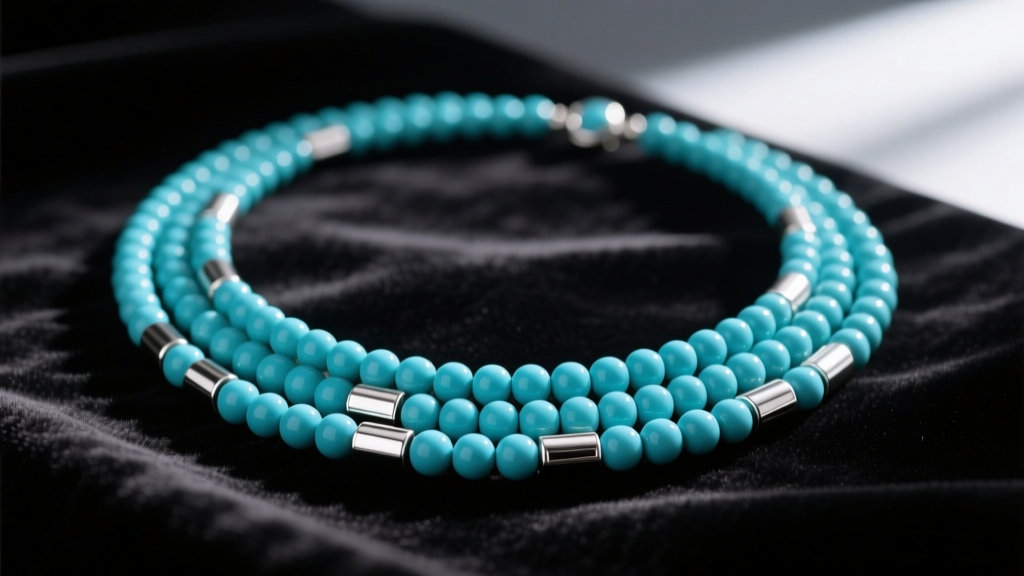
Constructing a high-quality turquoise multi strand necklace requires a mastery of both gemology and structural engineering. Unlike single-strand pendants that rely on a simple bail and chain, multi-strand pieces must manage complex weight distribution, shear stress on clasps, and the unique porosity of the turquoise itself. As of 2026, advancements in stabilization resins and micro-fused beading wires have revolutionized how jewelers approach these statement pieces, allowing for heavier, more durable designs that retain the organic beauty of the stone.
This expert deep dive dissects the technical specifications, material grades, and mechanical considerations required to design, string, and maintain a professional-grade turquoise multi strand necklace.
Gemological Grading: Natural vs. Stabilized Turquoise
The foundation of any turquoise piece lies in the Mohs hardness and porosity of the rough material. Natural, gem-grade turquoise is exceptionally rare, comprising less than 5% of all mined material. It typically registers between 5 and 6 on the Mohs scale, making it hard enough to be cut, polished, and drilled without chemical alteration. However, the vast majority of turquoise used in multi-strand necklaces is stabilized.
The Chemistry of Stabilization
Chalk or soft turquoise (Mohs 3 to 4) is too porous and fragile to withstand the drilling process required for bead-making, let alone the friction of daily wear. Stabilization involves placing the rough stone in a vacuum chamber, extracting the air from its microscopic pores, and introducing a clear epoxy resin or polymer. Under pressure, the resin penetrates the stone completely. Once cured, the turquoise becomes permanently hardened, its color is enhanced, and its porosity is sealed. According to the Gemological Institute of America (GIA), stabilization is an accepted industry practice, provided it is disclosed, as it prevents the stone from absorbing skin oils and turning green or brown over time.
Matrix Patterns and Mine Origins
When sourcing beads for a multi-strand design, gemologists look for consistency in the matrix—the host rock embedded within the turquoise.
- Sleeping Beauty: Prized for its solid, sky-blue color with little to no matrix. Ideal for uniform, classic multi-strand designs.
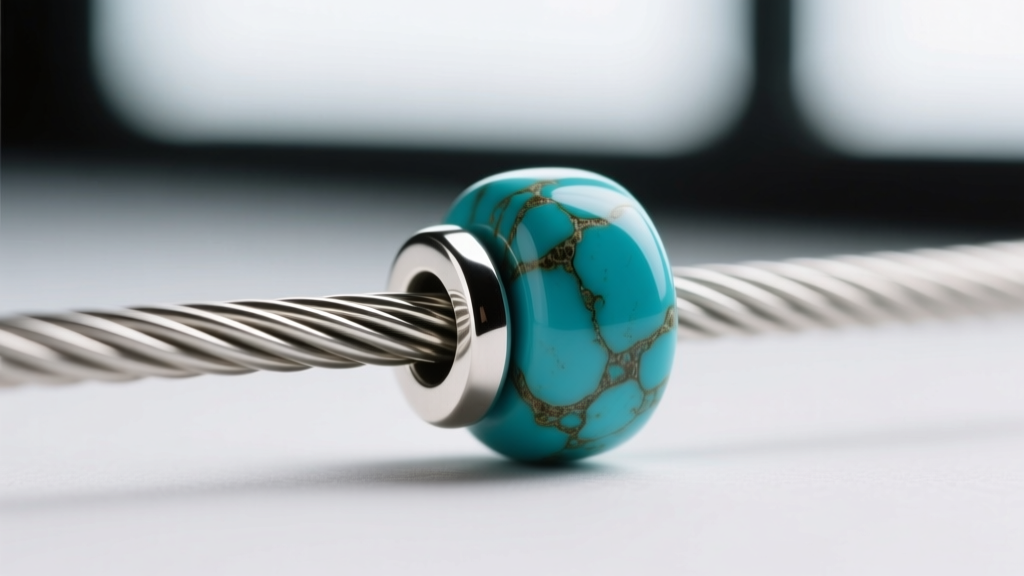
- Kingman: Famous for its deep blue color and striking pyrite (fool's gold) matrix, offering a metallic flash that pairs beautifully with sterling silver spacers.
- Royston: Known for its deep green to light blue hues with heavy, bold brown spiderweb matrix, perfect for rustic, graduated strand layouts.
Multi-Strand Stringing Mechanics
The most common point of failure in a turquoise multi strand necklace is the stringing material. Because turquoise beads are heavy and have sharp edges around the drill holes, traditional silk or nylon threads will eventually fray and snap. Modern jewelers rely on multi-strand beading wire, which consists of multiple micro-strands of stainless steel braided together and coated in a wear-resistant nylon sheath.
Wire Gauge and Tensile Strength
For a standard 3-to-5-strand turquoise necklace featuring 6mm to 8mm beads, a 49-strand micro-fused wire is the industry standard. The 49-strand configuration offers superior drape and flexibility compared to 7-strand or 19-strand alternatives, preventing the necklace from kinking when stored. According to the Soft Flex Company, a 0.018-inch diameter wire is suitable for most turquoise beads, but if the design incorporates heavy, irregular nuggets or beads larger than 10mm, stepping up to a 0.024-inch diameter wire is critical to prevent tensile failure.
| Material | Strand Count | Diameter | Tensile Strength | Best Use Case |
|---|---|---|---|---|
| Stainless Steel Wire | 49-Strand | 0.018" | 18-20 lbs | Standard 6mm-8mm turquoise rounds |
| Stainless Steel Wire | 49-Strand | 0.024" | 25-30 lbs | Heavy nuggets, large carved beads |
| Waxed Braided Nylon | N/A | 0.8mm | 15 lbs | Knotted designs with large drill holes |
| Silk Thread | N/A | Size F | 4-6 lbs | Not recommended for heavy turquoise |
Crimping and Finishing
Securing the wire requires precision. A 2x2mm sterling silver or 14k gold-filled crimp tube is standard. Using a micro-crimper tool, the tube is compressed into a crescent shape and then folded onto itself, creating a secure, rounded bead-like finish that will not abrade the adjacent turquoise bead. Always use a wire protector (French bullion) at the clasp loop to prevent the metal clasp from sawing through the nylon coating of the beading wire over time.
Clasp Engineering for Multi-Strand Weight
A multi-strand necklace concentrates the weight of three to seven individual strands onto a single closure point. Standard lobster claws and jump rings are entirely inadequate for this shear force; the jump ring will eventually pull apart, resulting in catastrophic loss of the piece.
Multi-Strand Slide Clasps
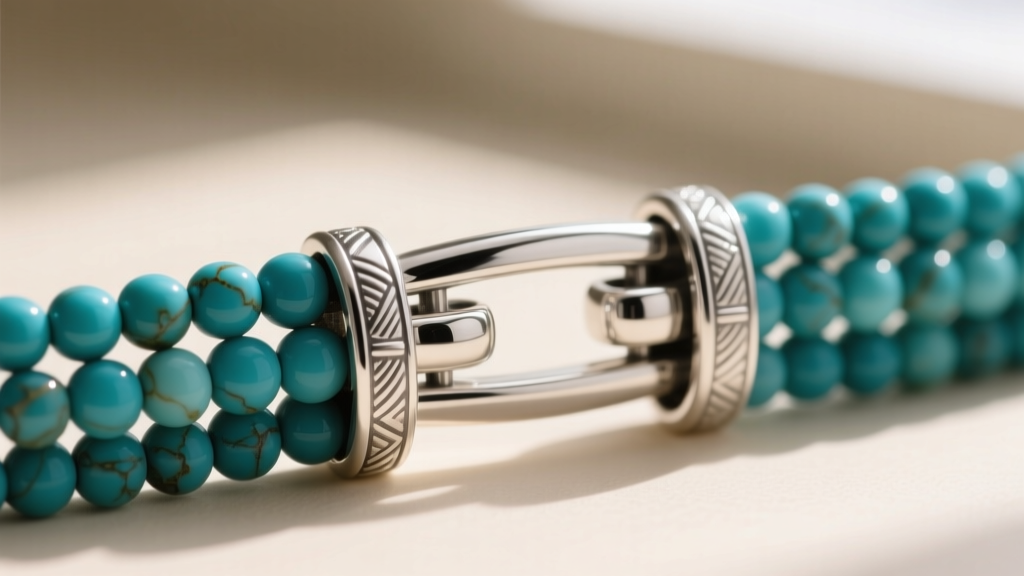
The optimal solution is a multi-strand slide clasp, typically crafted from cast sterling silver or solid 14k gold. These clasps feature parallel tubes that slide into one another. For added security in heavier designs, modern slide clasps incorporate embedded neodymium rare-earth magnets. When the tubes slide together, the magnets snap them into perfect alignment, locking the mechanism and distributing the tension evenly across the entire width of the clasp rather than a single microscopic jump ring.
Toggle Clasps and Weight Distribution
While toggle clasps are aesthetically pleasing, they present a mechanical challenge on multi-strand turquoise necklaces. If the strands are not perfectly balanced in weight and length, the uneven tension will cause the toggle bar to twist, potentially slipping through the ring. If a toggle must be used, it should be oversized (at least 1 inch in diameter) and soldered to a multi-strand separator bar to ensure even tension distribution.
Drape and Proportion Mechanics
Designing the layout of a turquoise multi strand necklace requires an understanding of concentric geometry. If all strands are cut to the exact same length, they will bunch together and fail to lay flat against the clavicle.
To achieve a flawless cascading drape, jewelers use a graduated length formula. For a 3-strand necklace, the inner strand (closest to the neck) is typically cut to 16 inches. The second strand is cut to 17.5 inches, and the outer strand to 19 inches. This 1.5-inch differential allows each strand to nest perfectly inside the next. Furthermore, utilizing 3mm to 4mm sterling silver or gold spacer tubes between the turquoise beads adds micro-weight, forcing the strands to hang with a heavy, luxurious fluidity rather than stiffening around the neck.
Care, Porosity, and Chemical Vulnerabilities
Even when stabilized, turquoise remains a relatively soft and chemically sensitive gemstone. Multi-strand necklaces, due to their high surface area and frequent contact with the décolletage, require strict maintenance protocols.
Expert Maintenance Rule: Never use ultrasonic cleaners, steam cleaners, or commercial jewelry dips on a turquoise multi strand necklace. The high-frequency vibrations can fracture the stone along its natural matrix veins, and harsh chemicals will strip the polish and degrade the epoxy resin used in stabilization.
To clean the piece, use a barely damp, lint-free microfiber cloth to gently wipe each bead individually. Avoid applying perfumes, lotions, or sunscreens before wearing the necklace, as the chemicals and lipids can build up in the crevices between the beads and the spacer tubes, eventually dulling the stone's luster and tarnishing the metal findings. Store the necklace flat in a lined jewelry box; hanging a heavy multi-strand piece for long periods can cause permanent memory kinks in the beading wire, ruining the engineered drape.


