Twisted Gold Necklace Guide: Karat & Material Properties Compared
Discover how karat purity and alloy blends affect the durability, drape, and price of a twisted gold necklace. Expert material comparison inside.

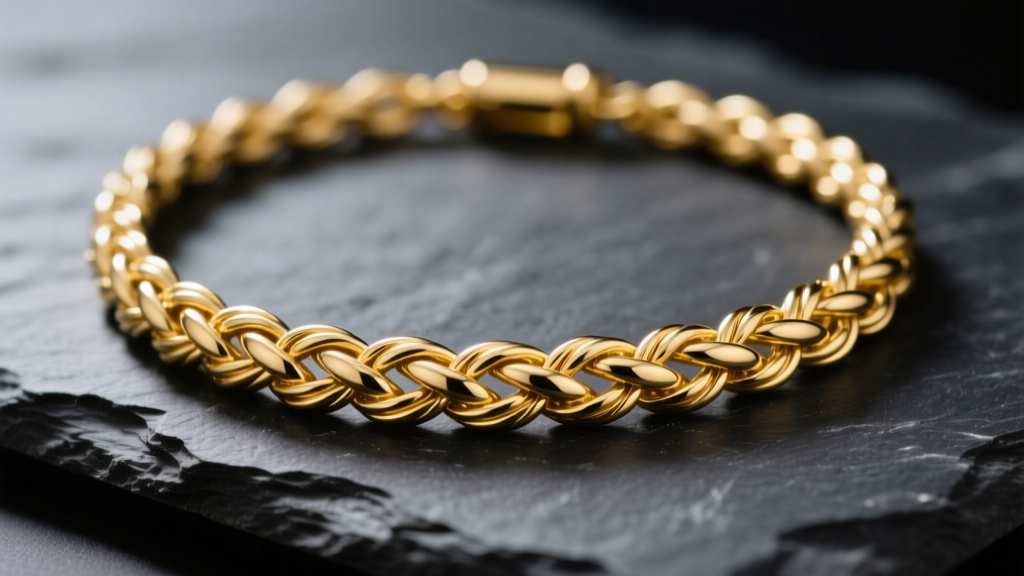
The Anatomy of a Twisted Gold Necklace
A twisted gold necklace is far more than a simple strand of precious metal; it is a feat of mechanical engineering and metallurgical art. Unlike standard cable or curb chains that rely on interlocking loops, twisted chains—such as the French rope, barleycorn, and twisted herringbone—derive their structural integrity and visual depth from torsional tension. The manufacturing process begins with a solid or semi-solid gold wire that is drawn down to a precise gauge, often as thin as 0.4mm, before being fed into a chain-making machine that applies continuous rotational force.
This twisting process work-hardens the metal, fundamentally altering its crystalline structure. As a result, the material properties of the gold alloy used dictate not just the color of the necklace, but its tensile strength, its resistance to kinking, and the way it drapes across the collarbone. Understanding these material science principles is critical for selecting a piece that will endure daily wear without succumbing to torsional fatigue.
14K vs. 18K vs. 22K: Tensile Strength & Drape
The purity of the gold, measured in karats, is the single most important variable in the performance of a twisted chain. Pure 24K gold is exceptionally malleable, boasting a Vickers Hardness (HV) of roughly 25. While this makes it ideal for cast bezels, it is disastrous for the high-tension geometry of a twisted rope chain. According to data from the Gemological Institute of America (GIA), alloying gold with metals like copper, silver, and zinc is mandatory to achieve the structural rigidity required for twisted links.
14K Gold (58.3% Pure): With a Vickers Hardness ranging from 140 to 160 HV, 14K gold is the workhorse of twisted chains. The high concentration of alloy metals creates a stiff, highly durable wire that holds the twist geometry rigidly. A 14K French rope chain will resist stretching and maintain its cylindrical profile for decades, making it the optimal choice for heavy pendants.
18K Gold (75% Pure): Sitting at approximately 120 to 130 HV, 18K gold offers a luxurious compromise. It provides a richer, deeper yellow hue and a slightly heavier, more fluid drape than 14K. However, the reduced alloy content means the chain is marginally more susceptible to torsional stretching if subjected to sudden snags.
22K Gold (91.6% Pure): At 60 to 70 HV, 22K gold is rarely used for complex twisted chains like the herringbone or omega. When it is used for simple twisted curbs, the chain will have a remarkably soft, liquid drape, but it will easily kink and deform under its own weight if stored improperly.
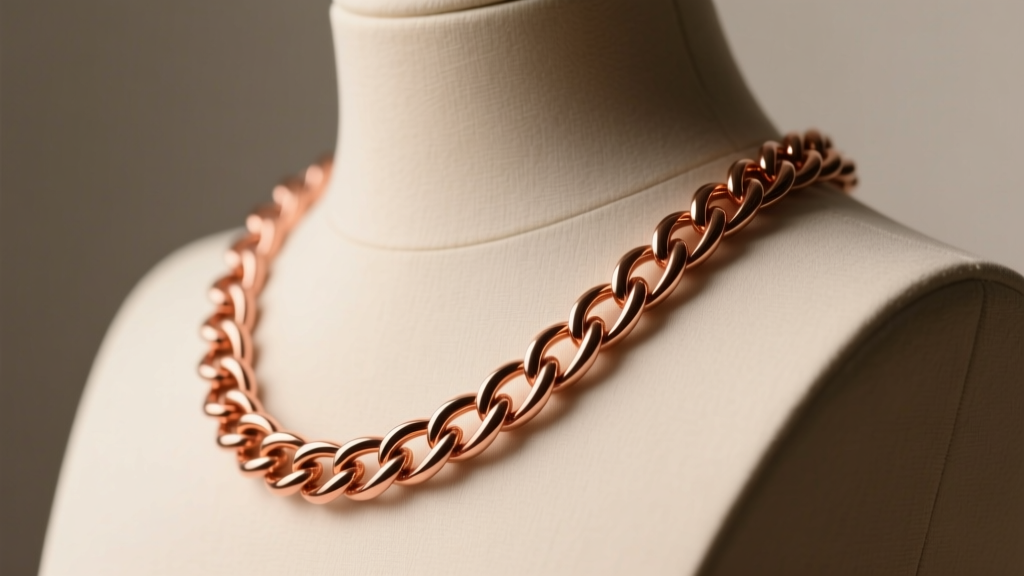
Material Property Comparison Chart
| Karat | Alloy Composition (Typical) | Vickers Hardness (HV) | Best Twist Style | Drape Characteristics |
|---|---|---|---|---|
| 14K | 58.3% Au, 25% Ag, 16.7% Cu | 140 - 160 | French Rope, Barleycorn | Stiff, structured, highly durable |
| 18K | 75% Au, 12.5% Ag, 12.5% Cu | 120 - 130 | Twisted Curb, Box Chain | Fluid, heavy, luxurious |
| 22K | 91.6% Au, 8.4% Cu/Ag | 60 - 70 | Simple Rope, Omega | Extremely soft, prone to kinking |
Alloy Blends: How Color Affects the Twist's Visual Depth
The visual impact of a twisted gold necklace relies heavily on shadow play. The deep grooves and high peaks of a twisted rope catch the light differently depending on the underlying alloy blend. The World Gold Council notes that the specific ratios of copper and silver not only dictate color but also influence the work-hardening rate during the manufacturing process.
Yellow Gold: The Classic Copper/Silver Mix
Standard yellow gold alloys utilize a balanced mix of copper and silver. In an 18K yellow gold twisted chain, this balanced alloy ensures uniform hardness across the wire. The warm, reflective nature of yellow gold maximizes the contrast between the polished peaks of the twist and the shadowed valleys, giving the necklace a three-dimensional, almost braided appearance.
Rose Gold: High Copper Content & Work Hardening
Rose gold achieves its pink hue through a significantly higher copper content (often exceeding 20% in 18K blends). Copper is a notoriously stiff metal that work-hardens very quickly. When a chainmaker twists a rose gold wire, the metal becomes brittle much faster than yellow gold. This requires the manufacturer to anneal (heat and cool) the wire more frequently during production. The resulting rose gold twisted chain is often slightly stiffer and more resistant to scratching than its yellow counterpart, but it can be more brittle if subjected to sharp impacts.
White Gold: Rhodium Plating Challenges
White gold is alloyed with nickel, palladium, or manganese to bleach the yellow color, but it almost always requires a surface plating of rhodium to achieve a bright, silvery finish. On a twisted gold necklace, the deep crevices of the rope or herringbone twist can cause the rhodium to pool or wear away unevenly. Over time, the high-friction peaks of the twist will reveal the slightly warm, underlying white gold alloy, requiring professional re-plating to maintain a uniform color.
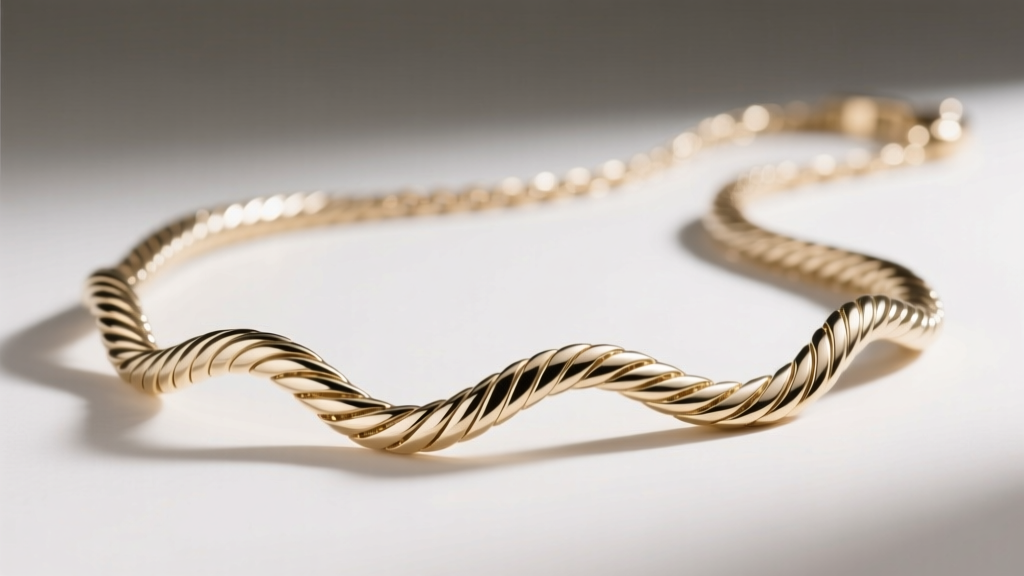
Gauge Thickness and Weight Metrics
When evaluating the material properties of a twisted chain, gauge thickness and gram weight are inextricably linked to durability. A twisted chain's width is measured in millimeters (mm), but its true strength lies in its internal density.
- Solid Core (2mm - 4mm): A 3mm solid 14K French rope weighing approximately 15 grams per 20-inch strand offers maximum tensile strength. The solid wire core prevents the chain from collapsing inward if crushed.
- Semi-Solid / Hollow Core (5mm - 10mm): To create visually massive twisted chains without the exorbitant cost of 80 grams of gold, manufacturers use hollow-core tubing. While a 6mm hollow rope may look identical to a solid one, its thin outer shell (often just 0.2mm thick) is highly susceptible to denting. Once a hollow twisted chain dents, the torsional geometry is compromised, and it cannot be easily repaired.
Expert Insight: Never pair a heavy cast pendant with a hollow-core twisted chain. The localized stress at the bail will quickly warp the thin gold tubing, leading to catastrophic failure. Always use a solid-core chain for pendants exceeding 10 grams.
Common Failure Modes in Twisted Chains
Despite their beauty, the complex geometry of twisted chains introduces specific vulnerabilities that buyers must understand to ensure longevity.
1. Kinking and Herringbone Deformation: Twisted herringbone and omega chains feature flat, tightly packed links that lay flush against the skin. Because the links are locked into a rigid, flat plane, bending the chain against its natural curve causes permanent kinks. Once the crystalline structure of the gold is fractured at the kink point, the chain loses its fluid drape and becomes a jagged, weak point prone to snapping.
2. Torsional Fatigue at the Clasp: A heavy twisted rope chain acts like a spring, storing kinetic energy as it moves. If the clasp is undersized, the constant rotational pulling will fatigue the jump ring connecting the chain to the clasp. Always ensure the jump ring is soldered closed and matches the wire gauge of the chain's end-links.
3. Snagging and Micro-Tears: The textured surface of a barleycorn or twisted curb chain is notorious for catching on knitwear and hair. When a single link snags and is pulled forcefully, the torsional tension can cause the wire to unspool slightly, creating a micro-tear that weakens the entire section.
Pricing Framework: Calculating the Manufacturing Premium
When shopping for a twisted gold necklace in 2026, it is vital to understand that you are paying for labor and machine time, not just the raw commodity. The manufacturing premium for twisted chains is significantly higher than for simple cable chains due to the multi-step drawing, twisting, and diamond-cutting processes required.
Expect to pay a 25% to 45% manufacturing premium over the daily melt value of the gold. For example, if a 20-gram 14K gold chain contains $800 worth of raw gold based on current spot prices, a high-quality, solid-core French rope will retail between $1,050 and $1,200. If a retailer is offering a heavy twisted chain at or near the raw melt value, it is almost certainly a hollow-core or electroformed chain with compromised structural integrity.
Expert Care & Maintenance
Proper maintenance of a twisted gold necklace requires an understanding of its physical crevices. The tight spirals of a rope chain trap skin oils, lotions, and environmental dust, which can dull the diamond-cut facets over time.
Avoid ultrasonic cleaners, especially for rose gold or rhodium-plated white gold twists. The high-frequency cavitation can force moisture and cleaning chemicals deep into the unpolished interior of the links, leading to hidden oxidation or plating degradation. Instead, soak the necklace in a solution of warm water and a few drops of phosphate-free dish soap for ten minutes. Use a soft horsehair detailing brush to gently sweep the grooves of the twist, following the directional spiral of the chain to avoid catching and pulling the links. Rinse with distilled water and pat dry with a microfiber cloth to preserve the alloy's natural luster.


