Authentic Ukrainian Coral Necklace: Grading, History & Care
Discover the gemological and historical details of the authentic Ukrainian coral necklace. Learn grading, bead sizing, restringing, and valuation.

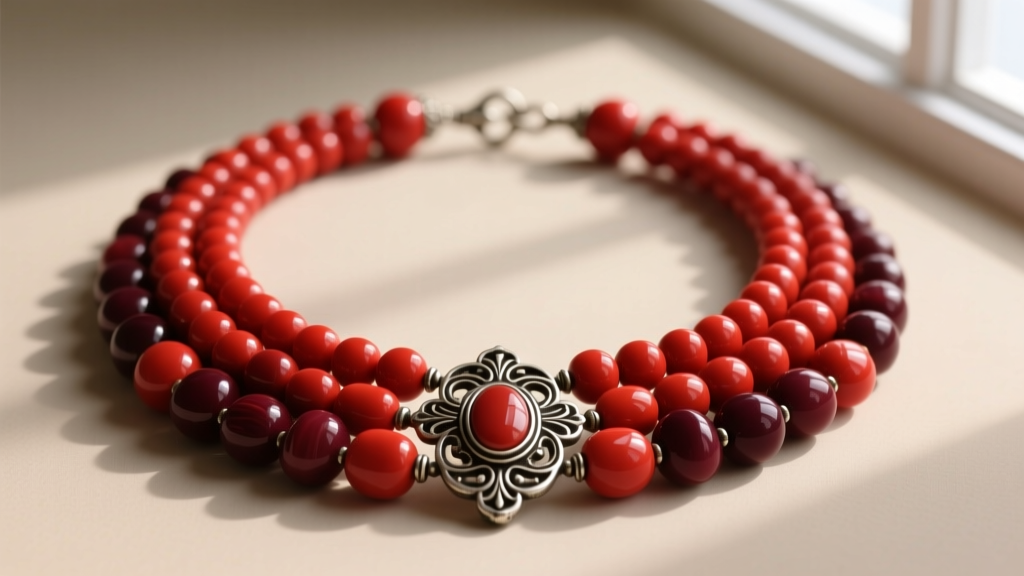
The Gemological Profile of Historical Red Coral
The traditional Ukrainian coral necklace, historically known as namysto or korali, is far more than a decorative accessory; it is a masterclass in organic gemology and cultural anthropology. To truly understand these pieces, one must first examine the material itself. Authentic antique Ukrainian strands are almost exclusively crafted from Mediterranean red coral (Corallium rubrum). Unlike the porous, chalky reef corals found in tropical waters, Corallium rubrum is a deep-sea species prized for its dense, calcareous skeleton and intense, uniform pigmentation.
From a gemological standpoint, Mediterranean red coral presents a specific gravity (SG) of 2.60 to 2.70 and a Mohs hardness of 3.5 to 4.0. Its primary chemical composition is calcium carbonate (CaCO3), which makes it highly susceptible to acidic environments. The depth of the red color—ranging from pale salmon to deep 'ox-blood'—is dictated by trace amounts of iron and organic carotenoid pigments. When evaluating an antique Ukrainian coral necklace, the saturation and uniformity of this red hue are the primary drivers of intrinsic gemological value. According to the Gemological Institute of America (GIA), the finest specimens exhibit a vitreous to waxy luster when polished, a trait heavily sought after by 19th-century Eastern European traders who imported these gems via Venice and the Ottoman Empire.
Anatomy and Architecture of the Namysto
A genuine Ukrainian coral necklace is defined by its highly specific structural architecture. These were not single-strand afterthoughts; they were multi-strand displays of wealth, with the number of strands and the diameter of the beads acting as a direct ledger of a family's socioeconomic status.
Strand Count and Graduation
Historically, necklaces featured anywhere from 3 to 15 individual strands, with odd numbers (5, 7, or 9) being culturally preferred for their talismanic properties. The beads were never uniform in size. Instead, they featured extreme graduation. The central bead (the namystyna) on the innermost strand could reach massive proportions of 15mm to 20mm in diameter, tapering down to 3mm or 4mm near the clasp. This required immense skill from the original lapidaries, who had to shape and drill the brittle calcium carbonate without causing micro-fractures.
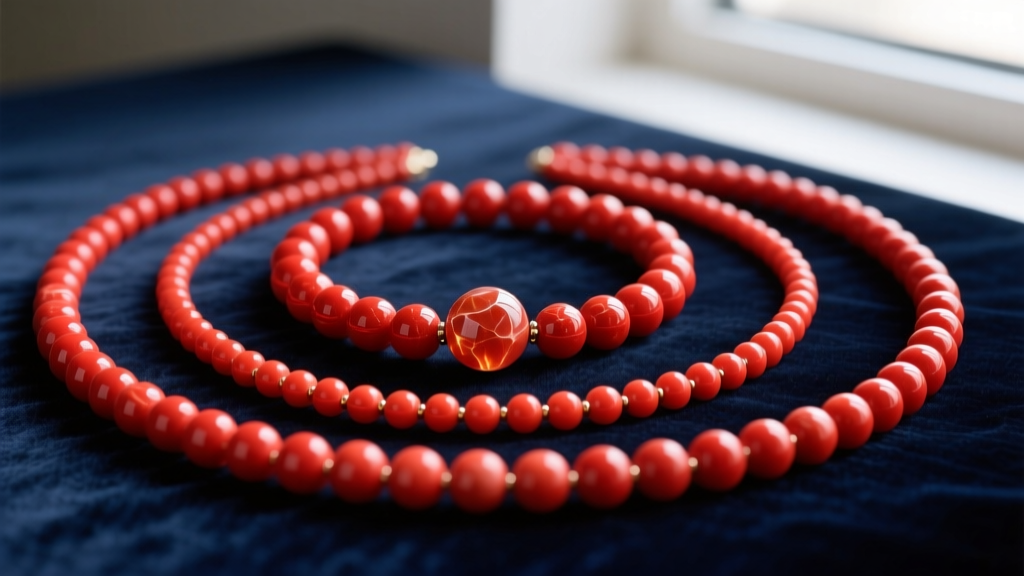
Clasps and the Duka Pendant
The termination of the strands is another critical authentication marker. Antique pieces rarely feature modern spring-ring clasps. Instead, they utilize custom-fabricated barrel clasps, slide tubes, or intricate filigree boxes crafted from 800 or 900-coin silver, often bearing Austro-Hungarian or Russian Imperial hallmarks. Furthermore, the central strand frequently features a duka—a large, ornate silver coin (such as a Maria Theresa thaler) or a cast silver medallion suspended directly below the central coral bead. The integration of the duka adds significant numismatic and historical weight to the overall appraisal.
Authentication Matrix: Genuine vs. Imitation
As the value of antique Eastern European jewelry has surged, the market has been flooded with highly deceptive imitations. Distinguishing genuine Corallium rubrum from synthetics requires a systematic approach. Below is a technical comparison matrix utilized by appraisers to verify authenticity.
| Diagnostic Test | Genuine Red Coral | Dyed Howlite / Magnesite | Glass / Paste | Plastic / Resin |
|---|---|---|---|---|
| Specific Gravity (SG) | 2.60 - 2.70 | 2.50 - 2.60 | 3.00 - 4.50 | 1.05 - 1.50 |
| Mohs Hardness | 3.5 - 4.0 | 3.0 - 3.5 | 5.5 - 7.0 | 1.5 - 2.5 |
| 10x Loupe Inspection | Subtle wood-grain or striation patterns | Concentrated dye in surface cracks | Gas bubbles, swirl marks, mold seams | Flow lines, perfect uniformity |
| Hot Point Test | Smells faintly of burning hair/shell | No reaction or faint chemical smell | No reaction | Acrid, melting plastic odor |
| Dilute HCl Acid Test | Vigorous effervescence (bubbling) | Slow effervescence | No reaction | No reaction |
Note: The acid test is destructive and should only be performed on an inconspicuous area, such as the edge of a drill hole, by a trained gemologist.
Technical Preservation and Restringing Protocols
Because calcium carbonate is inherently porous and chemically reactive, preserving an antique Ukrainian coral necklace requires strict environmental controls. The beads are highly vulnerable to the lactic acid and salts present in human sweat, which can degrade the polish over time, leaving the coral with a dull, chalky appearance. Ultrasonic and steam cleaners are strictly prohibited, as the high-frequency vibrations will exploit natural micro-fissures, leading to catastrophic bead failure.
Restringing Specifications
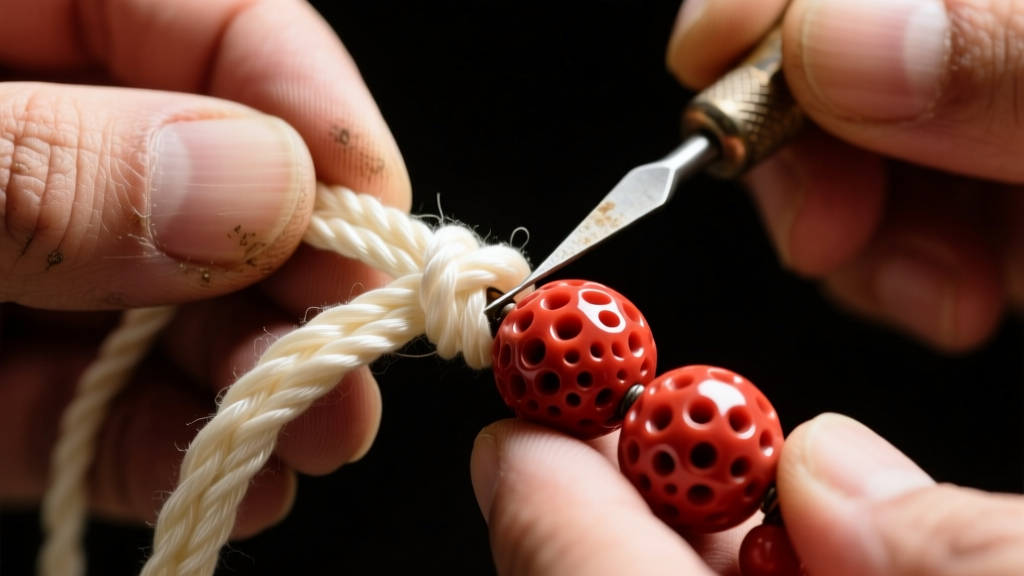
When an antique strand requires restringing, modern synthetic wires or monofilaments must be avoided. The sharp edges of the antique drill holes will eventually saw through rigid wires, and the lack of flexibility places undue stress on the bead rims. The industry standard for restringing high-value coral is 100% natural silk cord. For beads with drill holes ranging from 1.5mm to 3.0mm, a Griffin Silk cord in size No. 6 (0.70mm) or No. 8 (0.80mm) is recommended.
Crucially, the beads must be individually knotted. Knotting serves two purposes: it prevents the beads from grinding against one another, and in the event of a strand break, it ensures that only a single bead is lost rather than the entire strand. At the clasp termination, the silk must be protected from abrasion using French wire (bullion) or a flexible wire guard, as the friction against a silver clasp loop will sever raw silk within months of daily wear. For comprehensive historical context on how these garments and jewels were maintained regionally, The Ukrainian Museum archives offer extensive documentation on traditional textile and jewelry conservation.
Market Valuation and Sourcing Realities
The valuation of an authentic Ukrainian coral necklace in the current market is dictated by four pillars: bead integrity, color saturation, strand count, and the presence of hallmarked silver components. Due to stringent CITES regulations and Mediterranean harvesting bans, the supply of high-grade, large-diameter Corallium rubrum is effectively frozen, making antique strands highly liquid assets.
- Entry-Level (3 Strands, 5-8mm max bead): $400 – $800. Often features minor pitting or color inconsistencies.
- Mid-Tier (5 to 7 Strands, 10-14mm max bead): $1,200 – $3,500. Excellent color saturation, intact original silver barrel clasps.
- Museum/Collector Grade (9+ Strands, 15mm+ max bead, Duka pendant): $5,000 – $12,000+. Flawless ox-blood color, verified Austro-Hungarian silver hallmarks, and documented regional provenance.
When sourcing, buyers must demand a gemological report verifying the species as Corallium rubrum and explicitly stating that no evidence of artificial dyeing is present. The allure of the Ukrainian coral necklace lies not just in its striking visual impact, but in its survival as a meticulously engineered artifact of organic gemology and Eastern European heritage.


