How to Untangle Tangled Necklaces Without Breaking Chains
Learn how to safely untangle tangled necklaces using expert jeweler techniques, proper lubricants, and preventative storage methods.

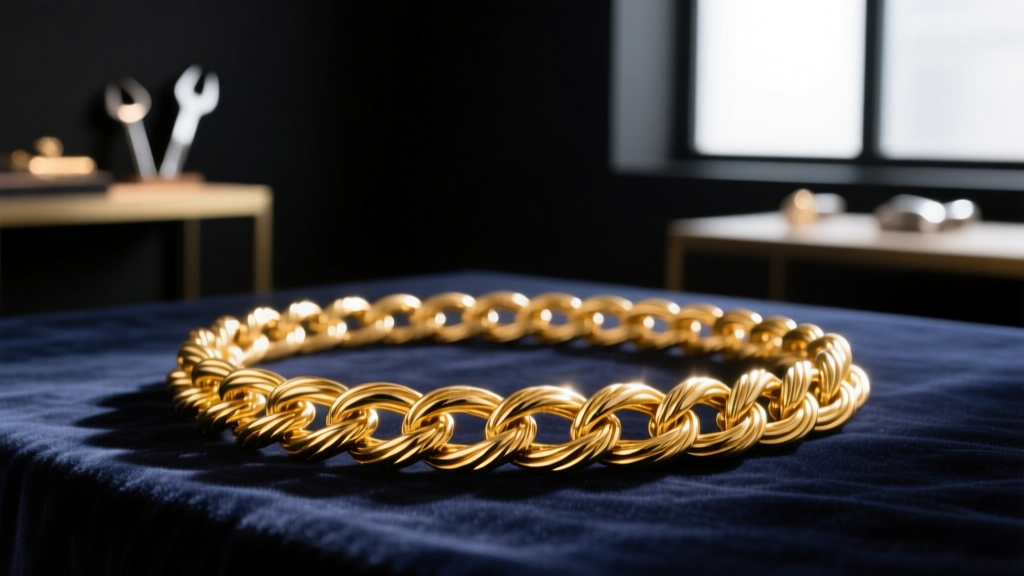
There are few things more frustrating in jewelry care than reaching for your favorite pendant only to find a chaotic bird's nest of metal. Tangled necklaces are a universal annoyance, but treating them with impatience or the wrong tools can result in stretched links, work-hardened metal, and permanent structural damage. Whether you are dealing with a micro-thin 0.8mm sterling silver chain or a heavy 18k gold box chain, understanding the mechanics of the knot is the first step toward a safe resolution.
In this comprehensive troubleshooting guide, we will explore the physics behind why certain chain styles tangle more frequently, the exact jeweler-grade tools and lubricants required to loosen stubborn micro-knots, and the preventative storage protocols you need to implement to keep your collection pristine.
The Physics of Chain Tangles: Why Delicate Links Knot
To effectively solve the problem of tangled necklaces, you must first understand how they form. In 2007, physicists Dorian Raymer and Douglas Smith published a landmark paper in the Proceedings of the National Academy of Sciences detailing the spontaneous knotting of agitated strings. They proved that when a flexible chain is subjected to random motion (like tumbling in a purse or a jewelry box drawer), the free ends weave through the coils, creating complex knots in a matter of seconds.
However, in jewelry, the geometry of the chain link plays a massive role in susceptibility. Chains with rigid, geometric links—such as box chains or certain cable chains—act like microscopic grappling hooks. When the sharp 90-degree corners of a box link catch the interior of an adjacent link, a slipknot forms. Conversely, chains with smooth, continuous curves, such as rope, wheat, or snake chains, allow the links to glide past one another, drastically reducing the friction that leads to knotting.
Furthermore, the gauge (thickness) of the chain dictates the severity of the tangle. Chains measuring between 0.8mm and 1.5mm are in the "danger zone." They are thin enough to easily slip through their own links, yet thick enough to possess the structural rigidity that makes pulling the knot tight incredibly difficult without specialized tools.
The Jewelry Box Toolkit: What You Actually Need
Most people reach for their fingers when faced with tangled necklaces, but the natural oils, friction, and blunt force of human fingertips often compact the knot further. To troubleshoot a severe tangle, you need a precision toolkit.
Precision Piercing Tools
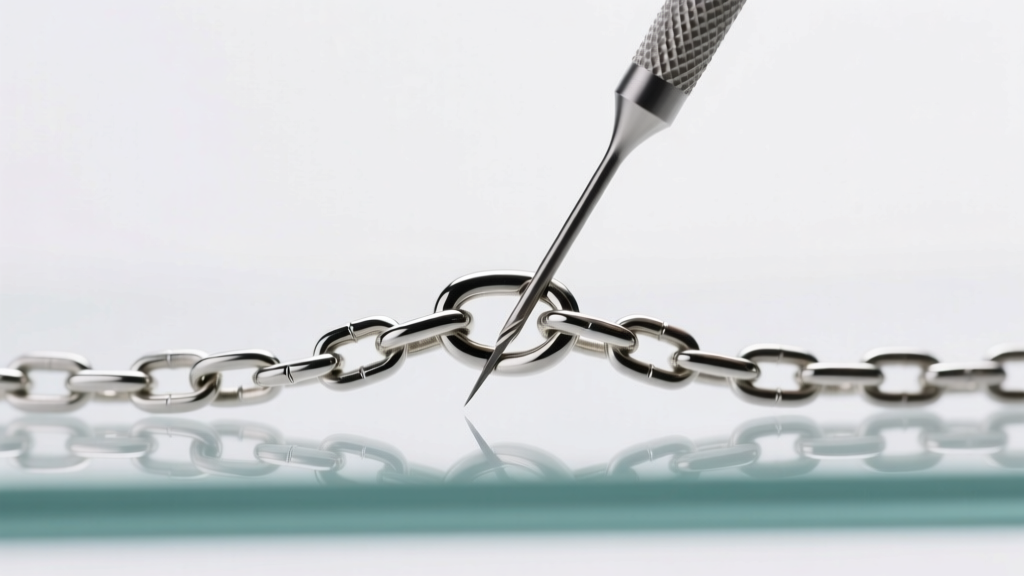
Forget standard sewing needles. A standard size 9 "between" needle is approximately 0.7mm thick, which is too blunt to penetrate a tightened micro-knot on a 1.0mm chain. Instead, use a 0.3mm stainless steel precision pin, a specialized jewelry knot picker, or the fine tip of a digital caliper. You need a tool that can slide into the microscopic gap between two compressed links without scratching the metal.
Jewelry-Safe Lubricants
Friction is the enemy of untangling. You must introduce a slip agent to the knot. However, you must choose your lubricant based on the materials present in the necklace:
- Baby Oil (Mineral Oil): Excellent for plain gold, platinum, and sterling silver chains. It provides high viscosity and excellent slip. Warning: According to the Gemological Institute of America (GIA), porous gemstones like pearls, opals, turquoise, and emeralds can be permanently stained or structurally compromised by mineral oils. Keep oil strictly away from gemstone settings.
- Graphite Powder: The ultimate dry lubricant. If your tangled necklace features delicate pearls or porous gems, gently rub a standard 2B pencil lead over the knot. The graphite dust will work its way between the links, providing frictionless slip without the risk of oil stains.
- Diluted Dish Soap (Dawn): A safe middle-ground for chains with non-porous gemstones (like diamonds or sapphires). Mix one drop of Dawn with a teaspoon of warm water and apply with a cotton swab.
Step-by-Step Troubleshooting for Stubborn Knots
When confronted with a severe cluster of tangled necklaces, follow this exact jeweler-approved protocol to avoid metal fatigue and link distortion.
Step 1: Isolate and Flatten
Never attempt to untangle a necklace while it is suspended in the air or resting in a padded box. Place the chain on a hard, flat, non-porous surface like a glass cutting board or a polished granite countertop. The hard surface provides resistance, preventing the knot from shifting and tightening as you work.
Step 2: The "Shake and Slide" Loosening
Before introducing tools, gently tap the knot with the flat side of your precision pin. Do not pry. Tapping vibrates the links, often allowing the tension to release slightly. Apply your chosen lubricant (e.g., a single drop of mineral oil via a toothpick) directly to the center of the knot.
Step 3: The Two-Pin Expansion Technique
Insert your 0.3mm precision pin into the center link of the knot. Insert a second pin into an adjacent link. Gently push the pins away from each other in opposite directions. You are not trying to pull the chain out of the knot; you are trying to expand the internal diameter of the knot itself. Once the center links are loosened, work your way outward in a spiral pattern.
Step 4: Addressing Work-Hardening
If a gold or silver chain has been tangled for months, the metal at the stress points may have become "work-hardened." This means the crystalline structure of the metal has become brittle from sustained tension. If the chain feels stiff or springs back when you try to loosen it, stop immediately. Apply gentle heat using a hairdryer on a low setting for 15 seconds. This mild thermal expansion can slightly relax the metal's tension, allowing the lubricant to penetrate deeper.
Chain Link Tangle Susceptibility Chart
Not all chains are created equal. Use this reference chart to understand the inherent risks associated with different chain styles and plan your storage accordingly.
| Chain Style | Tangle Risk | Primary Failure Mode | Best Untangling Lubricant |
|---|---|---|---|
| Box Chain | Very High | Geometric corners catch adjacent links; severe kinking. | Mineral Oil or Graphite |
| Cable Chain | High | Oval links slip through one another, creating tight slipknots. | Diluted Dish Soap |
| Herringbone | Low (Tangle) / High (Kink) | Does not tangle easily, but bends and kinks permanently. | N/A (Requires professional rolling) |
| Rope Chain | Low | Twisted links glide past each other; rare severe knotting. | Mineral Oil |
| Snake Chain | Low (Tangle) / High (Kink) | Smooth exterior prevents tangling, but internal structure crushes. | N/A (Avoid bending entirely) |
| Wheat Chain | Very Low | Interlocking figure-eight links prevent internal slipping. | Graphite Powder |
Preventative Storage & Maintenance Protocols
Troubleshooting tangled necklaces is a reactive measure. True jewelry care requires proactive prevention. As noted by Jewelers of America, proper storage is the single most effective way to extend the lifespan of delicate chainwork.
The Anti-Tangle Straw Method
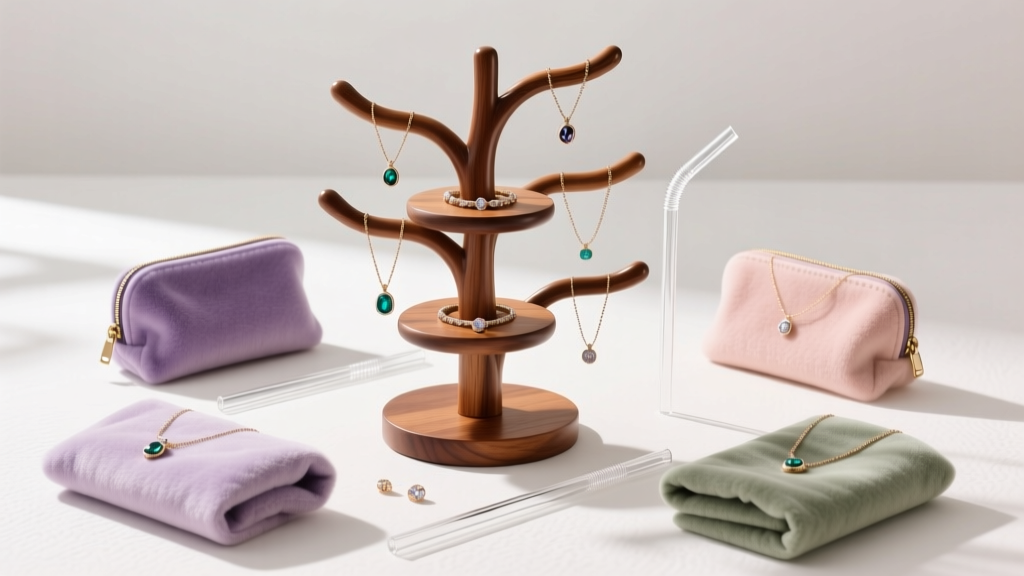
For chains under 2.0mm, the "straw trick" is an industry-standard travel hack. Unclasp the necklace, thread one end through a standard plastic drinking straw, and re-clasp it. The rigid plastic tube prevents the chain from coiling in on itself, making spontaneous knotting physically impossible during transit.
Individual Flannel Pouches
Never store multiple necklaces in a single compartment. The agitation of a drawer opening and closing provides the exact kinetic energy required to form knots. Store each necklace in an individual, anti-tarnish flannel pouch. The soft nap of the flannel creates high surface friction against the metal, preventing the chain from sliding and coiling even if the pouch is moved.
The Clasp-and-Drape Technique
If using a multi-tier necklace tree or a wall-mounted jewelry organizer, always ensure the clasp is securely fastened before hanging. An open clasp acts as a hook, catching on passing chains and guaranteeing a tangle. Furthermore, ensure the chain is fully draped over the hook without any twisted links at the apex, which can cause long-term stretching.
When to Seek Professional Jeweler Intervention
While most tangles can be resolved at home with patience and the right tools, there are specific scenarios where DIY troubleshooting becomes dangerous to the integrity of the jewelry.
1. The "Deadlock" Knot: If a box or cable chain has been pulled tight under heavy weight (e.g., caught on a doorknob and yanked), the links may be compressed beyond the yield strength of the metal. Forcing these links apart with pins will shear the metal or warp the links permanently. A professional jeweler can use microscopic mandrels and specialized lubricants to massage the links back into shape.
2. Gemstone Proximity: If the knot has migrated directly beneath a delicate gemstone setting (such as a tension set diamond or a bezel-set opal), the pressure of the knot can warp the bezel or crack the stone. Do not apply force. Take it to a professional who can untangle the chain while the stone is protected in a setting block.
3. Visible Micro-Fractures: Inspect the links at the center of the knot using a 10x jeweler's loupe. If you see any hairline cracks or notice that the metal has thinned significantly at the stress point, stop immediately. The chain requires laser welding to reinforce the link before it can be safely manipulated.
By understanding the mechanics of your chains, utilizing precision tools, and implementing strict storage protocols, you can eliminate the frustration of tangled necklaces and ensure your pendants remain ready to wear at a moment's notice.


