Expert Guide: Choosing the Right Necklace to Wear With V Neck Dress
Master the geometry of décolletage. Learn exact chain lengths, metal grades, and pendant weights for the perfect necklace to wear with v neck dress.

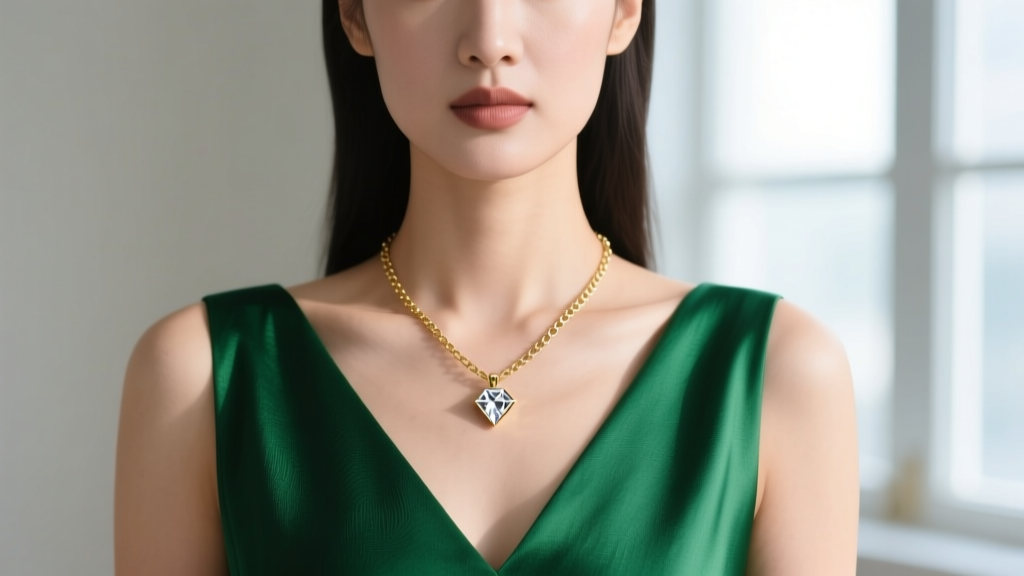
Selecting the ideal necklace to wear with v neck dress options requires more than a cursory glance at a jewelry box. The V-neck silhouette creates a distinct geometric void—a downward-pointing triangle that draws the eye directly to the décolletage. Most style guides offer superficial advice, such as "wear a Y-necklace" or "match the plunge." However, as a technical jewelry stylist, I approach this pairing through the lenses of spatial geometry, metallurgical skin interactions, and mechanical weight distribution. In 2026, with the rise of complex mixed-metal layering and advanced fabric weaves, understanding the physics of how a chain drapes across a V-neckline is essential for achieving a flawless, high-end aesthetic.
The Geometry of the V-Neck Plunge
The fundamental error most make is ignoring the exact angle and depth of the V-neck. A standard V-neck typically drops 3 to 4 inches below the sternal notch (the base of the throat). A deep V or plunge neckline extends 6 to 10 inches down. The necklace must act as a visual anchor, not a competing boundary line.
The "Rule of Parallelism" dictates that the bottom curve or point of your pendant should run parallel to, or slightly bisect, the angle of the dress's V. If the dress features a sharp, narrow 45-degree V, a linear bar pendant or a sharp marquis-cut gemstone mirrors the geometry beautifully. Conversely, a wide, sweeping scoop-V demands a curved, U-shaped lariat or a cluster pendant to soften the negative space. According to the Gemological Institute of America (GIA), the visual weight of a gemstone pendant should be proportional to the negative skin space it occupies; a massive 40-carat pendant in a narrow V-neck creates a claustrophobic, unbalanced look, whereas a delicate 2mm solitaire gets entirely swallowed by a wide plunge.
Exact Chain Lengths & Pendant Drops
To engineer the perfect drape, you must measure the dress first. The ideal necklace length is calculated by measuring from the collarbone to the absolute lowest point of the V-neck, then adding 1.5 inches. This ensures the chain rests gently on the fabric or skin without being pulled taut by the garment's tension.
| V-Neck Classification | Drop Depth (Inches) | Optimal Chain Length | Pendant Weight Limit | Recommended Chain Style |
|---|---|---|---|---|
| Standard / Conservative | 3" - 4" | 16" - 18" (Princess) | 5g - 12g | Cable, Bead, or delicate Box |
| Deep V / Evening | 5" - 7" | 20" - 22" (Matinee) | 15g - 25g | Rope, Figaro, or Curb |
| Plunge / Avant-Garde | 8" - 10"+ | 24" - 28" (Opera/Lariat) | 30g+ (Counter-weighted) | Snake, Wheat, or heavy Box |
Metallurgy & Skin Chemistry at the Décolletage
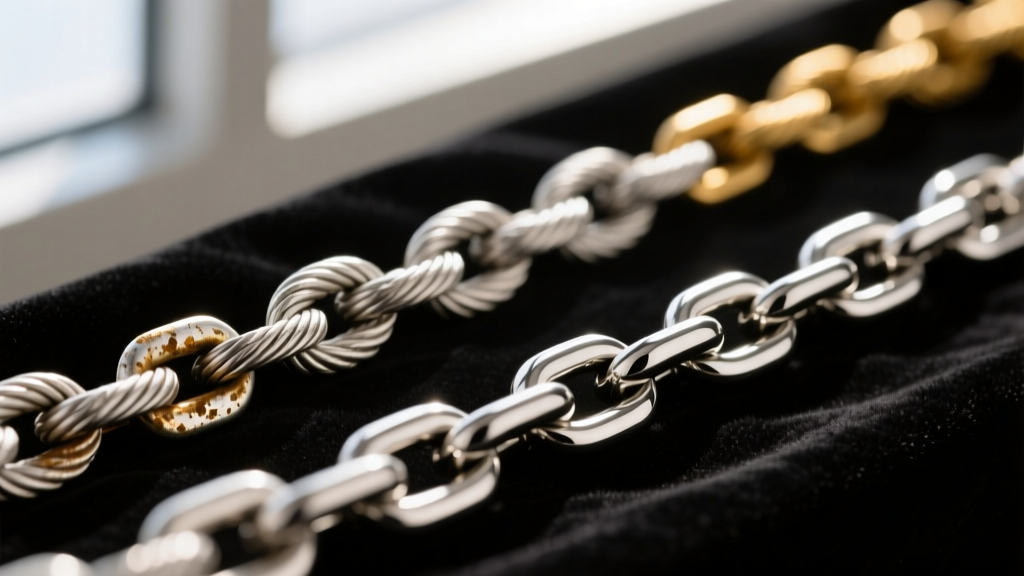
The décolletage is a high-friction, high-moisture environment. The density of sebaceous glands on the chest, combined with the trapping of body heat by dress fabrics, creates an accelerated environment for galvanic corrosion and metal oxidation. When choosing the necklace to wear with v neck dress ensembles for extended events, metal grade is non-negotiable.
- 925 Sterling Silver: Prone to rapid tarnishing when exposed to the slightly acidic pH (typically 4.5 to 5.5) of chest sweat. If wearing silver, ensure it is heavily rhodium-plated. Unplated silver will leave a greenish-black sulfide residue on the skin within 4 hours of heavy perspiration.
- 316L Surgical Steel: An exceptional, hypoallergenic alternative for fashion jewelry. The "L" denotes low carbon, and the alloy contains molybdenum, which resists chloride corrosion from sweat. Nickel release is strictly capped at <0.5 µg/cm²/week, making it safe for sensitive skin.
- 14k and 18k Gold Alloys: Pure 24k gold is too soft (Vickers hardness of ~25 HV) for structural chain links. 14k gold (58.5% gold, alloyed with copper and silver) offers a Vickers hardness of ~130 HV, providing the necessary tensile strength to hold a pendant without stretching. However, high-copper 14k rose gold can oxidize against acidic skin, so a clear nano-ceramic coating (increasingly standard in 2026) is recommended for rose gold plunge necklaces.
For verified hallmarking and precious metal purity standards, always cross-reference guidelines from authoritative bodies like the Sheffield Assay Office or local equivalent institutions to ensure your gold alloys are properly mixed and won't degrade against the skin.
Fabric Interaction & Static Mechanics
The material of your V-neck dress dictates the texture of your chain. This is a frequently overlooked technical failure point. If you are wearing a delicate silk charmeuse or chiffon V-neck, avoid snake chains and intricate rope chains. The micro-crevices in these chain styles act like microscopic saw blades, catching and pulling delicate silk threads, leading to irreversible fabric snags. For silk, opt for a polished, seamless box chain or a smooth, solid herringbone chain that glides over the fibers. Conversely, heavy crepe, wool-blend, or structured satin V-necks generate static electricity. Thin, lightweight chains will cling statically to the dress, ruining the drape. To combat this, increase the gram weight of the chain. A chain weighing over 15 grams possesses enough kinetic mass to overcome the static cling of winter-weight fabrics, maintaining a clean, vertical drop.
Bail Aperture & Weight Distribution
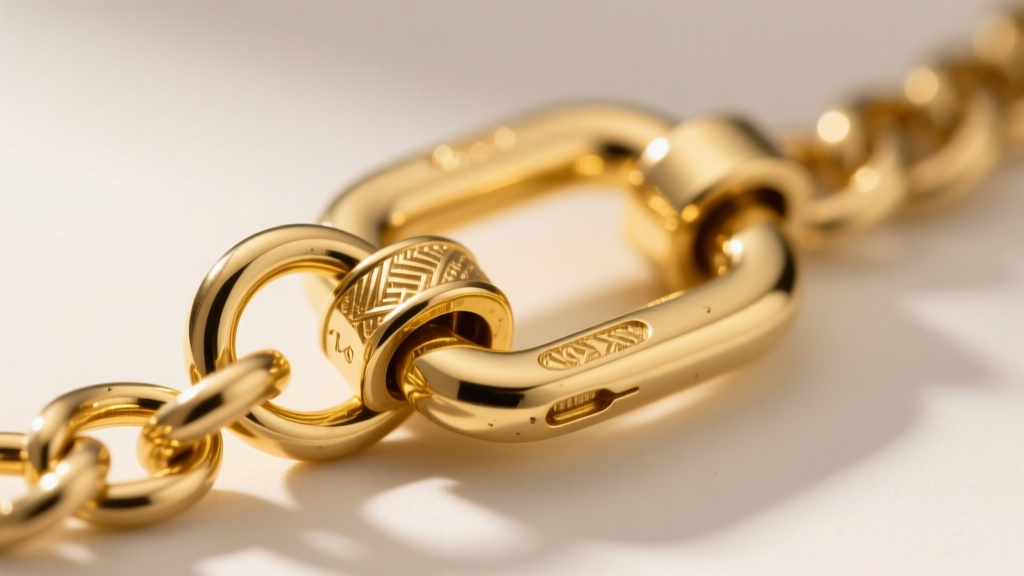
The bail—the loop that connects the pendant to the chain—is the most common point of mechanical failure. A heavy pendant on a V-neck dress swings with a high moment of inertia as the wearer moves. If the bail's inner diameter is too tight against the chain, the resulting friction will cause micro-abrasions, eventually snapping the chain links.
The 1.5x Bail Rule: The inner width of the pendant bail must be at least 1.5 times the diagonal width of the chain link. For example, if you are using a 2.5mm box chain, the bail aperture must be a minimum of 3.75mm to allow the chain to articulate freely without binding. Furthermore, for pendants exceeding 20 grams, a standard soldered ring bail is insufficient. You must upgrade to a "pinch bail" or a heavy-duty "tube bail" with reinforced walls to distribute the sheer stress across a wider surface area of the chain.
Clasp Mechanics: Preventing the "Flip-Over"
Nothing ruins the aesthetic of a carefully curated V-neck pairing faster than a pendant flipping backward, hiding the gemstone and exposing the flat back of the setting against the skin. This occurs when the center of gravity of the pendant is poorly calibrated against the chain's flexibility.
To solve this, utilize a counter-weighted bail or a swivel lobster clasp. A standard spring-ring clasp is entirely inadequate for V-neck pendants over 10 grams; the internal 0.4mm steel spring will fatigue and fail under the dynamic load of walking and dancing. A swivel lobster clasp allows the chain to rotate 360 degrees independently of the clasp mechanism, preventing the torsional twisting that causes the chain to bunch up at the back of the neck and pull the pendant sideways. Ensure the lobster clasp is forged from the same karat gold as the chain to prevent bimetallic galvanic corrosion at the connection point.
Troubleshooting Common V-Neck Failures
Problem: The pendant keeps sliding up the side of the V-neck, resting on the collarbone instead of the center plunge.
Technical Fix: The chain is too long and too light. Shorten the chain by 1 inch and add a 2mm silicone "necklace spacer" bead at the exact nape of the neck to increase friction against the skin, anchoring the chain and forcing the pendant to drop into the geometric center of the V.
Mastering the technical specifications of chain gauge, metal hardness, and spatial geometry elevates your styling from guesswork to precision engineering. By respecting the physics of the drape and the chemistry of the skin, the perfect necklace to wear with v neck dress silhouettes will remain secure, untarnished, and visually striking from the first toast to the final dance.


