Real vs Fake Van Cleeg Necklace: Van Cleef Alhambra Guide
Searching for a Van Cleeg necklace? Our expert guide details how to authenticate real Van Cleef Alhambra pieces, covering stone grades and hallmarks.

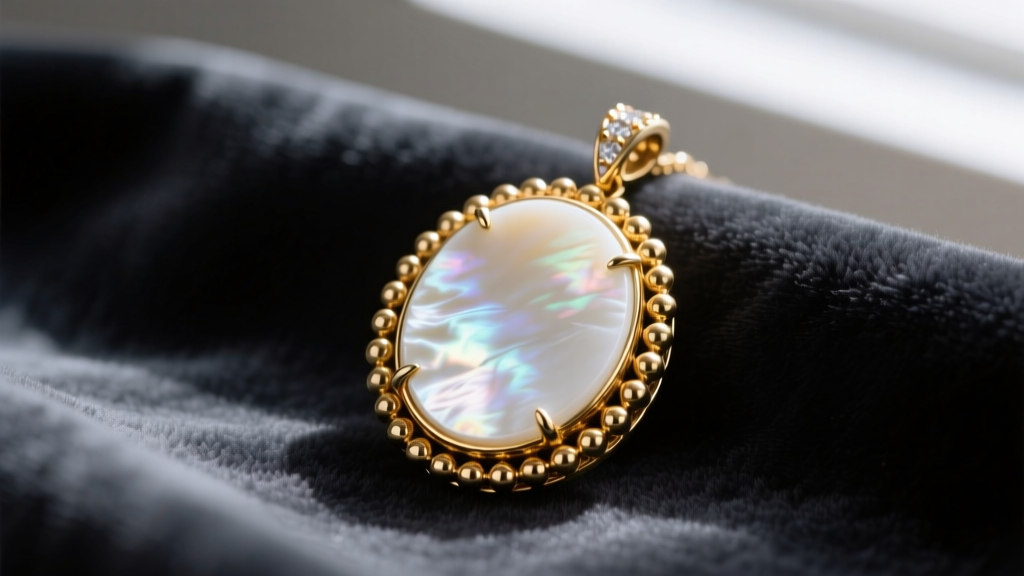
When collectors and enthusiasts search for a van cleeg necklace, they are almost universally hunting for the iconic Vintage Alhambra collection by Van Cleef & Arpels. The widespread misspelling has become a massive search trend, but the technical realities of authenticating, purchasing, and maintaining these masterpieces require exact precision. As high-end 'super clones' flood the secondary market in 2026, distinguishing a genuine French-crafted Alhambra from a sophisticated replica demands a gemological and horological level of scrutiny.
This expert deep dive bypasses the fluff, focusing strictly on the metallurgical, gemological, and structural hallmarks that define a genuine Van Cleef & Arpels necklace.
The Anatomy of the Serti: Beaded Gold Perfection
The defining visual signature of the Vintage Alhambra motif is the serti—the beaded gold border that frames the central hardstone. This is not merely stamped; it is meticulously hand-finished by master jewelers in the Place Vendôme workshops.
The Rule of 20 Beads
On a standard Vintage Alhambra pendant, the gold border features exactly 20 individual beads. While vintage pieces from the 1970s may show slight variations in bead symmetry due to hand-crafting, modern 2026 productions utilize precision CNC-milling followed by hand-polishing to ensure flawless equidistant spacing. Replicas frequently fail this test, often featuring 18 or 22 beads, or exhibiting uneven spacing and flattened beads where the polishing wheel slipped.
Material Grades and Hardstone Sourcing
Van Cleef & Arpels exercises ruthless quality control over its lapidary materials. Understanding the specific gravity, Mohs hardness, and visual banding of these stones is critical for authentication.
- White Mother-of-Pearl (MOP): Sourced primarily from Australia and Indonesia. Genuine VCA MOP exhibits a deep, iridescent 'orient' with no dead spots. It has a Mohs hardness of 2.5 to 4.5. Fakes often use bleached freshwater shell or synthetic resin, which lacks the sharp, microscopic crystalline structure visible under a 10x triplet loupe.
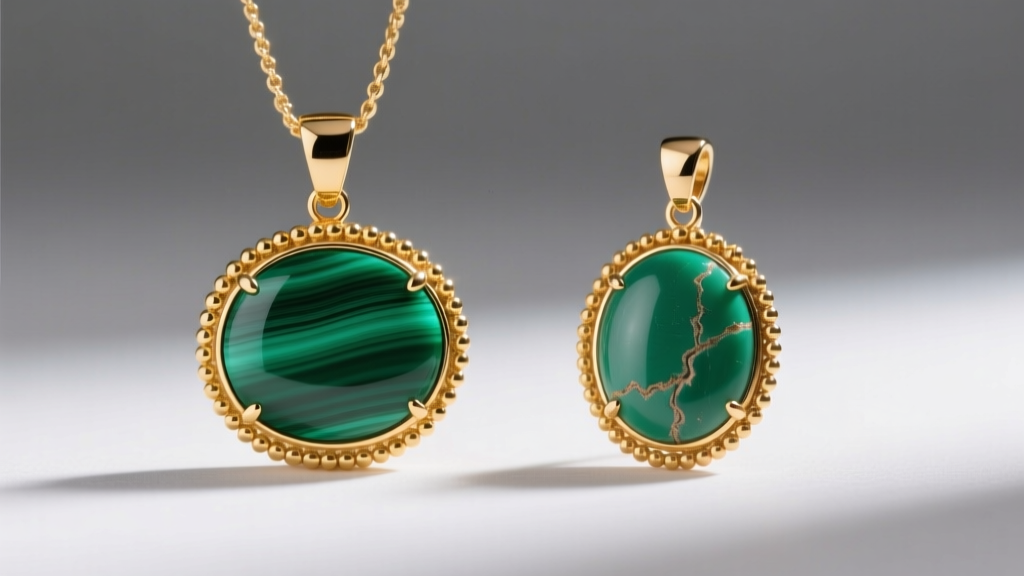
- Malachite: Sourced from the Democratic Republic of Congo. Natural malachite features distinct, non-repeating concentric banding. According to the Gemological Institute of America (GIA), natural malachite has a Mohs hardness of 3.5 to 4.0. Super clones often use dyed agate or synthetic glass, which will show repeating, artificial patterns and a higher hardness (7.0) when tested with a scratch pen.
- Onyx and Carnelian: VCA uses dyed agate for deep black onyx and heat-treated carnelian. The color saturation must be perfectly uniform, with zero visible dye concentrations in the microscopic fissures.
The Flush-Setting Technique: Zero Tolerance for Epoxy
The most common failure point for counterfeiters is the stone-to-metal junction. Van Cleef & Arpels utilizes a precision friction-fit channel setting. The hardstone is cut to exact micrometer tolerances and pressed into the gold bezel.
The Loupe Test: Using a 10x or 20x jeweler's loupe, inspect the seam where the gold meets the stone. On an authentic piece, the transition is seamless, and the gold lip slightly overlaps the stone to secure it. On 95% of replicas, you will detect microscopic bubbles, yellowing, or residue indicative of industrial epoxy used to glue a poorly cut stone into an oversized bezel.
Authentication Matrix: Genuine vs. 2026 Super Clone
The secondary market is currently battling highly sophisticated 'super clones' that replicate the weight and gold purity of the original. However, structural and hallmark discrepancies remain. Consult this technical matrix when evaluating a pre-owned piece.
| Feature | Genuine Van Cleef & Arpels | High-End Super Clone |
|---|---|---|
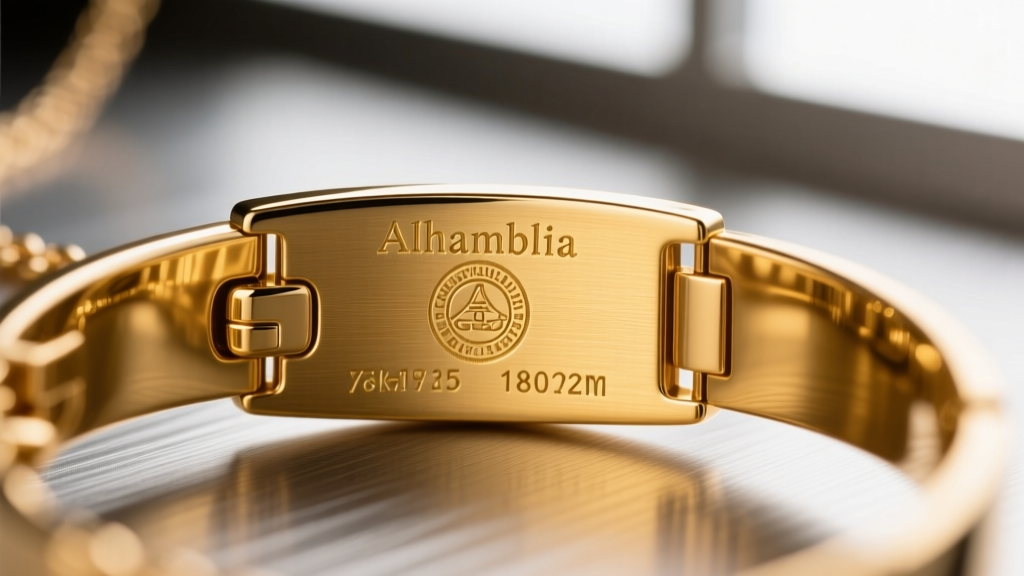
| Gold Purity Stamp | Au750, Eagle Head (French), VCA Maker's Mark | Au750 present, but Eagle Head is often laser-etched rather than struck |
| Serial Number | Laser-engraved (e.g., JE1234), matches certificate | Often stamped with fake serials; font weight and depth are inconsistent |
| Jump Rings | Soldered shut, perfectly circular, seamless | Pinched shut, visible seam, slightly oval from wire tension |
| Clasp Mechanism | Branded lobster clasp with internal VCA stamp | Generic lobster clasp, external stamp only |
| Chain Links | Proprietary flat-cable, uniform laser soldering | Standard cable chain, torch-soldered with heat marks |
The proprietary chain used on the Vintage Alhambra is a flat-cable link designed to lie perfectly flush against the clavicle. Under magnification, the soldering points on genuine links are micro-laser welded, leaving no discoloration or excess solder balls. Counterfeit chains often feature traditional torch-soldered links, which exhibit heat-darkened joints and inconsistent wire thickness. Furthermore, the jump rings connecting the motifs are seamlessly soldered shut. If you can insert the tip of a fine needle into the jump ring seam, the piece is immediately compromised.
For comprehensive care and maintenance protocols directly from the maison, refer to the official Van Cleef & Arpels Jewelry Care guide.
Market Pricing and Investment Value (2026 Outlook)
The Vintage Alhambra collection operates in a unique tier of the luxury market, functioning as both a wearable accessory and a hard asset. Due to annual price increases implemented by the brand, the secondary market has adjusted accordingly.
Current Pricing Tiers (USD)
- Single Pendant (Yellow Gold / MOP): Retail $4,150 | Secondary Market $3,400 - $3,800
- 10-Motif Bracelet (Yellow Gold / Onyx): Retail $12,800 | Secondary Market $10,500 - $11,900
- 20-Motif Long Necklace (Yellow Gold / Malachite): Retail $24,500 | Secondary Market $21,000 - $23,500
Note: Pieces accompanied by the original green velvet box, outer packaging, and matching certificate of authenticity command a 10-15% premium on platforms like Chrono24 and Vestiaire Collective.
Structural Vulnerabilities and Preventative Care
Despite their luxury status, Alhambra necklaces possess specific structural vulnerabilities dictated by their materials. The friction-fit setting, while beautiful, is susceptible to thermal shock and chemical degradation.
The Mohs Scale Reality Check
Because materials like Mother-of-Pearl (Mohs 2.5) and Malachite (Mohs 3.5) are significantly softer than the 18k gold (Mohs ~2.5-3 but highly malleable) and diamonds (Mohs 10), they require specialized care. Never use ultrasonic cleaners on an Alhambra necklace. The high-frequency vibrations will shatter the malachite or delaminate the nacre layers of the MOP. Furthermore, malachite is highly porous and reactive to acids; even mild contact with citrus juice or chlorine will permanently etch the surface, destroying the polish and the resale value.
When storing, the necklace must be kept in its original silk-lined box to prevent the gold beads from scratching the softer hardstone inlays. By understanding these technical parameters, collectors can confidently navigate the market, ensuring their investment remains as pristine as the day it left the Place Vendôme.


