Versace Medusa Necklace: Metal Grades & Auth Guide
Explore the technical specs of the Versace Medusa necklace. Learn about metal alloys, hallmarking, clasp mechanics, and expert authentication tips.

The Metallurgy of Versace Fashion Jewelry
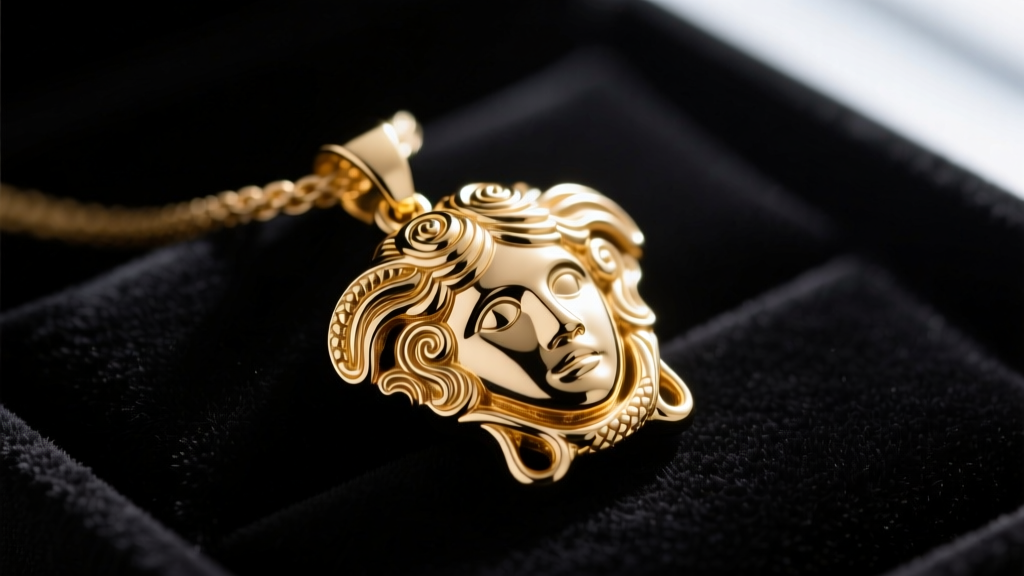
When evaluating a Versace Medusa necklace, understanding the base metallurgy and finishing techniques is paramount. Unlike fine jewelry houses that exclusively use solid precious metals, Versace’s iconic fashion jewelry line relies on advanced metallurgical engineering to achieve its signature heavy, luxurious drape without the prohibitive cost of solid gold. As of 2026, the vast majority of authentic Versace Medusa pendants are cast from a specialized, nickel-free brass alloy. This specific alloy is chosen for its high tensile strength and its ability to accept microscopic layers of precious metal plating without surface pitting.
PVD Coating vs. Traditional Galvanic Plating
Historically, luxury fashion jewelry relied on galvanic electroplating. However, modern authentic Versace pieces increasingly utilize Physical Vapor Deposition (PVD) for their gold-tone finishes. According to the Federal Trade Commission (FTC) Jewelry Guides, traditional gold electroplating must meet minimum thickness requirements to be labeled accurately, but PVD offers superior molecular bonding. Authentic Versace PVD coatings typically range from 0.5 to 2.5 microns in thickness, yielding a rich 18k to 24k gold hue that resists the micro-abrasions of daily wear. Counterfeit manufacturers, conversely, use 'flash plating' (often less than 0.05 microns), which quickly wears through to the brass base, resulting in a patchy, overly yellow, or orange-toned appearance.
For the sterling silver variants of the Medusa necklace, the base is 925 silver. These pieces are often finished with a thin layer of rhodium or palladium to prevent oxidation. You can verify this by checking for the '925' stamp, which must comply with international assay standards, as detailed by The London Assay Office.
Deconstructing the Medusa Motif: Casting and Enamel
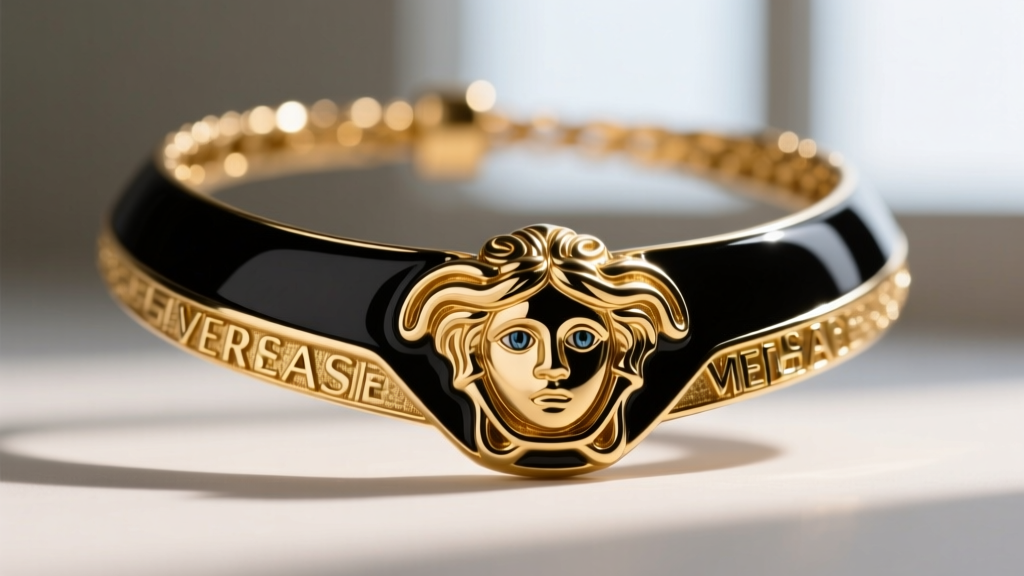
The Medusa head is not merely stamped; it is created using a lost-wax casting process. This allows for the deep, three-dimensional undercuts seen in the Gorgon’s hair and the intricate scales of the aegis (the shield or breastplate often depicted behind her head). The most critical technical detail to examine on pieces featuring colored accents—such as the Medusa '95 or the La Medusa collections—is the application of cold enamel.
Expert Insight: Authentic Versace cold enamel (a high-grade epoxy resin) is applied by hand and cured to sit perfectly flush with the surrounding metal borders. It possesses a glass-like, domed surface tension. Fakes almost universally fail this test, exhibiting raised, uneven resin that bleeds over the gold-plated brass lines or contains trapped micro-bubbles.
Dimensional Variants: '95, 100%, and La Medusa
The Versace Medusa necklace is not a single monolithic design; it spans several distinct architectural variants, each with specific weight profiles and layering applications.
- Medusa '95: Featuring a smaller profile (approximately 2.5cm in diameter) and weighing around 12 grams. It is typically suspended on a thinner box or curb chain (16-18 inches). Its lightweight nature makes it the ideal anchor piece for complex layering setups.
- 100% Medusa: The heavyweight champion of the collection. Measuring up to 5cm across and weighing between 35 and 45 grams, this pendant requires a heavy-gauge Greca or Cuban chain (20+ inches) to support its mass. It is a standalone statement piece that demands an open collar or deep V-neckline to prevent fabric friction from accelerating plating wear.
- La Medusa: Distinguished by the signature Greca (Greek key) border encircling the Medusa head. This added metalwork increases the pendant weight by 5-8 grams. Fashion line versions often incorporate pavé cubic zirconia along the border, while the fine jewelry line utilizes VVS diamonds set in solid 18k gold.
Layering Mechanics and Neckline Pairing
When layering a 16-inch Medusa '95 with a 20-inch unadorned Cuban link, the 4-inch length differential and contrasting weight profiles prevent the chains from tangling. The heavier pendant naturally sits lower, creating a visually balanced, staggered silhouette without the mechanical friction that degrades chain links over time.
Chain Architecture and Clasp Mechanics
The chain supporting a Versace Medusa necklace must be engineered to handle significant dynamic load. To support the heavier pendants, Versace utilizes heavy-gauge Greca link chains. The links on authentic chains are CNC-milled and laser-welded at the joints to prevent the links from pulling apart under the pendant's swinging weight.
Clasp Load-Bearing and Hallmarks
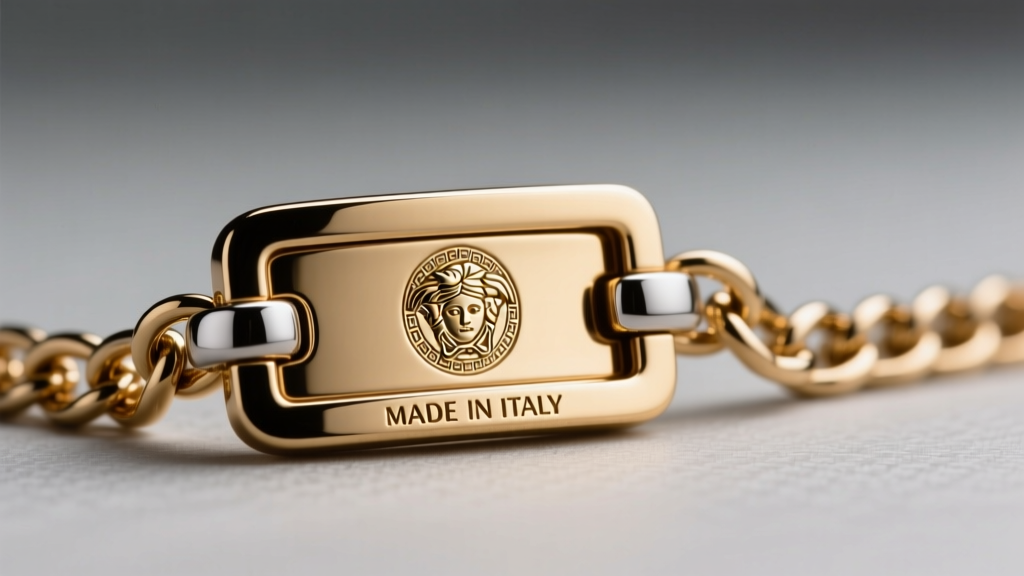
A frequent failure point in counterfeit necklaces is the clasp. Authentic Versace lobster clasps are reinforced with a thicker internal spring mechanism and a larger, soldered jump ring. The extender chain links are uniformly thick. Furthermore, the hallmarking on the clasp and the Medusa pendant itself is laser-engraved or deeply stamped with proprietary Versace typography. You will consistently find 'VERSACE', 'MADE IN ITALY', and often the CE mark (indicating compliance with European health and safety standards, specifically regarding nickel release). For comprehensive care and verification guidelines, you can always refer to Versace Official Customer Care.
Authentication Matrix: Spotting Counterfeits
The secondary market for Versace jewelry is saturated with high-tier 'super fakes.' Relying solely on the presence of a Medusa head is insufficient. Use the following technical matrix to authenticate your piece.
| Technical Feature | Authentic Versace | Counterfeit Indicator |
|---|---|---|
| Plating Thickness & Hue | 0.5 - 2.5 microns; rich, warm 18k-24k tone | Flash plated (<0.1 microns); overly yellow, brassy, or orange |
| Hallmark Engraving | Deep, crisp laser or stamp; correct proprietary font | Shallow, blurred, acid-etched, or missing entirely |
| Enamel Application | Flush with metal borders; glass-like, domed finish | Raised, uneven; bleeds over metal lines; visible bubbles |
| Pendant Weight | Heavy, substantial brass/silver core (15g - 45g) | Hollow, lightweight, plasticky feel; incorrect mass |
| Chain Link Welding | Seamless laser welds; uniform link thickness | Visible solder blobs; thin, easily bent links; sharp edges |
Long-Term Care and Oxidation Prevention
Even with advanced PVD coatings, a Versace Medusa necklace requires specific maintenance to preserve its structural and aesthetic integrity. Never use ultrasonic cleaners or harsh chemical dips (like silver polishing baths) on these pieces. The high-frequency vibrations of ultrasonic cleaners can fracture the cold enamel, while chemical dips will strip the microscopic gold or rhodium plating, exposing the base brass to rapid oxidation.
For routine cleaning, use a dry, untreated microfiber cloth to gently buff away skin oils and environmental pollutants. If the piece features the 925 sterling silver base and has begun to tarnish in the crevices of the Medusa's hair, use a specialized silver polishing cloth impregnated with anti-tarnish agents, taking care to avoid the enamel eye details. When storing the necklace, keep it in a low-humidity environment alongside 3M Silver Shield anti-tarnish strips to absorb ambient sulfur compounds that cause brass and silver to darken.
Final Verdict on the Versace Medusa Necklace
The Versace Medusa necklace remains a masterclass in luxury fashion jewelry engineering. By combining heavy-gauge brass casting, advanced PVD metallurgy, and precise enamel work, Versace creates a piece that offers the visual weight and presence of fine jewelry at a fraction of the cost. However, this popularity necessitates a rigorous, technically informed approach to authentication. By examining the micron-level plating, the flush boundaries of the cold enamel, and the load-bearing mechanics of the Greca chain, collectors and buyers can confidently separate authentic Italian craftsmanship from inferior counterfeits.


