Anatomy of a Victorian Silver Collar Necklace: An Expert Guide
Explore the technical anatomy, silver hallmarks, and construction methods of the Victorian silver collar necklace in this expert appraisal guide.

Defining the Silhouette: Collar vs. Choker Dimensions
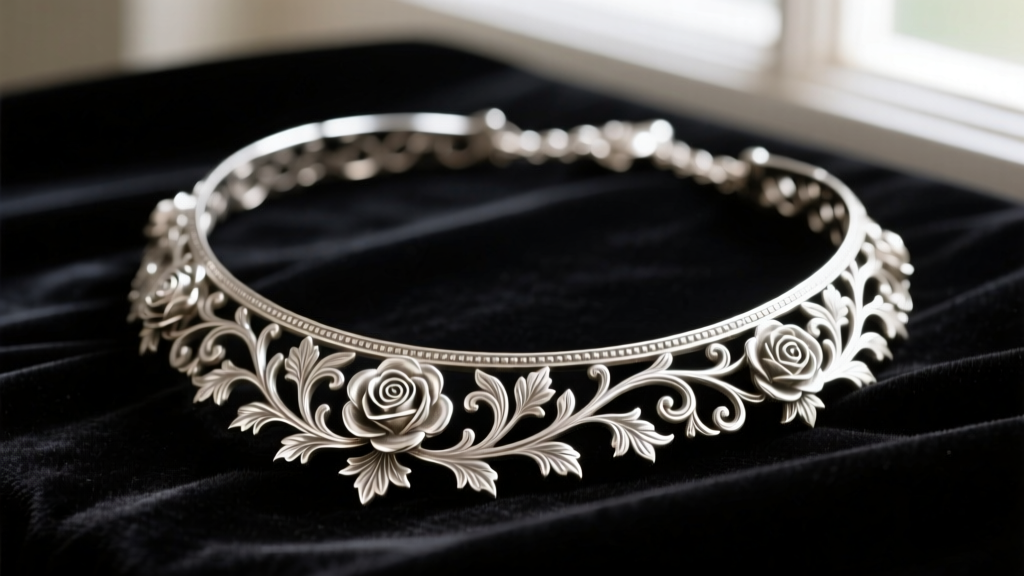
In the lexicon of antique jewelry, the terms 'collar' and 'choker' are frequently conflated by modern retailers, but to a horologist or antique appraiser, they denote distinctly different architectural silhouettes. A true Victorian silver collar necklace is engineered to sit precisely at the base of the neck, resting flush against the clavicle. Standard lengths for these pieces range strictly from 14.5 to 15.5 inches, designed to accommodate the high-necked bodices and lace collars prevalent in mid-to-late 19th-century fashion.
Unlike a choker, which may sit higher and feature a uniform width, the Victorian collar is almost always heavily graduated. The central focal point—often a repoussé plaque or a hinged geometric motif—can span 1.5 to 3 inches in width, tapering down to 0.5-inch articulated links at the nape of the neck. This graduation is not merely aesthetic; it is a structural necessity. The rigid nature of wide, ornate silver links requires a tapered hinge system to allow the necklace to articulate around the cervical spine without kinking or placing undue stress on the solder joints.
Metallurgy & Hallmarks: Decoding Victorian Silver Grades
Authenticating a Victorian silver collar necklace begins with metallurgical analysis. The 19th century saw significant shifts in silver standardization, particularly following the British Hallmarking Act and the widespread adoption of the Sterling standard. When examining antique pieces, appraisers look for three primary silver grades:
| Silver Grade | Purity | Historical Context & Usage | Hallmark Indicators |
|---|---|---|---|
| Sterling Silver | .925 | The dominant standard post-1850s. Offers the ideal balance of malleability for repoussé work and tensile strength for link construction. | Lion Passant (UK), 'STERLING' stamp (US) |
| Britannia Silver | .958 | A softer, higher-purity silver mandated between 1697 and 1720, but occasionally used in early Victorian revival pieces for deep casting. | Figure of Britannia |
| Coin Silver | .900 | Prevalent in American Victorian pieces prior to the widespread adoption of the Sterling standard by US silversmiths like Tiffany & Co. | 'COIN', 'PURE COIN', or maker's mark only |
According to the British Hallmarking Council, the presence of a duty mark (the sovereign's head) alongside the lion passant and date letter is a definitive indicator of a piece assayed between 1784 and 1890. In a Victorian silver collar necklace, these marks are typically struck on the tongue of the clasp or the inner curve of the central plaque, areas protected from friction wear.
Construction Techniques: Repoussé, Chasing, and Cannetille
The visual depth of a high-end Victorian silver collar necklace is achieved through labor-intensive, hand-fabricated techniques that are prohibitively expensive to replicate today. The most prominent of these is repoussé, a method where the silver sheet is hammered from the reverse side to create a raised, three-dimensional relief. To execute this without tearing the metal, the artisan must anneal the silver and embed it in a specialized jeweler's pitch—a composite of rosin, tallow, and plaster that supports the metal during hammering.
Following repoussé, the piece undergoes chasing, where the front surface is refined with specialized punches to add texture, vein details to floral motifs, and sharp definition to scrollwork. The contrast between the highly polished raised areas and the matte, oxidized recesses is a hallmark of quality Victorian craftsmanship.
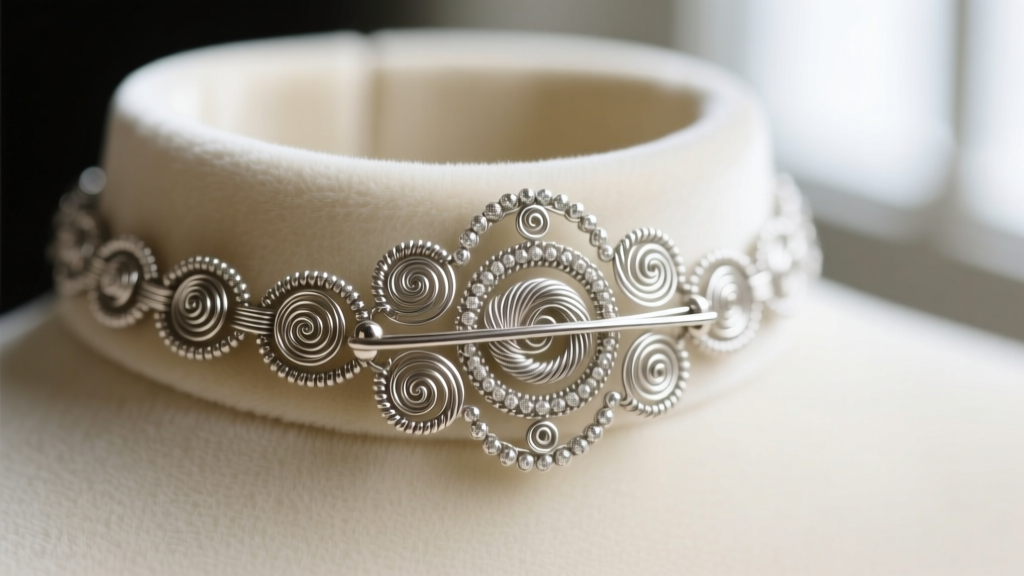
Another technique frequently found in the linkages and clasp housings of these collars is cannetille. This involves coiling extremely fine silver wire—typically between 28 and 32 gauge—into tight springs and granules, which are then soldered onto the base metal. As noted by the Lang Antiques University, cannetille work requires exceptional temperature control during soldering; if the torch is too hot, the microscopic wire coils will instantly melt into featureless beads. Surviving examples with intact, sharp cannetille are highly prized by collectors.
Clasp Mechanics & Failure Modes in Antique Pieces
The clasp of a Victorian silver collar necklace is its most vulnerable mechanical component. Because these collars are heavy—often weighing between 40 and 80 grams—the clasp must endure significant tensile stress. The three most common clasp types and their specific failure modes include:
- The Bayonet Barrel Clasp: This features a push-in tongue with a spring-loaded latch that locks into a hollow cylindrical barrel. Failure Mode: The internal spring was often made of base metal or early steel. Over a century of exposure to skin acidity and sulfur, the internal spring corrodes and snaps, leaving the outer silver shell intact but the clasp non-functional.
- The C-Clasp with Pin: A simple hook and pin mechanism. Failure Mode: The pin, subjected to repetitive bending, suffers from metal fatigue and work-hardening, eventually snapping at the solder joint.
- The Padlock Clasp: Often used as a decorative central motif that doubles as a closure. Failure Mode: The internal wafers and keyways wear down from friction, resulting in a clasp that locks but fails to engage the secondary safety catch.
Conservation vs. Restoration: Handling Tarnish and Patina
A critical error made by novice collectors is aggressively polishing a Victorian silver collar necklace to a mirror finish. Silver tarnish is primarily silver sulfide ($Ag_2S$), formed when the copper alloy in sterling silver reacts with atmospheric sulfur. In antique repoussé pieces, the dark tarnish trapped in the recesses is not dirt; it is intentional contrast that provides visual depth.
'Stripping a 19th-century repoussé collar of its patina using electrochemical dips or abrasive pastes removes the historic surface layer, leaving a porous, matte finish that destroys both the aesthetic intent and the numismatic value of the piece.' — Conservation Guidelines, Victoria and Albert Museum
For routine maintenance, experts recommend a light application of precipitated calcium carbonate (CaCO3) mixed with distilled water, applied with a soft cotton swab only to the raised, high-friction areas. The recesses should be left entirely untouched to preserve the original chased contrast.
Sourcing and Authentication Checklist
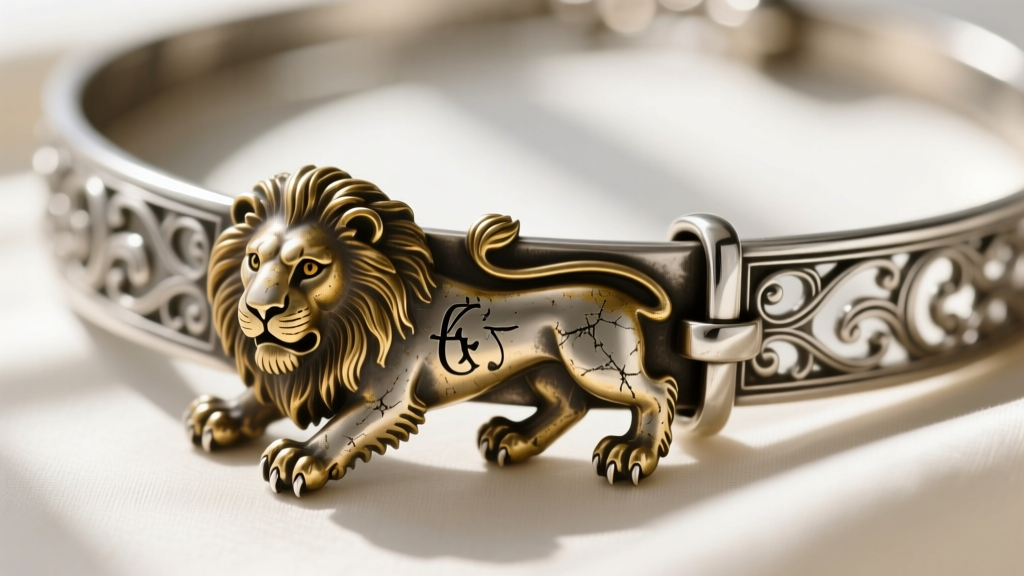
When evaluating a Victorian silver collar necklace for acquisition, rely on a strict technical checklist to differentiate genuine antiques from modern 'antique-style' reproductions:
- Examine the Solder Joints: Victorian artisans used lead-based or early cadmium solders that leave a slightly grey, matte seam. Modern laser welding or silver solder leaves a clean, bright, and uniform line.
- Inspect the Link Articulation: Antique links were hand-cut and filed. Look for slight asymmetries in the jump rings and a lack of uniform machine stamping.
- Verify the Hallmark Wear: A genuine 140-year-old necklace will show micro-abrasions and a softening of the hallmark edges. Reproductions often feature artificially darkened, laser-etched, or perfectly crisp stamped marks that lack the depth of a hand-struck punch.
- Test the Magnetism: While the silver body will be non-magnetic, passing a rare-earth magnet over the barrel clasp should reveal a slight pull if the original internal steel spring is still intact—a strong indicator of original, unaltered mechanical components.
By understanding the metallurgical composition, structural engineering, and conservation chemistry of these pieces, collectors and jewelers can properly preserve the legacy of the Victorian silver collar necklace for future generations.


