The Anatomy of a Vintage Costume Necklace: Plating & Base Metals
Explore the technical anatomy of a vintage costume necklace. Learn about base metals, plating thickness, clasp mechanics, and expert restoration tips.

Introduction: Beyond the Rhinestones
When collectors and archivists evaluate a vintage costume necklace, the untrained eye is immediately drawn to the brilliance of aurora borealis rhinestones or the intricate enameling of a statement pendant. However, the true hallmark of quality—and the primary determinant of a piece's structural longevity—lies hidden beneath the surface. High-end vintage costume jewelry is a marvel of mid-century metallurgy and surface engineering. Understanding the exact base alloys, the micron thickness of electroplated finishes, and the mechanical tolerances of period-correct findings is essential for serious collectors, restorers, and appraisers. This technical deep dive deconstructs the material science that separates heirloom-quality costume pieces from disposable fast-fashion accessories.
The Core: Base Metal Metallurgy
Unlike fine jewelry, which relies on the inherent value of noble metals, a costume necklace must achieve durability, malleability, and weight through engineered base alloys. The choice of base metal dictates how well the piece will accept plating and how it will degrade over decades of wear.
Zamak and the Threat of Zinc Pest
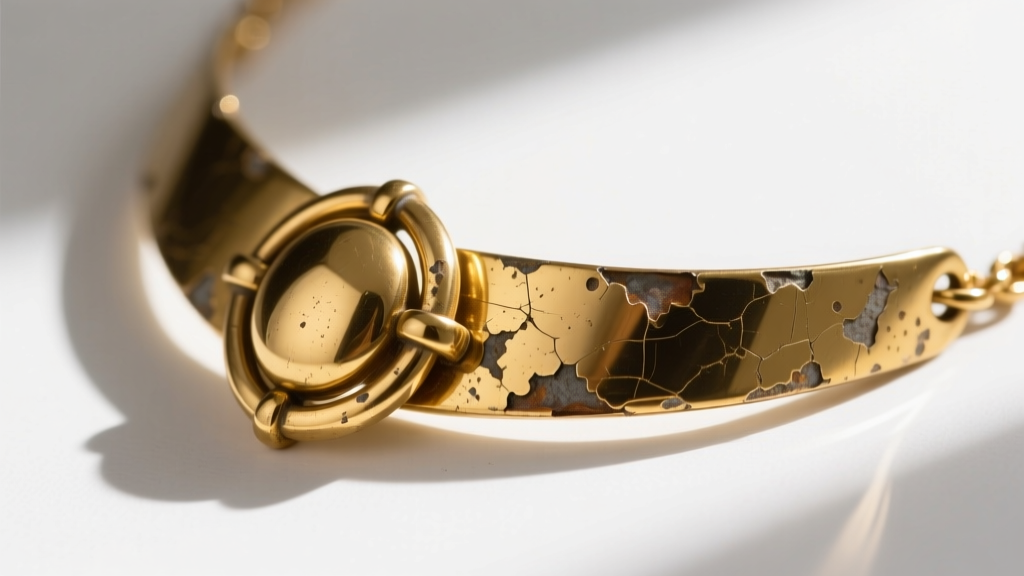
Many mid-century three-dimensional pendants and ornate chain links were cast using Zamak, a family of alloys with a base of 95% zinc, 4% aluminum, and trace amounts of magnesium and copper. While Zamak allowed for highly detailed, low-cost die casting, it is highly susceptible to a catastrophic failure mode known as zinc pest. If the lead or tin impurities in the alloy exceed 0.02%, intergranular corrosion occurs. This manifests as a slow, irreversible expansion and cracking of the metal, often shattering the plating above it. According to conservation guidelines from Lang Antiques, identifying early signs of zinc pest—such as microscopic surface webbing or a powdery white residue in crevices—is critical before attempting any restorative polishing.
Lead-Free Brass and Beryllium Copper
For stamped and drawn components, such as the links of a vintage snake chain or the backing of a collar necklace, jewelers relied on C26000 cartridge brass. This 70/30 copper-zinc alloy offers exceptional tensile strength and a naturally smooth surface that requires minimal polishing before plating. However, for the internal springs of clasps, brass lacks the necessary fatigue resistance. Expert makers utilized beryllium copper (Alloy 25), which can be heat-treated to achieve a tensile strength exceeding 200,000 psi, ensuring that a spring-ring clasp retains its snap even after 50 years of actuation.
Surface Engineering: Plating Techniques and Micron Thickness
The visual appeal of a vintage costume necklace relies entirely on its surface finish. The electroplating processes of the 1940s through 1970s were remarkably sophisticated, often employing cyanide-based copper and gold baths that produced denser, more adherent layers than many modern, environmentally compliant non-cyanide alternatives.
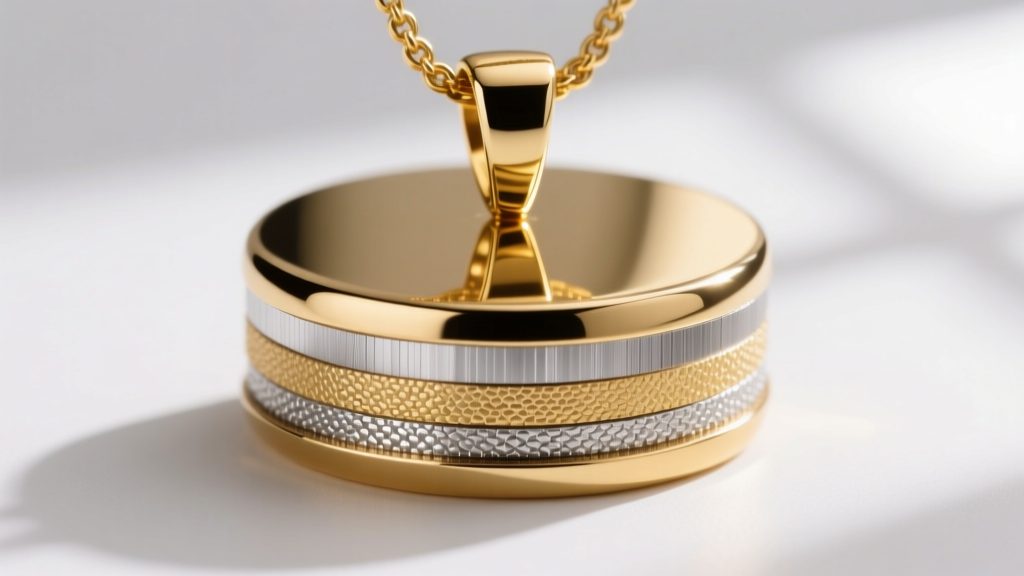
The Architecture of an Electroplated Finish
A high-quality vintage gold-plated necklace is not simply gold over brass. It is a complex, multi-layered composite designed to prevent galvanic corrosion and ensure color stability. The standard architecture includes:
- The Strike Layer (0.1 - 0.5 microns): A microscopic flash of copper or nickel applied directly to the base metal to promote adhesion and block the migration of zinc atoms to the surface.
- The Barrier Layer (1.0 - 2.0 microns): Historically, a thick layer of nickel was used to provide a bright, hard, and level surface. Today, due to nickel allergy regulations, palladium or white bronze is often substituted.
- The Topcoat (1.0 - 5.0+ microns): The final karat gold (usually 14k or 18k) or rhodium layer that provides the aesthetic finish.
Plating Classification Matrix
| Classification | Base Metal Requirement | Minimum Gold Thickness | Durability & Wear Profile |
|---|---|---|---|
| Gold Flash / Wash | Any Base Alloy | < 0.175 microns | Extremely low; wears off within weeks of friction. |
| Gold Electroplate | Brass, Copper, Nickel | 0.175 - 1.0 microns | Moderate; standard for most vintage commercial pieces. |
| Heavy Gold Electroplate (HGE) | Brass, Silver | 2.5 microns+ | High; can withstand decades of careful wear and light polishing. |
| Gold Vermeil | Sterling Silver (925) | 2.5 microns+ (10k+) | Very High; hypoallergenic barrier, highly valued by collectors. |
Note: The Federal Trade Commission (FTC) strictly regulates these definitions. True vermeil requires a sterling silver base, whereas standard electroplate can utilize any base metal.
Structural Failure Points: Findings and Soldering
The most common point of failure in any vintage costume necklace is not the chain itself, but the findings—the clasps, jump rings, and solder joints. Evaluating these components requires a jeweler's loupe and an understanding of period-correct manufacturing techniques.
Soldered vs. Unsoldered Jump Rings
In fine jewelry, jump rings connecting the pendant to the chain are almost always soldered shut. In vintage costume jewelry, however, you will frequently encounter unsoldered, flush-cut jump rings. Because the base metals (like brass or pot metal) have lower melting points than the silver solders traditionally used, applying a torch to solder a brass jump ring risks melting the pendant or blistering the gold plating. Consequently, makers relied on precision flush-cutting pliers to create nearly invisible seams. When restoring these pieces, modern jewelers must use low-temperature laser welding or conductive epoxies rather than traditional torch soldering to avoid catastrophic thermal damage.
Clasp Mechanics: The Barrel and Fold-Over
While spring rings are ubiquitous, the barrel clasp (or tongue-and-groove clasp) was the standard for heavy multi-strand pearl and rhinestone collar necklaces. The internal mechanism relies on a folded leaf of beryllium copper or spring steel that compresses upon insertion and snaps into a recessed groove. Over time, the constant compression causes metal fatigue, resulting in a 'dead' spring that no longer locks. Restoring this requires carefully extracting the internal leaf, annealing it, and re-tensioning it with nylon-jaw pliers to avoid marring the exterior gold plating.
Restoration and Patina Preservation: A Technical Framework
Cleaning a vintage costume necklace requires a radically different approach than cleaning solid gold or platinum. The primary enemy of plated base metals is moisture entrapment and chemical stripping.
Expert Warning: Never place a vintage costume piece in an ultrasonic cleaner. The high-frequency cavitation can easily fracture the adhesive bonds holding foil-backed rhinestones and cause microscopic fracturing in brittle Zamak castings.
Safe Chemical Protocols
When removing decades of sebum, cosmetic residue, and environmental tarnish, restorers must avoid ammonia-based cleaners. Ammonia aggressively attacks copper and zinc, which will rapidly strip the finish if the plating has any micro-fissures. The recommended protocol involves:
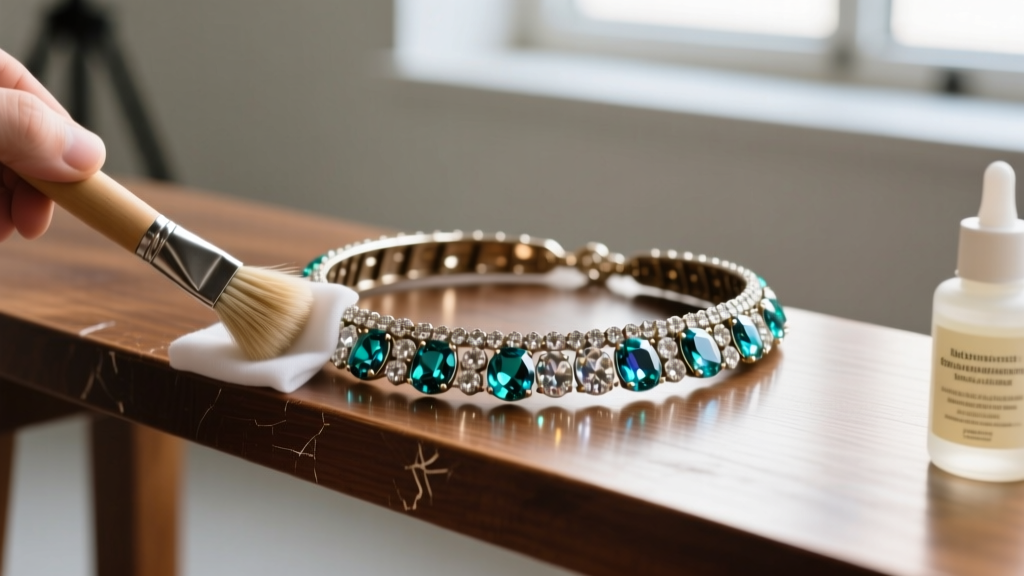
- Dry Mechanical Removal: Use a soft, natural-bristle brush (like a horsehair detailing brush) to dislodge dry particulate matter from crevices and stone settings.
- Solvent Application: Apply a specialized, non-ammonia, non-alcohol jewelry solvent to a microfiber swab. Alcohol can degrade the lacquer coatings often applied over silver plating to prevent tarnish.
- Targeted Detailing: Use a wooden orangewood stick, rather than metal tools, to gently scrape grime from the bezel edges of rhinestones without scratching the soft gold electroplate.
- Moisture Displacement: Immediately dry the piece using compressed air or a low-heat hair dryer to ensure no moisture remains trapped in the clasp mechanisms or under stone settings, which would trigger galvanic corrosion.
Sourcing and Valuation Metrics
When appraising or sourcing a vintage costume necklace, technical condition supersedes brand name. A piece by a highly sought-after maker like Trifari or Miriam Haskell will lose significant value if the gold vermeil has been aggressively machine-polished, exposing the brass underlayer. Collectors should look for 'patina'—the gentle, natural softening of the gold tone in high-friction areas—rather than harsh, bright, modern-looking replating. Understanding the exact micron thickness of the original finish and the metallurgical composition of the core allows you to differentiate between a masterfully preserved mid-century artifact and a chemically stripped, devalued shell. For further reading on historical jewelry conservation, the Victoria and Albert Museum provides extensive archives on the preservation of non-precious metals and composite jewelry structures.