The Viral Necklace Meme: Troubleshooting Tangling, Breaks & Fails
Decode the viral necklace meme by learning expert troubleshooting for sliding clasps, chain tangling, gym snaps, and green skin. Fix your jewelry fails.

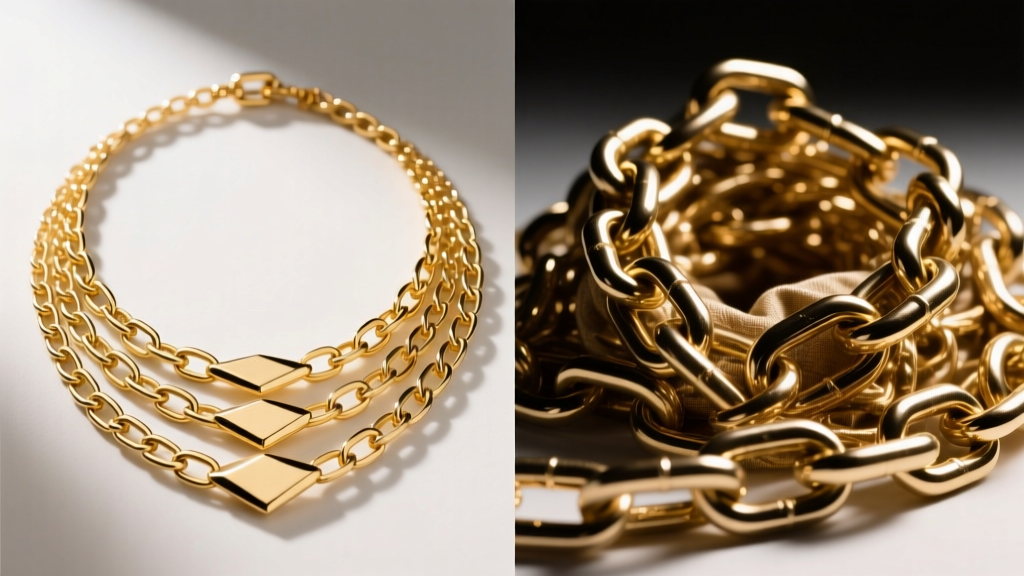
If you have spent any time on TikTok, Instagram Reels, or Reddit over the last few years, you have undoubtedly encountered the ubiquitous necklace meme. Whether it is the hilarious "expectation vs. reality" of layered pendants turning into a single knotted rope, the frustrating "clasp sliding to the front" audio trend, or the tragic "my chain snapped at the gym" montage, these viral moments highlight genuine jewelry engineering flaws. As we navigate the jewelry landscape in 2026, consumers are demanding more than just aesthetics; they want structural integrity and wearable ergonomics.
At Jewel Style Radar, we believe that behind every viral necklace meme is a solvable materials science problem. This guide decodes the most common jewelry fails and provides expert-level, metallurgical troubleshooting to keep your necklaces looking pristine and functioning perfectly.
The "Sliding Clasp" Meme: Center of Gravity Fixes
The most universally mocked necklace meme involves the wearer constantly reaching behind their neck to pull the clasp back to the center of their nape. This is not a curse; it is basic physics. The sliding clasp occurs when the center of gravity on the chain's circumference is unbalanced.
Why It Happens
Most mass-market necklaces use a standard 5mm or 7mm lobster clasp made of solid brass or stainless steel. If the chain is a lightweight 20-gauge (0.8mm) cable or box chain, the clasp is often the heaviest single component on the entire piece. Gravity naturally pulls the heaviest point to the lowest possible position—which, when you are upright, is the front of your chest.
Expert Troubleshooting
- The Counterweight Method: Add a 2mm to 3mm solid gold or tungsten bead directly adjacent to the clasp (on the opposite side of the jump ring). This balances the weight distribution without altering the chain's drape.
- Silicone O-Rings: For an immediate, non-destructive fix, slide a micro-silicone jewelry stay bead (often sold as 1mm clear silicone O-rings) over the chain and rest it against the clasp. The high-friction silicone grips the skin and hair, preventing the metal from gliding.
- Clasp Swaps: Replace heavy brass lobster clasps with lightweight 4mm spring ring clasps or hidden magnetic barrel clasps, which distribute weight more evenly.
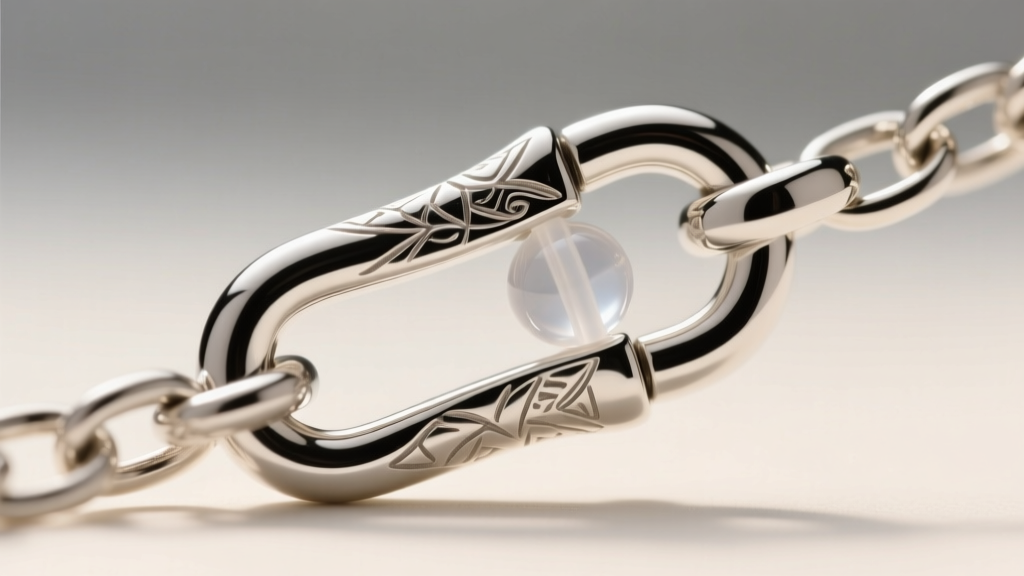
The "Expectation vs. Reality" Layering Tangle Meme
Layering three delicate chains is a staple of modern styling, but the inevitable "necklace meme" shows the reality: a hopelessly snarled bird's nest of metal. Tangling is driven by link geometry, surface friction, and length differentials.
Link Geometry and Friction Coefficients
Chains tangle when their links are small enough to pass through the links of an adjacent chain, or when high surface friction causes them to grip one another during movement. According to manufacturing data from Rio Grande Jewelry Supply, chains with high surface-area-to-volume ratios (like Herringbone or Snake chains) are notorious for micro-snagging because their flat, tightly packed scales easily catch on the open loops of Cable or Rolo chains.
The 2026 Anti-Tangle Framework
To prevent layering fails, you must engineer your stack using the Geometry & Length Rule:
- Length Differential: Maintain a strict minimum 2-inch gap between layered chains. A 16-inch choker, an 18-inch princess, and a 20-inch matinee length prevent the pendants from occupying the same physical space.
- Mix Link Geometries: Never layer two identical cable chains. Pair a smooth, flat Herringbone chain with a chunky, rounded Rolo or Figaro chain. The rounded edges of the Rolo chain will glide over the flat Herringbone rather than interlocking.
- PVD Coatings: In 2026, PVD (Physical Vapor Deposition) coated titanium and 316L stainless steel chains offer a surface roughness (Ra) of less than 0.2 µm. This ultra-smooth finish drastically reduces the coefficient of friction, allowing layered chains to slide apart naturally rather than binding.
| Chain Link Type | Tangle Risk | Surface Friction | Best Layering Partner |
|---|---|---|---|
| Cable (Standard) | High | Medium | Box or Cuban |
| Herringbone | Very High | High (Snag-prone) | Thick Rolo (Wear alone or bottom) |
| Box | Low | Low | Cable or Bead |
| Cuban / Figaro | Very Low | Low | Any fine chain |
The "Gym Snap" Meme: Tensile Strength & Gauge Sizing
Another tragic entry in the necklace meme hall of fame is the "I wore my chain to the gym and it snapped" video. Sweat, friction, and sudden tensile loads are the enemies of fine jewelry. Understanding tensile strength and gauge sizing is critical for active wearers.
Material Tensile Strength vs. Gauge
The Gemological Institute of America (GIA) and metallurgical standards dictate that the durability of a chain is a product of its cross-sectional area (gauge) and its material yield strength. Standard 925 Sterling Silver in an annealed state has a tensile strength of roughly 250 MPa. When subjected to the repetitive stress of weightlifting or running, silver quickly work-hardens, becomes brittle, and snaps at the soldered jump rings.
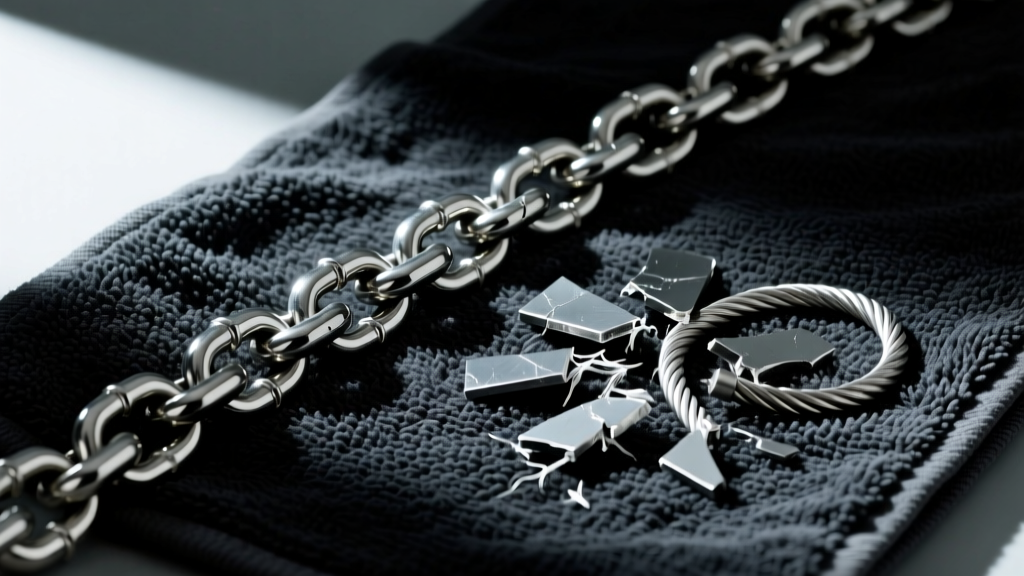
For active lifestyles, abandon 22-gauge (0.6mm) and 20-gauge (0.8mm) silver chains entirely. Instead, opt for the following material and gauge combinations:
- 316L Surgical Stainless Steel (16-gauge / 1.2mm): Offers a tensile strength of ~515 MPa and exceptional resistance to chloride corrosion (sweat).
- Grade 5 Titanium (Ti-6Al-4V) (14-gauge / 1.6mm): The ultimate active-wear metal. With a tensile strength exceeding 900 MPa, it is virtually impossible to snap during human physical exertion, and it weighs 45% less than steel.
Pro-Tip: The weakest point of any chain is the soldered jump ring connecting the clasp. If you are wearing a chain to the gym, ensure the jump rings are laser-welded rather than traditionally soldered, or opt for a continuous chain loop with a heavy-duty magnetic clasp that detaches under extreme load to prevent choking hazards.
The "Green Neck" Meme: Alloy Composition & Plating Failures
The "my cheap necklace turned my neck green" meme is a rite of passage, but the chemistry behind it is often misunderstood. Green skin is not an allergic reaction; it is a chemical oxidation process.
The Chemistry of Cupric Chloride
When base metals like brass or copper-heavy alloys (often found in 10k gold or gold-plated zinc) come into contact with the chlorides and lactic acid in human sweat, a galvanic reaction occurs. The copper oxidizes and forms cupric chloride, a green salt that transfers directly onto the epidermis. This is exacerbated by lotions, perfumes, and high-humidity environments.
Permanent Solutions for Sensitive Skin
To permanently retire the green neck meme from your personal life, you must upgrade your alloy composition:
- Argentium 935 Silver: Unlike traditional 925 sterling (which is 7.5% copper), Argentium silver replaces some of the copper with germanium. The germanium forms a transparent, self-healing oxide layer that completely blocks copper oxidation, making it highly tarnish and green-skin resistant.
- Solid 14k or 18k Gold: Ensure you are buying solid gold, not gold vermeil or gold-filled. The higher the karat, the lower the copper content. 18k gold (75% pure gold) rarely causes greening unless the wearer's sweat is highly acidic.
- Niobium & Titanium: For pendant bails and clasps that rest directly against the nape of the neck (where sweat pools), anodized niobium or pure titanium are completely inert and biocompatible.
Conclusion: Engineering Your Jewelry Wardrobe
The next time you see a viral necklace meme highlighting a frustrating jewelry fail, remember that these issues are not inevitable. By applying basic principles of physics, understanding link geometry, and respecting the tensile limits of metallurgical alloys, you can curate a necklace collection that is as structurally sound as it is visually stunning. Stop fighting your jewelry and start engineering your style.


