Wave Pendant Necklace Design: Metallurgy and Chain Mechanics
Explore the technical anatomy of a wave pendant necklace. Learn about metal casting grades, optimal chain gauges, and bail mechanics to prevent flipping.

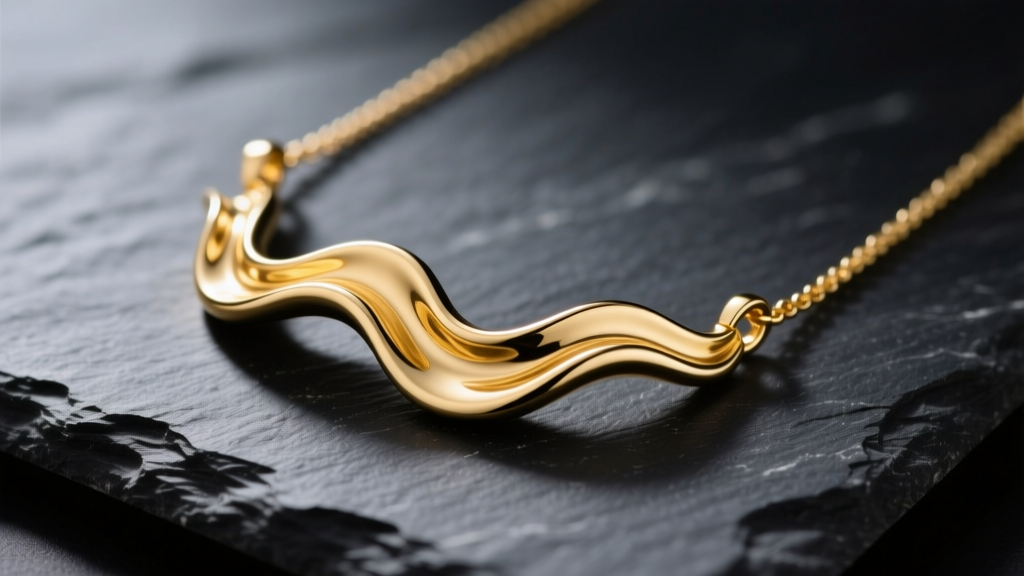
The Physics of the Crest: Engineering the Wave
The wave pendant necklace is a staple in contemporary jewelry, but beneath its fluid, organic aesthetic lies a complex exercise in physics and spatial engineering. Unlike flat-stamped charms, a true wave pendant operates across three distinct axes. The X and Y axes define the width and length of the undulating silhouette, while the Z-axis dictates the depth of the crest and the hollow of the trough. When a jewelry CAD (Computer-Aided Design) technician models a wave pendant, they must carefully calculate the center of gravity (CoG). If the Z-axis depth of the crest exceeds 4.5mm without adequate counter-weighting at the base, the pendant's CoG shifts away from the wearer's sternum. This results in the dreaded 'pendant flip,' where the piece constantly rotates upside down against the skin.
To counteract this, expert bench jewelers employ a technique called 'mass redistribution.' By subtly thickening the bottom trough of the wave and hollowing out the underside of the top crest using CAD Boolean operations, the CoG is forced downward. This ensures the wave pendant necklace lays flush against the collarbone, regardless of the wearer's movements. Furthermore, the transition between the crest and the trough must feature a minimum thickness of 1.2mm to survive the casting process without developing structural porosity or micro-fractures during the quenching phase.
Metallurgical Selection: Hardness, Flow, and Finish
The visual impact of a wave pendant necklace relies heavily on how light interacts with its curved surfaces. This interplay is dictated by the chosen alloy's metallurgical properties, specifically its Vickers Hardness (HV) and its flow characteristics during the lost-wax casting process. High-polish crests require metals that can withstand aggressive tumbling and polishing without rounding off the sharp peaks of the wave.
According to data from the World Gold Council, the copper-to-silver ratio in gold alloys dramatically affects both the color and the structural integrity of the final piece. For wave pendants featuring deep, dramatic relief, 14k yellow gold is often preferred by master casters. Its higher copper and zinc content provides a Vickers Hardness of approximately 135-150 HV, allowing it to hold sharp crest lines better than its 18k counterpart. Conversely, 18k rose gold, which contains a higher copper percentage, offers superior tarnish resistance and a beautiful warm hue, but its increased brittleness requires the wave's curves to be more gradual to prevent stress fractures at the apex of the bends.
| Alloy Grade | Vickers Hardness (HV) | Casting Flow & Detail | Ideal Wave Topography |
|---|---|---|---|
| 14k Yellow Gold | 135 - 150 HV | Excellent; fills sharp crevices | Deep relief, sharp crests, high-polish |
| 18k Rose Gold | 170 - 190 HV | Good; prone to brittleness if too thin | Minimalist, gradual curves, matte finishes |
| 950 Platinum | 110 - 130 HV (High Density) | Requires high heat; exceptional detail | Heavy, sculptural waves, mirror polish |
| Sterling Silver (Rhodium) | 100 - 115 HV | Superb flow; captures micro-textures | Budget-friendly, oxidized troughs |
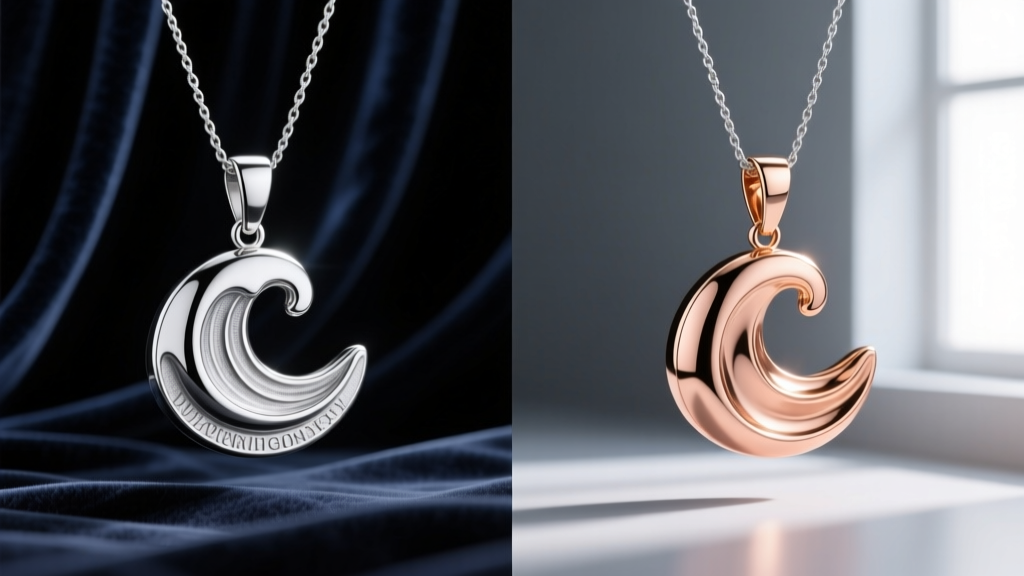
Bail Mechanics: Solving the Pendant Flip
The bail is the critical nexus between the chain and the pendant. In a poorly engineered wave pendant necklace, the bail is simply soldered onto the highest point of the crest. This creates a rigid pivot point that exacerbates flipping and places immense shear stress on the solder joint. When a wearer tugs on the chain, the rigid bail acts as a lever, eventually cracking the solder and detaching the pendant.
To solve this, high-end manufacturers utilize a 'floating' or 'hidden sliding bail.' This mechanism involves casting a hollow, horizontal tube through the top crest of the wave. The chain threads directly through this tube, allowing the pendant to slide laterally and pivot independently of the chain's tension. According to manufacturing guidelines cited by Jewelers of America, moving parts in jewelry require precise tolerances to prevent friction wear. If the inner diameter of the sliding bail is too tight against the chain, the constant micro-abrasion will eventually wear through the metal, leading to catastrophic failure.
The 1.5mm Clearance Rule
When designing or selecting a wave pendant with a sliding bail, bench jewelers adhere to the 1.5mm Clearance Rule. This dictates that the inner diameter of the bail tube must be exactly 1.5mm wider than the outer width of the chain. This specific tolerance allows for:
- Lubrication Retention: Enough space for natural skin oils and microscopic debris to pass through without creating a grinding paste that accelerates wear.
- Thermal Expansion: Metals expand and contract with body temperature and environmental changes; the clearance prevents the chain from binding inside the bail during thermal fluctuations.
- Fluid Drape: It allows the wave pendant to articulate naturally, following the contour of the collarbone without resisting the chain's movement.
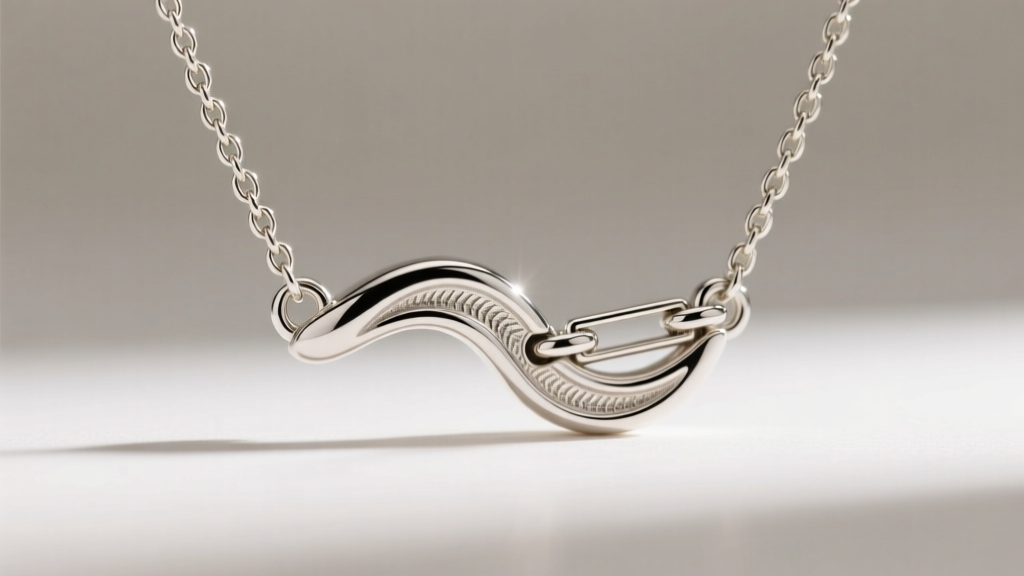
Chain Topography and Friction Coefficients
The chain you pair with your wave pendant necklace is not merely an aesthetic choice; it is a mechanical decision that affects the longevity of the bail. Different chain weaves possess distinct surface topographies, which directly correlate to their friction coefficients against the inside of the pendant's bail.
Rope Chains: While visually stunning and highly reflective, rope chains feature a spiraling, twisted surface. This helical topography acts like a mild file against the inside of a gold or silver bail. Over a period of 12 to 18 months of daily wear, a rope chain can wear down the interior of a sliding bail by up to 0.2mm, significantly compromising its structural integrity.
Wheat (Spiga) Chains: This is the gold standard for wave pendants. The interlocking, teardrop-shaped links of a wheat chain create a remarkably smooth, almost cylindrical outer surface. This low-friction topography glides through the bail without causing micro-abrasions, making it the ideal choice for heavy, solid-cast wave pendants.
Box Chains: Box chains offer a modern, geometric contrast to the organic curves of a wave pendant. However, their sharp, 90-degree corners can catch on microscopic casting porosity inside the bail. If you choose a box chain, ensure the bail has been polished with a high-grit diamond compound to eliminate any internal burrs.
Ultrasonic Cleaning and Trough Maintenance
The deep troughs and undulating valleys of a wave pendant necklace are notorious traps for sebum, cosmetic lotions, and environmental dust. Because the design mimics fluid dynamics, it naturally channels skin oils into the lowest points of the casting. Over time, this buildup creates a dull, matte film in the troughs, ruining the light-play between the high-polish crests and the shadowed valleys.
While ultrasonic cleaners are highly effective at dislodging this debris through high-frequency cavitation, they must be used with caution. If your wave pendant features any tension-set gemstones along the crest, or if the piece has been treated with a chemical patina (oxidation) in the troughs to enhance contrast, ultrasonic cavitation will strip the patina and potentially shake loose the tension settings. For these specific designs, the Gemological Institute of America (GIA) recommends manual cleaning using a soft-bristled cosmetic brush, warm water, and a pH-neutral dish detergent, gently agitating the bristles into the troughs to lift the sebum without damaging the surface treatments.
Expert Bench Tip: If your wave pendant has deep, narrow troughs that a standard brush cannot reach, use a wooden interdental pick. Wood is softer than gold, silver, and platinum, allowing you to scrape out compacted debris from the tightest curves without leaving micro-scratches on the precious metal.
Final Verdict: Engineering Your Perfect Wave
A masterfully crafted wave pendant necklace is a triumph of metallurgical science and mechanical engineering. When selecting your piece, look beyond the immediate visual appeal and inspect the architecture. Seek out pendants that utilize mass redistribution to maintain a low center of gravity, ensuring the piece lays flat against the skin. Opt for 14k gold or platinum if you desire sharp, dramatic crests that will withstand decades of polishing. Finally, always pair your pendant with a low-friction wheat chain and respect the 1.5mm clearance rule in the bail to guarantee a lifetime of fluid, uninterrupted wear. By understanding the technical anatomy of your jewelry, you transition from a passive consumer to an informed collector of wearable engineering.


