What's My Necklace Made Of? House Marks & Metal Guide
Discover what's my necklace made of by decoding metal stamps and jewelry house hallmarks. Learn to identify gold, silver, and luxury brand markers.

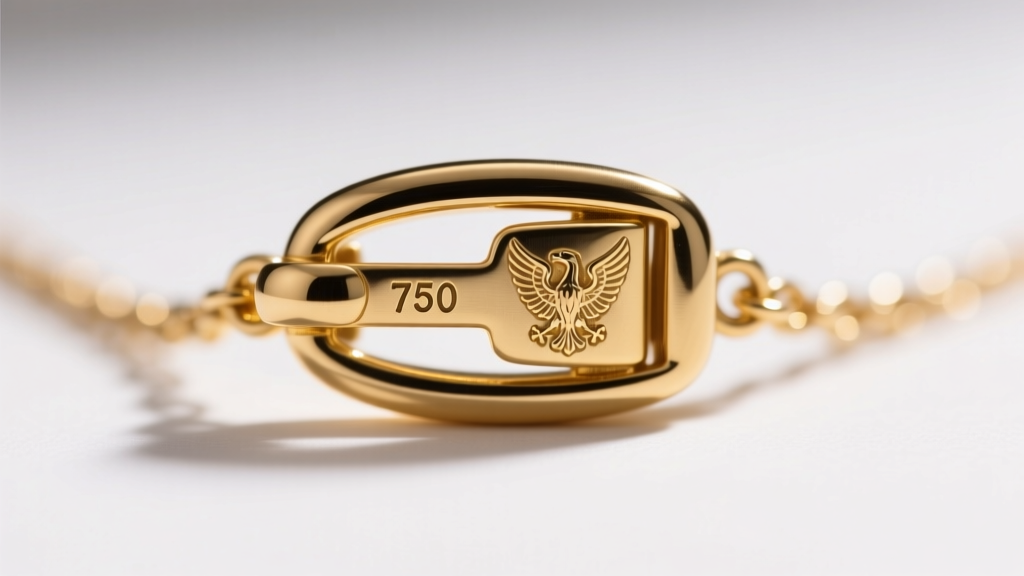
The Anatomy of a Necklace Stamp: Metals vs. Makers
When holding a vintage or luxury piece and asking, "what's my necklace made of," the answer lies in a microscopic world of engravings. Identifying the base metal is only the first step in valuation. The true exponential value of a necklace often comes from identifying the jewelry house—the specific brand, artisan, or historic maker that crafted it. In 2026, with the secondary luxury market more saturated than ever, understanding the precise difference between a generic 18k gold chain and a certified Cartier or Van Cleef & Arpels piece is essential for both buyers and sellers.
This guide decodes the dual-language of necklace hallmarks: the metal purity stamps that tell you what the piece is made of, and the house marks that tell you who made it. We will cover exact serial formats, FTC plating standards, and practical testing methods to authenticate your jewelry.
Decoding Metal Purity Stamps
Before identifying the house, you must verify the canvas. Jewelry houses use specific regional stamping conventions depending on where the piece was manufactured or intended for sale.
The Karat vs. Millesimal System
American and British jewelry traditionally uses the karat (k) system, measuring gold purity out of 24 parts. Continental Europe relies on the millesimal fineness system, measuring purity out of 1,000 parts. A high-end jewelry house will often stamp both, or use the millesimal mark for international compliance.
- 10k Gold: Stamped 417 or 10k (41.7% pure gold). The minimum standard for gold in the US, but rarely used by high luxury houses.
- 14k Gold: Stamped 585 or 14k (58.5% pure gold). Note: Vintage US pieces may read 583, an older standard before the FTC aligned with international norms.
- 18k Gold: Stamped 750 or 18k (75.0% pure gold). The absolute standard for luxury houses like Bvlgari and Chopard due to its rich color and workability.
- Sterling Silver: Stamped 925 (92.5% pure silver). Often accompanied by a maker's mark or a regional assay mark, like the British Lion Passant.
- Platinum: Stamped PT950, PLAT, or 950. Luxury houses favor platinum for high-jewelry diamond pendants due to its secure prong-setting properties.
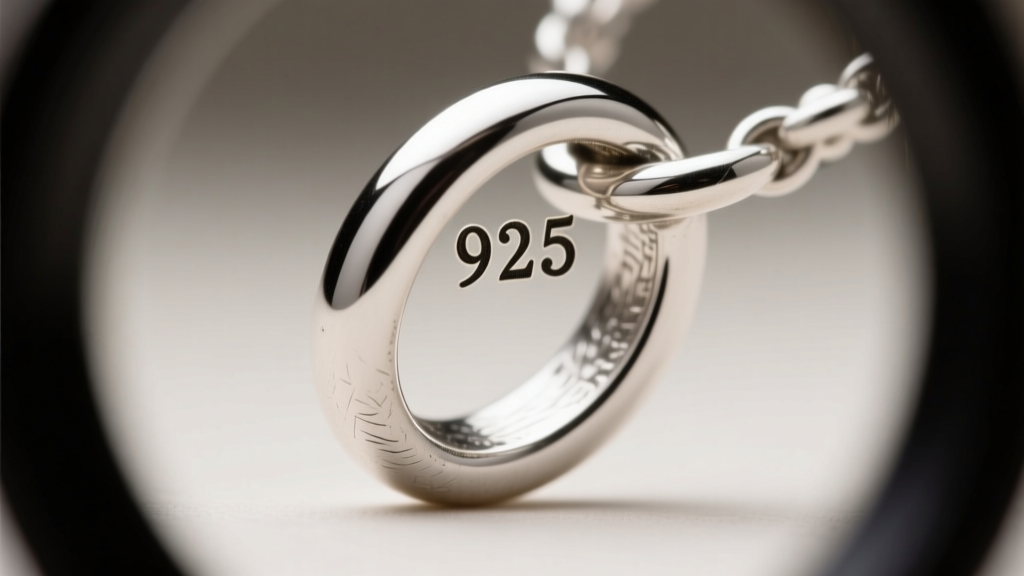
Identifying the Jewelry House: Iconic Hallmarks
Once the metal is verified, the hunt for the house mark begins. Luxury houses employ strict, standardized stamping protocols. Counterfeiters often get the metal stamp right but fail to replicate the exact typography, depth, or serial format of the house mark.
Cartier: The Serial Number Evolution
Cartier necklaces, particularly the iconic Love and Juste un Clou collections, feature a highly specific stamping sequence. You will typically find the Cartier logo, the metal stamp (e.g., 750), and a unique serial number.
Crucial Detail: Pre-2000s Cartier serial numbers were typically 6 digits. Post-2000s serials shifted to a format of 2 letters followed by 4 digits (e.g., AB1234). The engraving should be crisp, centered, and use Cartier's proprietary serif font. A blurry or laser-etched serial is an immediate red flag.
Van Cleef & Arpels (VCA): The Alhambra Protocol
For VCA's famous Alhambra necklaces, the house mark is usually stamped on the back of one of the motifs or on a dedicated metal plaque near the clasp. Authentic pieces will display the VCA maker's mark, the Au750 gold stamp, a unique serial number, and the French eagle head hallmark (indicating 18k gold assayed in France). The serial number on modern pieces can be verified directly through VCA boutiques.
Tiffany & Co.: Beyond the Blue Box
While the "Please Return To Tiffany & Co. New York" engraving is famous on silver tag necklaces, high jewelry and gold pieces from the house use a different nomenclature. Look for T&Co. or Tiffany & Co. alongside the metal purity. For vintage pieces, the Lang Antiques Hallmark Database is an invaluable resource for tracking Tiffany's evolving maker marks throughout the 20th century.
| Jewelry House | Metal Stamp Format | Serial Number Format | Distinctive Assay Mark |
|---|---|---|---|
| Cartier | 750, 18k, PT950 | 6 digits (Vintage) or 2 Letters + 4 Digits (Modern) | Cartier Copyright © |
| Van Cleef & Arpels | Au750, 750 | Alphanumeric, often 6-8 characters | French Eagle Head (18k) |
| Bvlgari | 750, Au750 | Often etched on the inner clasp or motif back | BVLGARI (Double V) |
| Tiffany & Co. | 925, 750, PT950 | Varies; often 8 digits on high jewelry | T&Co. Maker's Mark |
Vermeil, Plated, or Solid? The FTC Standards
If your necklace lacks a solid metal stamp but reads HGE (Heavy Gold Electroplate) or GF (Gold Filled), you are dealing with a layered material. The Federal Trade Commission (FTC) Jewelry Guides strictly regulate these terms to protect consumers.
The Micron Threshold
Standard gold plating can be as thin as 0.175 microns (often called gold wash or gold flashed). This will wear off rapidly on high-friction areas like the clasp or jump ring. Gold Vermeil, however, is a premium standard. By FTC definition, vermeil must have a sterling silver (925) base and be plated with a minimum of 2.5 microns of gold (usually 14k or 18k). If a house markets a piece as vermeil but uses a brass base, it is legally mislabeled.
Gold-Filled (GF): Stamped as 1/20 14k GF, this means the gold layer is mechanically bonded to a base metal and constitutes at least 5% of the item's total weight. It is vastly more durable than electroplating and was heavily used by mid-century American jewelry houses.
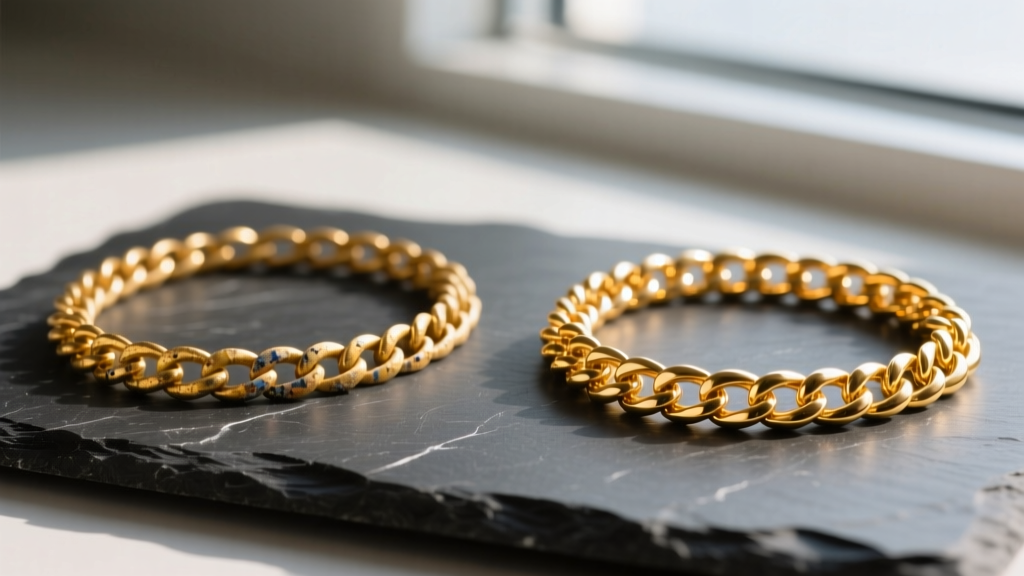
Practical Testing: How to Verify Your Necklace at Home
Before taking your necklace to a certified gemologist or appraiser, you can perform non-destructive tests to narrow down its composition and authenticity.
The Neodymium Magnet Test
Precious metals—gold, silver, and platinum—are entirely non-magnetic. If your necklace is pulled toward a strong neodymium magnet, it contains a ferromagnetic base metal like iron, steel, or nickel. Caveat: The internal spring mechanism of a lobster clasp is usually made of steel and will exhibit a slight magnetic pull. Test the chain links and pendants, not the clasp internals.
The 10x Loupe Wear Inspection
Using a 10x or 20x jeweler's loupe, inspect the high-friction zones: the jump rings connecting the pendant, the clasp tongue, and the links nearest the clasp. If you see a silvery or brassy undertone bleeding through the yellow surface, the necklace is plated. Solid gold scratches will reveal the exact same color underneath the scratch. For deeper insights into metal identification, the GIA Gem Encyclopedia offers extensive visual guides on metal wear patterns.
When to Seek Professional XRF Testing
If your necklace features a luxury house mark but lacks a clear metal stamp, or if you suspect a sophisticated counterfeit, do not use destructive acid tests. Instead, visit a reputable jeweler equipped with an XRF (X-ray Fluorescence) analyzer. This machine shoots X-rays into the metal and reads the exact elemental breakdown in seconds, verifying not just the karat of the gold, but detecting dangerous base metals like lead or cadmium that counterfeiters often use in 2026's black market replicas.
Understanding what your necklace is made of requires looking past the surface shine. By mastering the language of millesimal stamps, FTC plating standards, and luxury house serial formats, you transform from a passive wearer into an informed custodian of jewelry history.


