White Gemstone Necklace Guide: Optics and Durability
Compare diamond, moissanite, sapphire, and moonstone. Expert guide on refractive index, Mohs hardness, and settings for your white gemstone necklace.

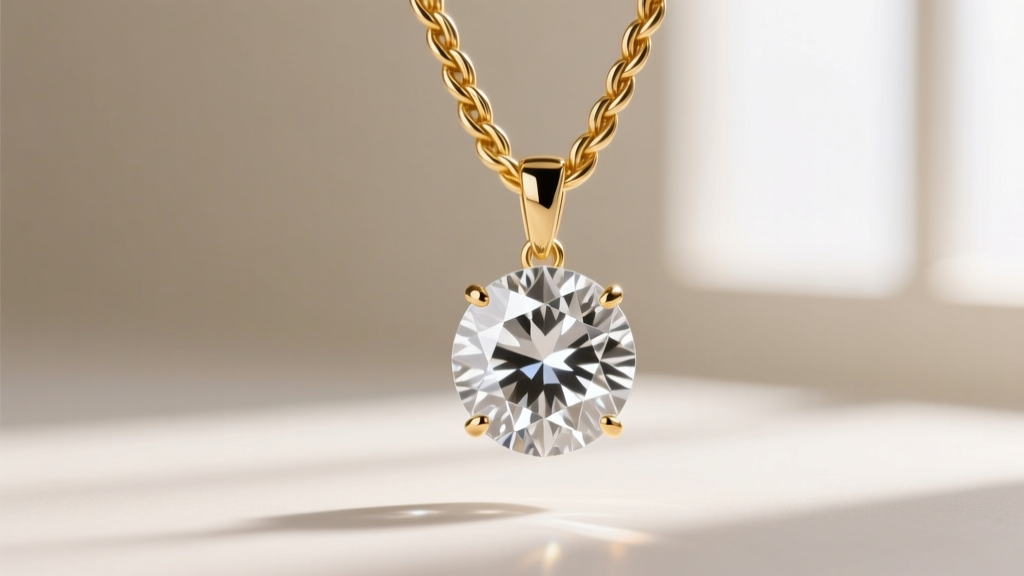
The Gemological Spectrum of White Stones
When selecting a white gemstone necklace, the untrained eye often groups all colorless or white stones into a single category of 'clear gems.' However, from a gemological perspective, the optical mechanics driving the brilliance, fire, and scintillation of these stones vary wildly. The two critical metrics governing a white gemstone's visual performance are Refractive Index (RI) and Dispersion.
Refractive Index measures how much light bends as it enters the stone. A higher RI means greater internal reflection, resulting in superior brilliance. Diamond sits at an impressive 2.42, which is why it remains the benchmark for brightness. However, Moissanite (silicon carbide) actually outperforms diamond with an RI of 2.65 to 2.69. Furthermore, Moissanite is doubly refractive (birefringence of 0.043), meaning light splits into two rays as it passes through the crystal lattice, creating a distinctive 'crushed ice' or disco-ball effect that gemologists can easily identify under 10x magnification.
Dispersion, on the other hand, dictates 'fire'—the stone's ability to split white light into spectral colors. Diamond's dispersion is 0.044. Moissanite's dispersion is a staggering 0.104, yielding more than double the colored flashes. For buyers seeking a more subdued, icy white aesthetic without rainbow flashes, White Sapphire (RI 1.76-1.77, Dispersion 0.018) offers a sophisticated, glassy luster that prioritizes elegance over aggressive sparkle. Understanding these optical properties ensures your white gemstone necklace aligns with your specific aesthetic preferences.
Hardness, Cleavage, and Pendant Vulnerability
A pervasive myth in jewelry is that the Mohs Hardness Scale dictates a stone's overall durability. In reality, Mohs only measures scratch resistance. For a pendant necklace, which is subject to accidental impacts against desks, doorframes, and steering wheels, toughness and cleavage are far more critical metrics. According to the Gemological Institute of America (GIA), toughness measures a gem's resistance to breaking, chipping, or cracking.
Diamond ranks a 10 on the Mohs scale, making it virtually scratch-proof, but it possesses perfect octahedral cleavage. This means if a diamond pendant is struck precisely along one of its natural crystal planes—often right at the vulnerable girdle edge—it can cleave or chip cleanly in half. White Sapphire, ranking 9 on the Mohs scale, lacks any true cleavage planes. Its conchoidal fracture pattern and tightly packed corundum crystal structure give it exceptional toughness, making it highly resistant to chipping from blunt impacts.
Organic and hydrous white gemstones require entirely different care protocols. Opals (Mohs 5.5-6.5) contain between 3% and 21% water. If exposed to extreme heat, low humidity, or sudden temperature changes, they can develop a network of fine fractures known as 'crazing.' Similarly, Rainbow Moonstone (a variety of labradorite feldspar) relies on internal exsolution lamellae to create its signature adularescence. These microscopic layers are structural weak points, making moonstones highly susceptible to pressure-induced fracturing during setting or daily wear.
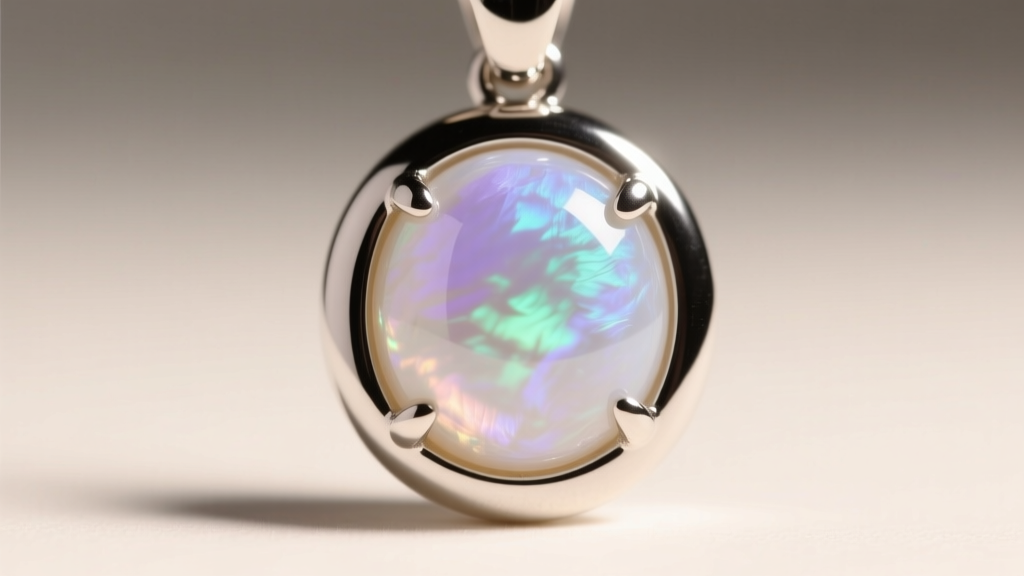
Setting Mechanics for High-Risk White Gemstones
The setting of your white gemstone necklace must be engineered to mitigate the specific structural vulnerabilities of the chosen stone. The classic 4-prong or 6-prong Tiffany setting maximizes light entry, which is ideal for high-RI stones like diamond and moissanite. However, prongs leave the girdle and crown facets exposed to lateral impacts.
- V-Prongs: Mandatory for white gemstones cut in marquise, pear, or princess shapes. The sharp corners of these cuts are structural weak points where stress concentrates. A V-prong caps the corner, distributing impact forces away from the cleavage planes.
- Bezel Settings: The gold standard for cabochon-cut opals and moonstones. A full bezel wraps a continuous rim of metal around the stone's perimeter, protecting the fragile edges from chipping and securing the stone against sheer forces that could pop it out of a prong setting.
- Tension Settings: While visually striking, these rely on the tensile strength of the metal shank to grip the stone. They are only recommended for stones with high toughness and no cleavage, such as white sapphire or synthetic cubic zirconia. Never use tension settings for diamonds with deep inclusions or fracture-filled stones.
Comparative Data: White Gemstone Necklace Specs
To make an informed technical decision, refer to the comparative matrix below. This data synthesizes optical performance, structural integrity, and current market pricing for a standard 1-carat equivalent pendant stone.
| Gemstone | Refractive Index | Mohs Hardness | Toughness | Cleavage | Ideal Setting |
|---|---|---|---|---|---|
| Diamond | 2.42 | 10 | Good | Perfect (Octahedral) | 4/6 Prong, V-Prong |
| Moissanite | 2.65 - 2.69 | 9.25 | Excellent | Indistinct | 4/6 Prong, Bezel |
| White Sapphire | 1.76 - 1.77 | 9 | Excellent | None (Conchoidal) | Prong, Tension, Bezel |
| Rainbow Moonstone | 1.52 - 1.53 | 6 - 6.5 | Poor | Perfect (Two directions) | Full Bezel, Cabochon |
| White Opal | 1.44 - 1.46 | 5.5 - 6.5 | Very Poor | None | Deep Bezel, Solid Backing |
Data sourced from the Hudson Institute of Mineralogy (Mindat) and GIA gemological databases.
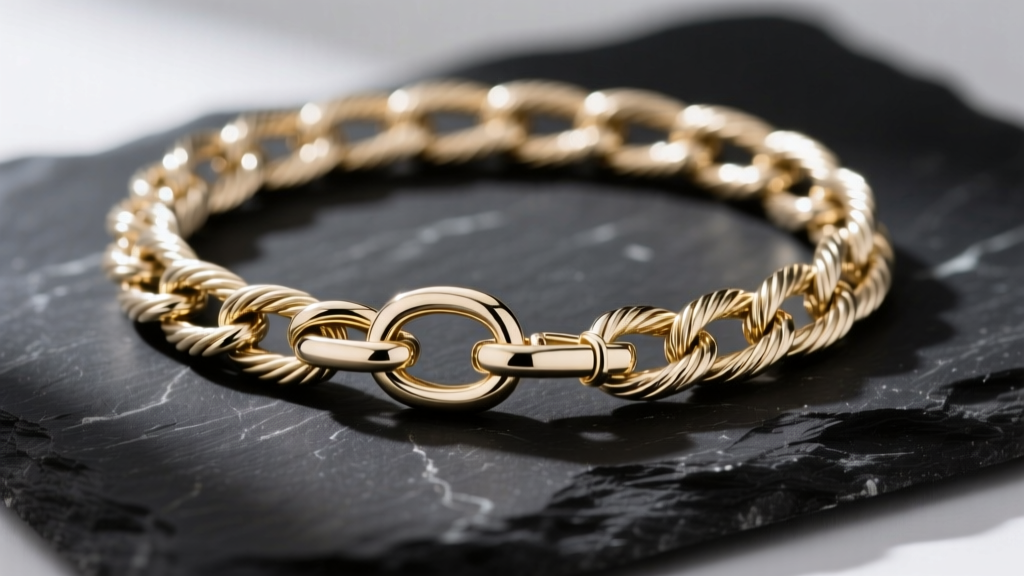
Chain Gauge and Clasp Engineering
The pendant is only half the engineering equation; the chain and clasp dictate the necklace's ultimate survival. A common failure point in white gemstone necklaces is the jump ring—the small loop connecting the pendant bail to the chain. If the jump ring is not laser-welded or torch-soldered shut, the lateral torque of a heavy pendant will eventually pry the metal apart, resulting in a lost stone. Always inspect the jump ring for a visible solder seam or weld mark.
Chain gauge (thickness) must be matched to the pendant's weight. For delicate pendants under 3 grams, a 0.9mm to 1.1mm cable or box chain is sufficient. However, for heavy solitaire pendants (5+ grams) or intricate halo settings, you must upgrade to a minimum 1.5mm wheat or rope chain. Wheat chains distribute tensile stress across interwoven links, offering a significantly higher yield strength before snapping compared to standard cable chains.
Finally, evaluate the clasp. Spring ring clasps rely on a tiny internal steel spring that frequently degrades, jams, or snaps. For any white gemstone necklace valued over $500, a solid cast lobster clasp is mandatory. Lobster clasps feature a wider, more robust internal spring mechanism and a larger gripping surface, reducing the risk of accidental unhooking when catching on clothing.
Expert Verdict: Matching Stone to Lifestyle
Choosing the right white gemstone necklace requires aligning material science with your daily environment. If you demand maximum optical fire and plan to wear the piece daily without removing it, Moissanite offers superior toughness and optical metrics at a fraction of the cost of diamond. If you prefer a natural, icy, understated elegance and prioritize chip-resistance over rainbow dispersion, White Sapphire in a bezel or sturdy prong setting is the ultimate technical choice. Conversely, if you are drawn to the ethereal glow of Moonstone or Opal, you must commit to a protective bezel setting, a heavier gauge chain, and a strict protocol of removing the necklace before physical activity or exposure to harsh chemicals. By respecting the gemological and mechanical realities of these stones, you ensure your necklace remains both secure and brilliant for decades.


