Technical Guide to Choosing a White Mother of Pearl Necklace
Discover the technical grading, nacre thickness, and setting methods that determine the quality and value of a white mother of pearl necklace.

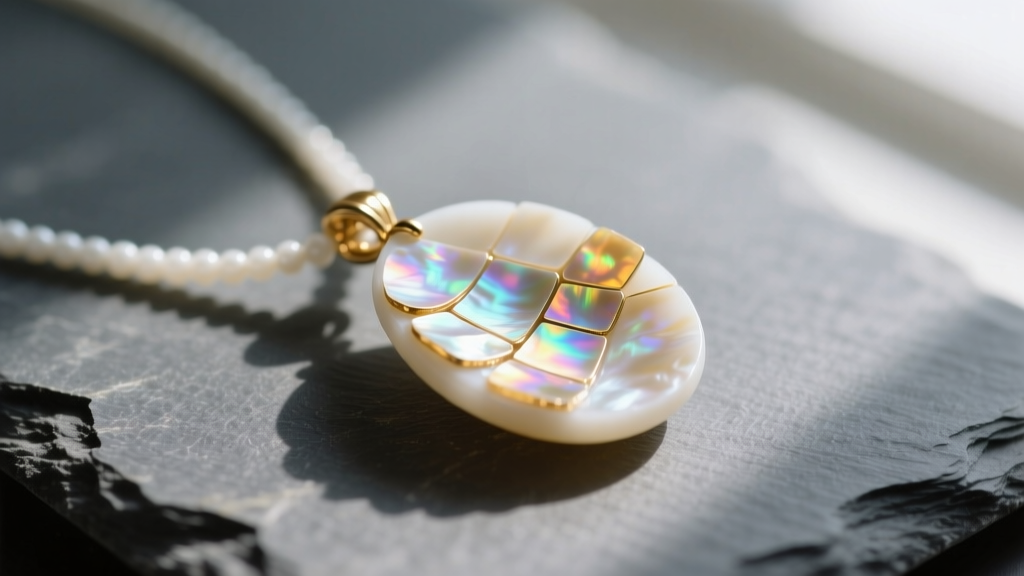
When evaluating a white mother of pearl necklace, most consumers focus solely on the iridescent flash. However, as a gemological material, mother of pearl (MOP) requires a rigorous technical assessment. Unlike faceted gemstones, MOP is an organic-inorganic composite. Its longevity, structural integrity, and ultimate value are dictated by its biomineralization, nacre thickness, and the mechanical tolerances of its setting. This guide bypasses superficial styling advice to provide a deep-dive technical framework for selecting, grading, and maintaining high-caliber white MOP jewelry.
The Mineralogy and Biomineralization of White Nacre
White mother of pearl is primarily harvested from the silver-lipped variety of the Pinctada maxima oyster, native to the warm waters of Australia, Indonesia, and the Philippines. The stark, luminous white coloration is a direct result of the oyster's mantle tissue genetics, which dictate the deposition of nacre without the dark organic pigments found in the black-lipped Pinctada margaritifera.
Under a scanning electron microscope, white MOP reveals a 'brick-and-mortar' microstructure. The 'bricks' are hexagonal platelets of aragonite (a crystalline form of calcium carbonate), typically measuring 0.5 micrometers in thickness. The 'mortar' is conchiolin, an organic protein matrix that binds the platelets together. This composite structure gives MOP its remarkable toughness compared to pure calcite, but it also introduces specific vulnerabilities. According to the Gemological Institute of America (GIA), the refractive index of nacre ranges from 1.53 to 1.68, and its specific gravity sits between 2.60 and 2.85. These optical and physical properties are what create the deep, satiny luster and subtle orient (iridescence) characteristic of premium white MOP.
Veneer vs. Solid: The Critical Thickness Metric
The single most important technical specification when buying a white mother of pearl necklace is the cross-sectional thickness of the nacre. The market is heavily saturated with veneered MOP, which fundamentally alters the piece's value and lifespan.
Veneered MOP (0.2mm to 0.8mm)
In mass-market jewelry, a paper-thin slice of high-grade white nacre is epoxied to a backing material—often dyed howlite, black onyx, or stamped brass. While this creates a high-contrast visual effect, the structural integrity relies entirely on the adhesive bond. Veneered MOP is highly susceptible to delamination if exposed to heat, ultrasonic cleaners, or solvent-based cosmetics.
Solid Carved MOP (2.0mm to 6.0mm+)
Premium necklaces utilize solid MOP, carved directly from the hinge of the oyster shell where the nacre is thickest. Solid pieces possess a three-dimensional depth of luster, as light penetrates the aragonite layers and reflects back through the conchiolin matrix. When assessing a solid piece, look for a uniform, waxy luster on the back of the pendant rather than a flat, matte, or artificially polished backing stone.
Setting Tolerances and Mechanical Stress
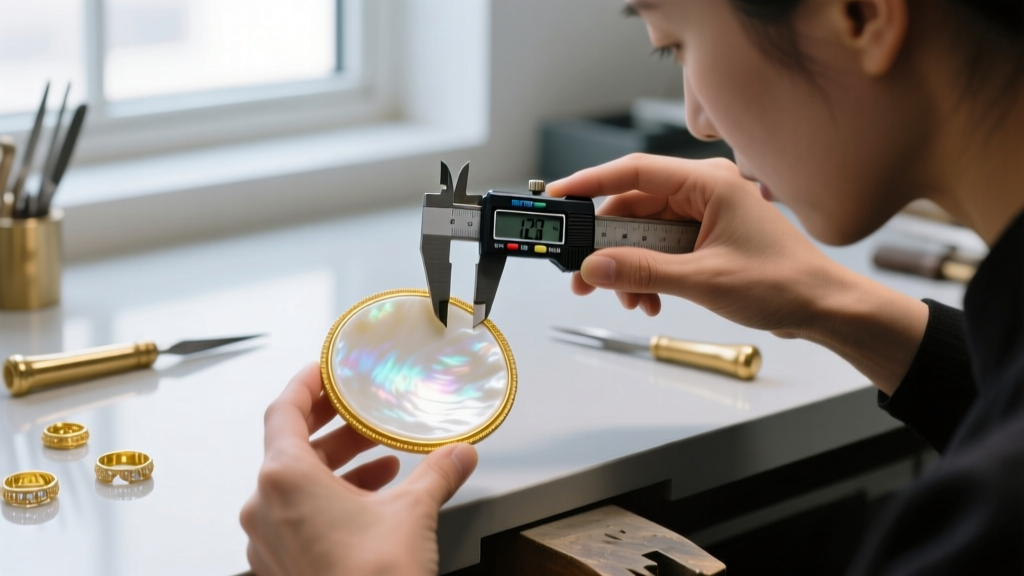
With a Mohs hardness rating of only 2.5 to 4.5, white MOP is exceptionally soft. For context, standard airborne quartz dust has a Mohs hardness of 7.0, meaning MOP can be scratched simply by wiping it with a dry, unwashed cloth. Because of this softness and its conchoidal fracture pattern, the setting technique used in a white mother of pearl necklace dictates its survival rate.
| Setting Type | Mechanical Risk | Technical Recommendation |
|---|---|---|
| Bezel | Low | Optimal. A 0.5mm to 1.0mm gold or platinum lip fully encapsulates the fragile edge, preventing conchoidal chipping from lateral impacts. |
| Prong | High | Avoid. Prongs concentrate kinetic stress onto microscopic points on the MOP surface, inevitably leading to micro-fractures and eventual cleavage. |
| Channel / Inlay | Medium | Acceptable if calibrated perfectly. Requires a 0.1mm expansion gap to account for the differing thermal expansion rates of the metal and the organic nacre. |
As noted in the GIA Pearl Quality Factors documentation, the craftsmanship of the mount is just as critical as the gem material itself in organic jewelry. A poorly executed bezel that applies uneven pressure during the burnishing process will cause internal stress fractures that may not appear until months after purchase.
Chemical Vulnerabilities and Real-World Failure Modes
Understanding the chemical failure modes of calcium carbonate is essential for long-term preservation. White MOP is highly reactive to acids. Human sweat has a pH ranging from 4.5 to 7.0, containing lactic and ureic acids. When a MOP pendant rests against the décolletage during high heat or physical exertion, the acid slowly etches the aragonite platelets, converting the surface into calcium lactate. This manifests as a permanent, dull, chalky white film that cannot be polished away without removing significant layers of nacre.
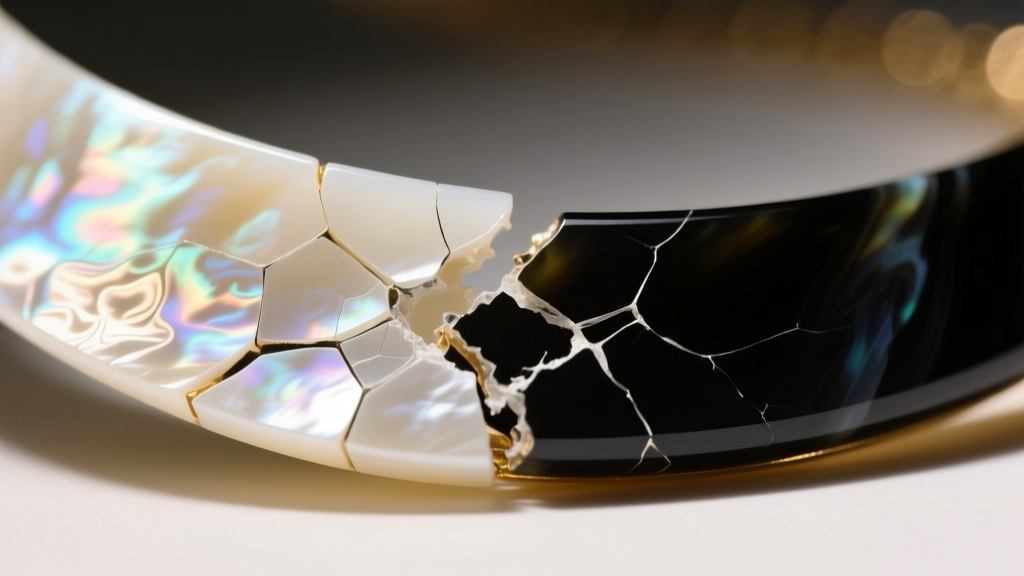
Furthermore, the conchiolin protein matrix is vulnerable to desiccation and chemical degradation. Exposure to chlorinated pool water, sulfur-heavy hot springs, or alcohol-based perfumes will break down the organic bonds, leading to 'crazing' (a network of fine surface cracks) and eventual exfoliation of the nacre layers. To mitigate this, solid MOP should be stored in a humidity-controlled environment (ideally 40-50% relative humidity) and never sealed in an airtight plastic bag, which can trap off-gassing chemicals from synthetic fabrics.
Market Pricing and Value Tiers
Pricing for a white mother of pearl necklace is highly stratified based on the metrics outlined above. Use this framework to evaluate market offerings:
- Tier 1: Fashion / Veneer ($40 - $150) Features 0.3mm nacre glued to brass or dyed stone. Usually set in sterling silver or gold vermeil. High visual impact but a functional lifespan of 2 to 5 years before delamination or edge wear occurs.
- Tier 2: Commercial Solid ($200 - $600) Features 2.0mm to 3.0mm solid MOP, often mass-cut in standardized cabochon shapes. Set in sterling silver with basic bezels. Excellent for daily wear, provided the nacre is free of heavy calcitic banding.
- Tier 3: Gemological / Artisan ($800 - $3,000+) Features 4.0mm+ solid nacre harvested from the premium hinge zone of Pinctada maxima. Exhibits high-contrast orient and is set in 18k gold or platinum with precision-engineered expansion gaps. These are heirloom-grade pieces that appreciate in value as wild-harvested shell restrictions tighten globally.
By prioritizing nacre thickness, mechanical setting tolerances, and chemical awareness, you can confidently select a white mother of pearl necklace that is not only visually stunning but structurally engineered to endure.