Why Do People Wear Cross Necklaces? A Beginner's Guide to Faith & Fashion
Discover why do people wear cross necklaces, exploring the blend of faith, history, and fashion. Learn how to choose the right metal, chain, and length.

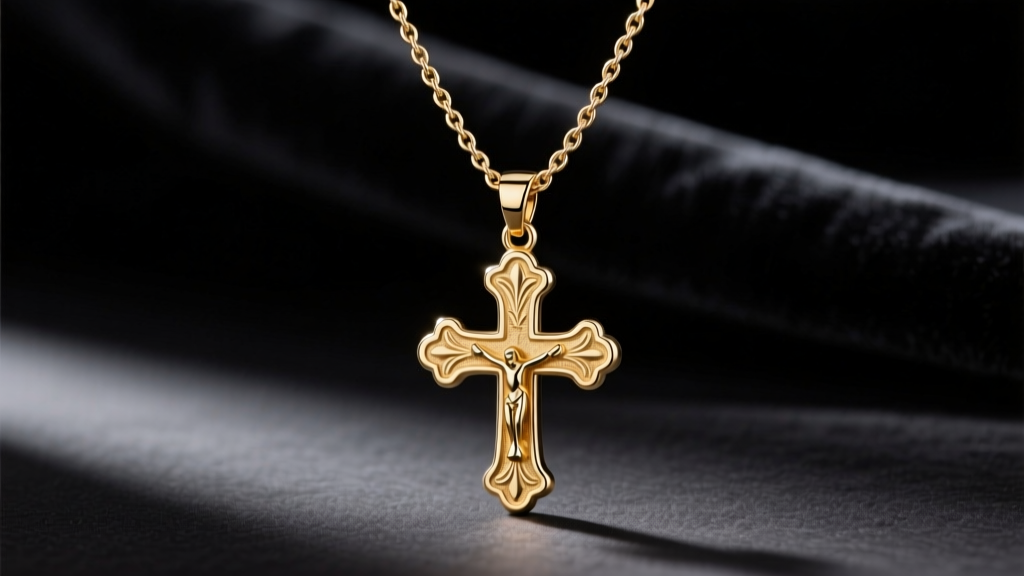
If you have ever wondered why do people wear cross necklaces, the answer lies at the fascinating intersection of ancient devotion, cultural heritage, and modern streetwear. For centuries, the cross has been one of the most recognizable symbols in human history. While its roots are deeply embedded in Christian theology, its evolution into a ubiquitous jewelry staple means that today, people wear cross pendants for a multitude of reasons—ranging from profound spiritual grounding to pure aesthetic expression.
In this beginner-friendly explainer, we will unpack the historical and cultural drivers behind this iconic accessory. More importantly, we will provide actionable, expert-level guidance on how to select the right metal grade, chain gauge, and pendant length to suit your personal style and skin sensitivities.
The Historical and Spiritual Roots
To understand the enduring appeal of the cross necklace, we must look back to the early centuries of the Common Era. Initially, early Christians used covert symbols like the Ichthys (the Jesus fish) to avoid persecution. It wasn't until the 4th century, following the Roman Emperor Constantine's conversion, that the cross emerged as a public emblem of faith. According to historians at Britannica, the cross transitioned from an instrument of Roman execution to a universal symbol of resurrection, hope, and divine protection.
For many believers today, wearing a cross necklace is a deeply personal act of devotion. It serves as a tactile reminder of their faith, a source of comfort during difficult times, and a public declaration of their spiritual identity. The physical weight of the pendant against the chest often provides a grounding, meditative effect throughout the day.
Cultural Crossovers: From Altars to Streetwear
While faith remains the primary driver for millions, the cross has also transcended its religious boundaries to become a powerhouse motif in global fashion. The pivot began in the mid-20th century and exploded in the 1980s when pop icons like Madonna and George Michael incorporated crucifixes into their stage wardrobes, blending the sacred with the provocative.
Today, high-end fashion houses and streetwear brands alike utilize the cross for its striking geometric symmetry. The intersecting vertical and horizontal lines create a visually balanced focal point that anchors any outfit. Whether it is a diamond-encrusted piece worn by a hip-hop artist or a minimalist, matte-black steel cross worn by a skater, the symbol has been adopted as an emblem of rebellion, remembrance, and high fashion.
Choosing the Right Metal: Durability and Skin Sensitivities
When shopping for a cross pendant, the material dictates not only the price but also how the piece will age and interact with your skin. The Gemological Institute of America (GIA) emphasizes that understanding metal alloys is crucial for daily-wear jewelry. Here is a breakdown of the most common metals used for cross necklaces:
| Metal Grade | Durability & Care | Price Range | Best For |
|---|---|---|---|
| 316L Surgical Steel | Highly durable, tarnish-free, hypoallergenic | $15 - $50 | Shower/swim wear, sensitive skin, tight budgets |
| 925 Sterling Silver | Medium (requires occasional polishing to remove oxidation) | $40 - $150 | Classic vintage looks, moderate budgets |
| 14k Solid Gold | Very high (58.5% gold, scratch-resistant alloy) | $150 - $600+ | Lifetime daily wear, heirloom pieces |
| 18k Solid Gold | Medium-High (75% gold, softer and more prone to scratching) | $300 - $1,200+ | Rich color, occasional wear, luxury gifting |
| Platinum (950) | Extreme (dense, hypoallergenic, develops a patina over time) | $500 - $2,000+ | High-end diamond settings, luxury collectors |
Expert Tip: If you have a nickel allergy, avoid cheap 'gold-plated' brass or mystery white gold alloys. Always opt for 316L stainless steel, platinum, or high-palladium white gold to prevent contact dermatitis.
Chain Pairings: Matching Gauges and Styles
A cross pendant is only as good as the chain that holds it. A common beginner mistake is buying a heavy solid gold crucifix and hanging it on a flimsy 0.9mm chain, which will eventually snap or wear through the bail (the loop connecting the pendant to the chain).
Chain Styles and Their Vibe
- Cable Chain (1.2mm - 2.0mm): The classic, minimalist choice. Perfect for lightweight, small Latin crosses. It stays hidden and lets the pendant take center stage.
- Box Chain (1.5mm - 2.5mm): Features square, interlocking links. Highly durable and reflects light beautifully. Ideal for medium-weight pendants.
- Figaro Chain (2.5mm - 4.0mm): An Italian design with a pattern of three short links and one long link. Offers a vintage, masculine, or streetwear aesthetic.
- Rope Chain (2.0mm - 5.0mm): Twisted links that mimic a rope. Excellent for heavy, gemstone-studded crosses because the twisted structure distributes weight evenly.
Length Guide for Necklines
Where the cross rests on your chest changes the entire dynamic of your outfit. According to archival styling notes from The Metropolitan Museum of Art, the placement of religious artifacts has historically denoted different social and spiritual standings. Today, it is purely about proportions:
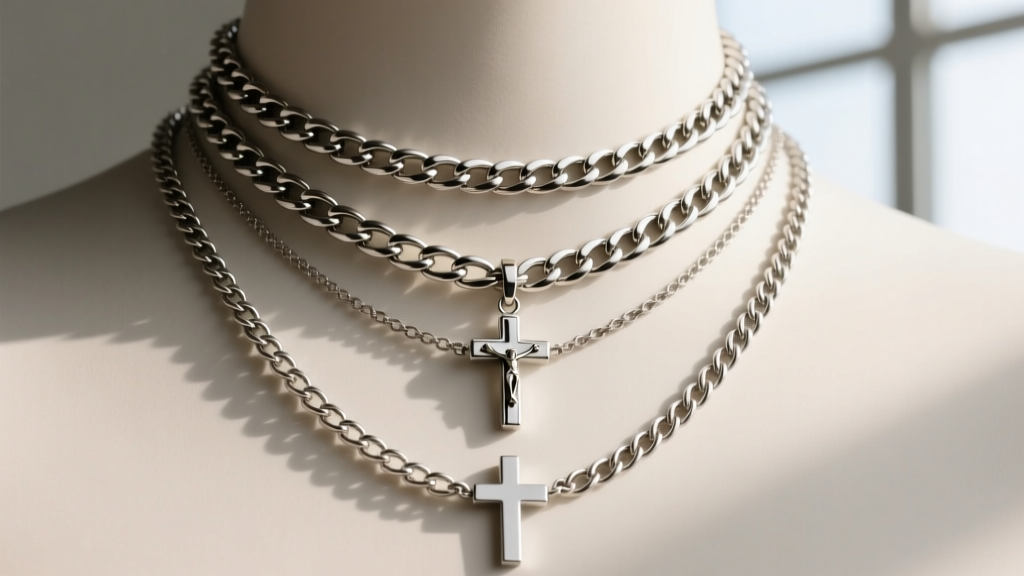
- 16 Inches (Choker): Sits tightly on the collarbone. Best for women's delicate, minimalist crosses or layered looks.
- 18 Inches (Standard): Rests at the base of the neck. The most versatile length for both men and women, easily tucked under a t-shirt or left over a button-down.
- 20 to 22 Inches (Chest): Hangs on the upper chest. The go-to length for streetwear, pairing perfectly with hoodies and oversized graphic tees.
- 24 to 30 Inches (Long): Rests on the sternum or lower. Often used for large, statement crucifixes or layered over winter outerwear.
Decoding Cross Variations
Not all crosses are created equal. The specific design you choose often signals your heritage, denomination, or aesthetic preference.
'The geometry of the cross is as diverse as the cultures that have adopted it. From the elongated Latin cross to the ringed Celtic cross, each variation carries centuries of localized history and theological nuance.'
- The Latin Cross: The most universal design, featuring a longer descending arm. It is the standard representation of the crucifixion.
- The Crucifix: A cross that includes a three-dimensional corpus (the body of Christ). Primarily worn by Catholics and Orthodox Christians to emphasize the sacrifice of the Passion.
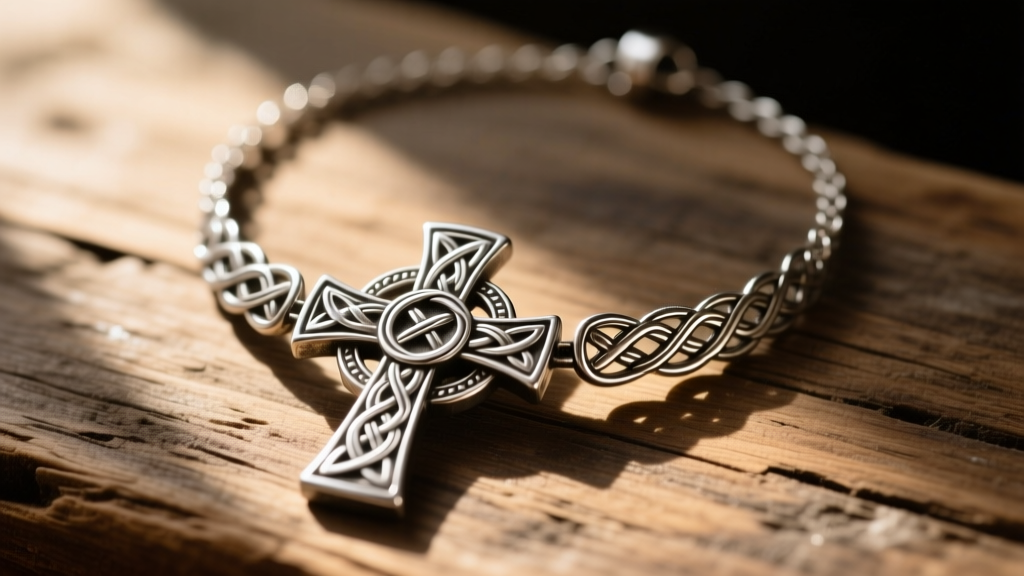
- The Celtic Cross: Features a ring intersecting the crossbars. Originating in early medieval Ireland and Britain, the circle is often interpreted as a symbol of eternity or the sun.
- The Orthodox Cross (Slavic): Features three horizontal beams, with the lowest beam slanted. It is deeply tied to Eastern Orthodox traditions in Russia, Greece, and Eastern Europe.
- The Ankh: While not a Christian cross, this ancient Egyptian 'key of life' is frequently adopted in gothic and alternative fashion for its striking, loop-topped silhouette.
Final Thoughts on Styling Your Cross
Ultimately, the reason people wear cross necklaces is as individual as the wearers themselves. Whether you are holding onto a family heirloom passed down through generations, signaling your faith to the world, or simply appreciating the timeless, architectural symmetry of the shape, the cross remains an unparalleled jewelry staple. By paying close attention to metal grades, chain gauges, and proportional lengths, you can ensure your cross necklace is not just meaningful, but built to last a lifetime.


