Wire Flower Necklace Buying Guide: Metals, Gauges & Care
Discover how to choose the perfect wire flower necklace. Learn about wire gauges, metal grades, gemstone settings, and care tips in our expert guide.

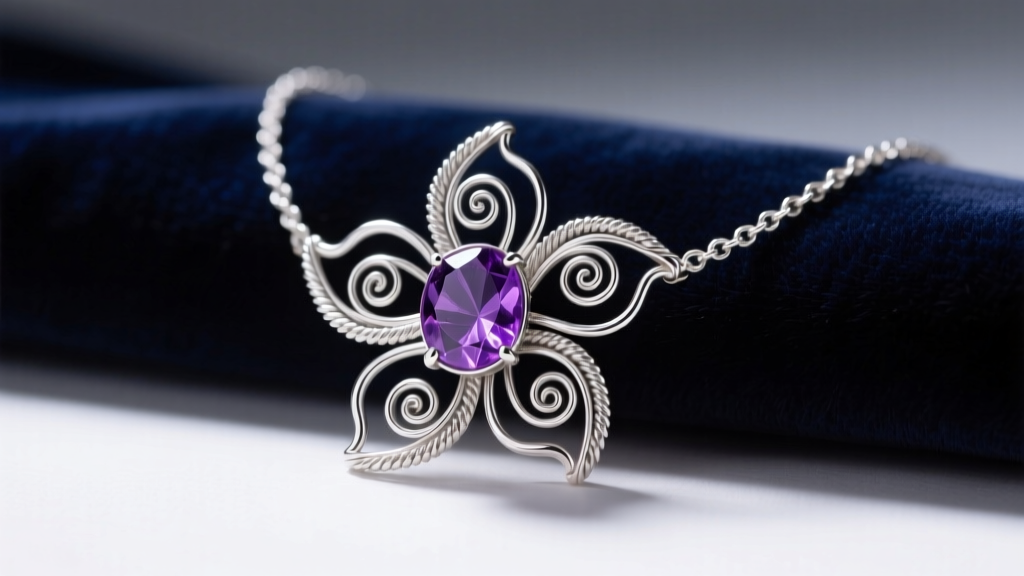
The Art and Engineering of Wire-Wrapped Floral Jewelry
A wire flower necklace is more than just a decorative accessory; it is a miniature feat of metallurgical engineering and botanical artistry. Unlike cast or stamped jewelry, handcrafted wire-wrapped florals rely entirely on the artisan's understanding of metal temper, tension, and structural integrity. When you are investing in a wire flower necklace, you are purchasing a piece where every petal, stamen, and stem has been individually manipulated. However, the market is flooded with mass-produced imitations and fragile amateur pieces that bend out of shape after a single wear. This comprehensive buying guide will equip you with the technical knowledge to evaluate wire gauges, metal compositions, and structural durability, ensuring you select a botanical masterpiece that lasts a lifetime.
Decoding Wire Gauges: The Backbone of Floral Design
The most critical factor in determining the longevity and detail of a wire flower necklace is the wire gauge. In jewelry making, the American Wire Gauge (AWG) system is the standard. Counterintuitively, the higher the gauge number, the thinner the wire. A high-quality floral pendant requires a strategic combination of multiple gauges to mimic the delicate veins of a petal while maintaining a rigid stem. According to jewelry supply experts at Fire Mountain Gems, utilizing a single gauge for an entire floral piece is a hallmark of poor craftsmanship, as it results in either a piece that is too bulky to show detail or too fragile to hold its shape.
| AWG Size | Millimeter (mm) | Botanical Application | Required Temper |
|---|---|---|---|
| 16 - 18 Gauge | 1.29mm - 1.02mm | Main stems, heavy branches, pendant bails | Half-Hard or Full-Hard |
| 20 - 22 Gauge | 0.81mm - 0.64mm | Primary petals, structural leaves, frames | Half-Hard |
| 24 - 26 Gauge | 0.51mm - 0.40mm | Petal weaving, stamen, gemstone wrapping | Dead Soft |
| 28 - 30 Gauge | 0.32mm - 0.25mm | Micro-weaving, delicate vine tendrils | Dead Soft |
When inspecting a wire flower necklace, look closely at the stem. If the stem is made from 24-gauge wire or thinner, the pendant will inevitably droop and deform under the weight of the chain and any integrated gemstones. Conversely, if the delicate tips of the petals are crafted from 18-gauge wire, the flower will look clunky and lack organic fluidity.
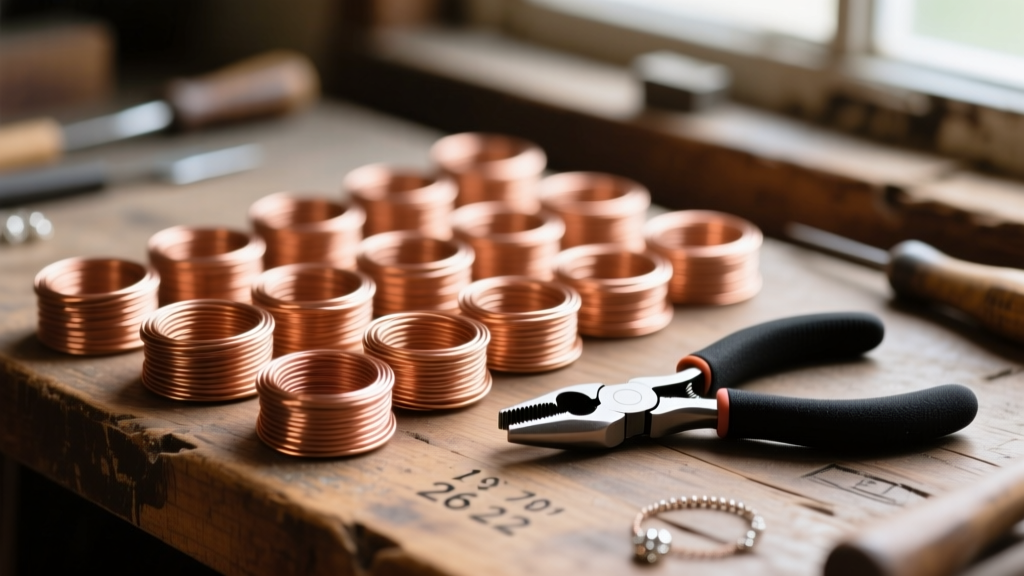
Metal Selection: Durability, Allergies, and Aesthetics
The metal chosen for a wire flower necklace dictates not only its visual warmth but also its work-hardening potential and skin safety. Wire wrapping relies on 'work-hardening'—the process where metal becomes stiffer and more brittle as it is bent and manipulated. Different metals respond to this process in vastly different ways.
Precious and Filled Metals
- .925 Sterling Silver: The gold standard for heirloom-quality wire flowers. Sterling silver work-hardens beautifully, allowing artisans to create crisp, rigid petals. However, it is prone to sulfide tarnishing. Look for pieces that have been treated with anti-tarnish sealants or stored with anti-tarnish strips.
- 14/20 Gold-Filled: Not to be confused with gold-plated wire. By FTC guidelines, gold-filled wire must contain at least 5% (1/20th) gold by weight, mechanically bonded to a brass core. It offers the rich luster of solid gold and the structural rigidity required for stems, without the exorbitant price tag of 14k solid gold wire.
Base and Alternative Metals
- Bare Copper: Highly favored by artisans for its warm, earthy tone and excellent malleability. Copper work-hardens quickly and is often treated with 'liver of sulfur' to create a dark, antique patina that highlights the intricate weaves of the petals. Be aware that unsealed copper will oxidize and can leave a green residue on the skin due to natural body acidity.
- Jeweler's Brass (Merlin's Gold): An alloy of copper and zinc that mimics the color of 14k gold. It is stiffer than copper, making it excellent for structural stems, but it can cause contact dermatitis in individuals with severe nickel or zinc sensitivities.
For a deep dive into metal compositions and allergy safety, the Gemological Institute of America (GIA) provides extensive resources on jewelry metallurgy and skin reactions.
Evaluating Gemstone Integration in Wire Flowers
A premium wire flower necklace often features a gemstone serving as the 'pistil' or center of the bloom. The method used to secure the stone is a major indicator of the artisan's skill level. Because wire wrapping does not use solder, the stone must be held entirely by mechanical tension.
Look for stones that are secured using a 'bezels' or 'prong' technique where the wire is anchored to the structural frame of the flower. If the gemstone is merely glued into a wire nest, or if the wire wrapping around the stone feels loose when gently wiggled, the stone will eventually dislodge. Cabochon (smooth, unfaceted) stones like moonstone, opal, and turquoise are ideal for wire flowers because their flat backs sit flush against the wire frame, while their domed tops allow the wire to grip the edges securely. Faceted stones require significantly more advanced wire-weaving techniques to prevent the wire from slipping off the angled edges.
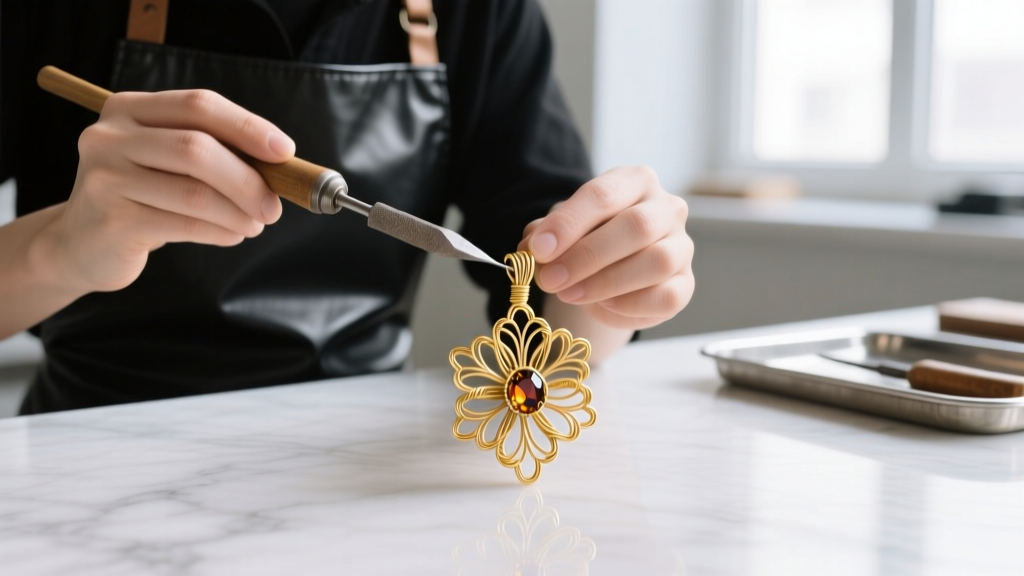
Common Failure Points and the Quality Check Protocol
Before purchasing a handcrafted wire flower necklace, perform these three critical quality checks to identify potential failure modes:
The Artisan's Rule of Thumb: Every single cut end of a wire must be filed, sanded, or burnished flush. If a wire end is merely snipped with flush cutters, it will leave a microscopic sharp edge that will eventually snag on clothing or scratch the wearer's skin.
- The Snag Test: Gently run the pendant over a piece of delicate silk or a microfiber cloth. If the wirework catches or snags the fabric, the piece has sharp burrs or poorly tucked wire ends. A master-crafted wire flower should feel completely smooth to the touch.
- The Flex Test: Gently squeeze the outer petals. They should exhibit slight resistance and spring back to their original shape. If the petals bend easily and stay deformed, the artisan failed to work-harden the metal after shaping, meaning the necklace will lose its form during normal wear.
- The Bail Inspection: The bail (the loop the chain passes through) experiences the most friction. Ensure the bail is wrapped securely and that the wire ends are tucked inward, not resting against the chain where they could cause premature wear on the chain links.
Pricing Tiers: What Should You Expect to Pay?
Understanding the pricing structure of wire-wrapped jewelry helps you identify fair market value and avoid overpaying for amateur work. Prices are generally dictated by material costs, the complexity of the weave, and the artist's reputation.
- $45 - $120 (Amateur to Intermediate): Typically features bare copper, brass, or silver-plated wire. Designs are often simpler, utilizing basic weaving techniques. Gemstones may be tumbled or lower-grade cabochons. Excellent for everyday, casual wear, but may require occasional reshaping.
- $150 - $350 (Advanced Artisan): Crafted with .925 sterling silver or 14/20 gold-filled wire. These pieces feature complex, multi-layered petals, micro-weaving (using 28g+ wire), and high-quality, ethically sourced gemstones. The metal is properly work-hardened and finished with professional tumbling or polishing.
- $400 - $800+ (Master / Heirloom): Museum-quality botanical replicas. These pieces often incorporate solid gold accents, rare gemstones (likeParaíba tourmaline or high-grade Australian opals), and hundreds of hours of meticulous micro-sculpting. They are treated as wearable fine art.
Care and Maintenance for Intricate Wirework
Because a wire flower necklace relies on tension and mechanical wraps rather than solder, it requires specific care to maintain its structural integrity. Never place a wire-wrapped floral pendant in an ultrasonic cleaner. The high-frequency vibrations can loosen the tension wraps holding the gemstones and cause delicate 28-gauge micro-weaves to fracture.
Instead, clean your necklace using a few drops of mild dish soap, lukewarm water, and a baby-soft toothbrush. Gently brush the crevices of the petals to remove skin oils and lotion buildup. Dry thoroughly with a lint-free cloth. For sterling silver and copper pieces, use a treated jeweler's polishing cloth to gently buff the high points of the wire, leaving the dark patina in the deep crevices to maintain the three-dimensional contrast of the flower. Always store your wire flower necklace flat in a rigid box; hanging it on a traditional jewelry tree can cause the stems to bend under their own weight over time.


