Wooden Disc Necklace Guide: Wood Types, Hardness & Properties
Compare wood types for your next wooden disc necklace. Learn about Janka hardness, moisture resistance, and finishing techniques for lasting wear.

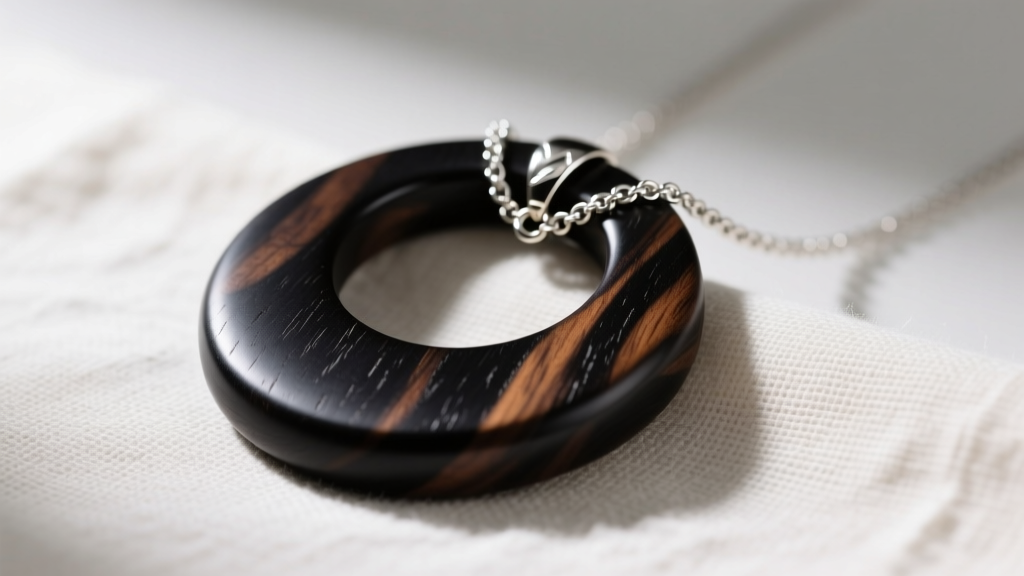
Organic jewelry has seen a massive resurgence, with the wooden disc necklace emerging as a staple for its minimalist geometry and natural warmth. However, not all wood is created equal. A pendant crafted from soft pine will dent, warp, and degrade within months of daily wear, while a high-density hardwood can last generations. Understanding the material science behind wood species, specific gravity, and finishing chemistry is critical for selecting a piece that balances aesthetic appeal with structural longevity.
The Janka Hardness Scale: Measuring Disc Durability
In woodworking and jewelry design, the Janka hardness test is the gold standard for measuring a wood's resistance to denting and wear. The test measures the force (in pounds-force, or lbf) required to embed a 0.444-inch steel ball halfway into the wood. For a wooden disc necklace that rests against the collarbone and is subject to accidental impacts, dropping, and fingernail scratches, a minimum Janka rating of 1,200 lbf is highly recommended.
Below is a comparative framework of popular wood species used in disc pendants, evaluating their hardness, specific gravity (which dictates weight), and ideal use cases.
| Wood Species | Janka Hardness (lbf) | Specific Gravity (SG) | Wear Profile & Best Use |
|---|---|---|---|
| African Ebony | 3,220 | 1.10 - 1.15 | Extremely durable, heavy, sinks in water. Best for premium, dark-toned statement pieces. |
| Olive Wood | 2,710 | 0.85 - 0.90 | High natural oil content, highly water-resistant. Ideal for intricate grain patterns. |
| Hard Maple | 1,450 | 0.63 - 0.70 | Lightweight, tight pores, takes dye exceptionally well. Best for brightly colored or painted discs. |
| Genuine Mahogany | 800 - 900 | 0.50 - 0.60 | Softer, lightweight, warm reddish-brown. Requires heavy surface sealing to prevent denting. |
| Bamboo (Grass) | 1,380 | 0.60 - 0.75 | Sustainable, fibrous texture, prone to splintering if not laser-cut and sealed properly. |
Top Wood Species for Disc Pendants Compared
Ebony and Wenge: The Dense Heavyweights
Woods like African Ebony and Wenge boast incredibly tight cellular structures. Because their pores are so small, they can be sanded to 3000-grit and buffed to a glass-like finish using nothing but friction and natural waxes, without requiring chemical sealants. The trade-off is weight. A 50mm diameter, 5mm thick ebony disc will feel noticeably heavy on a delicate chain, requiring a robust cable chain (at least 2.0mm thick) to support the pendant's specific gravity without stretching the links over time.
Maple and Birch: The Porous Canvases
Hard Maple and Baltic Birch are significantly lighter and feature a pale, neutral base color. Their open, albeit tight, pore structure makes them the premier choice for woodworkers who want to stabilize the wood with resin or apply vibrant aniline dyes. If you are purchasing a dyed wooden disc necklace, ensure the artisan has used a penetrating dye rather than a surface stain, which can chip or rub off against white clothing.
Olive Wood: The Oily Classic
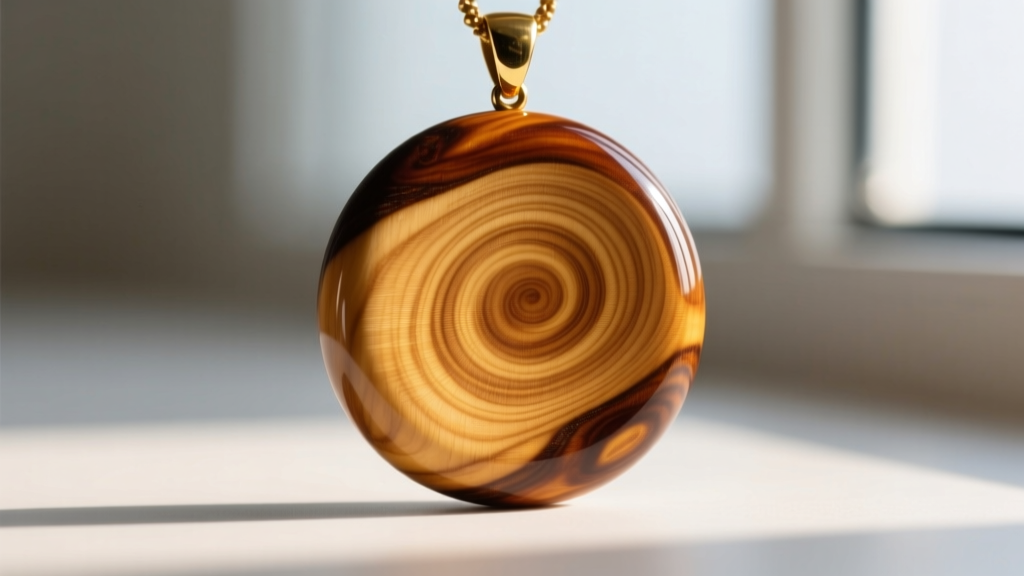
Olive wood is prized for its chaotic, swirling grain patterns and high natural oil content. This inherent oleoresin makes it naturally resistant to moisture absorption, meaning it is less likely to warp when exposed to ambient humidity changes. However, these same natural oils can interfere with certain chemical adhesives and surface finishes, requiring the wood to be wiped with acetone before any polyurethane or CA glue finish is applied.
Moisture, Oils, and Finishing Techniques
Wood is a hygroscopic material; it absorbs and releases moisture from the air and from your skin. According to the USDA Forest Products Laboratory, unsealed wood will constantly expand and contract with humidity fluctuations, eventually leading to micro-fractures around the hardware holes. To combat this, a high-quality wooden disc necklace must be properly sealed.
- Penetrating Oils (Tung & Linseed): These oils polymerize inside the wood pores, hardening from the inside out. They provide a matte, natural-feeling finish that is easily spot-repaired, but they offer moderate resistance to heavy sweat and lotions.
- Carnauba Wax: Often applied over penetrating oils, carnauba provides a soft, low-luster sheen. It requires reapplication every few months to maintain water resistance.
- Cyanoacrylate (CA) Glue Finish: A favorite among woodturners, thin CA glue is spun onto the disc and sanded flat. It creates a micro-thin, completely impermeable acrylic shell that is highly resistant to skin acids, perfumes, and water. If a wooden disc looks like it has a glass-like, high-gloss reflection, it likely features a CA finish.
- Polyurethane Varnish: Provides excellent water resistance but can look plasticky and thick, obscuring the tactile warmth of the wood grain.
Chain Pairing and Hardware Considerations
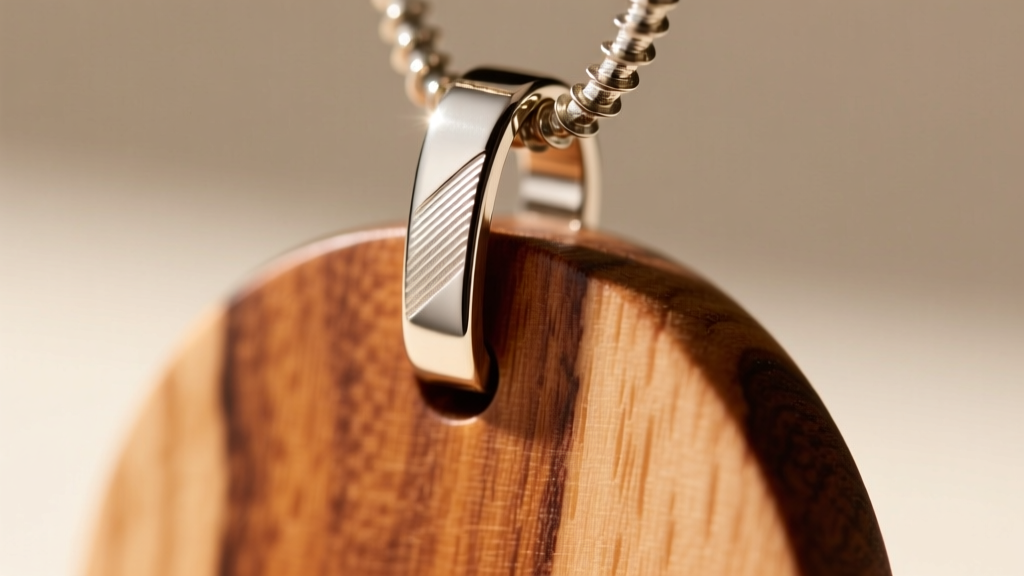
The structural failure point of almost any wooden pendant is not the disc itself, but the hardware attachment. Because wood is anisotropic (its strength varies depending on the grain direction), attaching a bail to the end-grain requires precise engineering.
Screw-Eye vs. Sandwich Bails
A screw-eye bail is threaded directly into the top edge of the disc. For this to hold securely without splitting the wood, the artisan must drill a pilot hole that exactly matches the core diameter of the screw threads, leaving only the threads to bite into the wood. Furthermore, using titanium or surgical stainless steel hardware is vital; cheap plated brass or iron screw-eyes will rust inside the wood when exposed to sweat, causing the surrounding wood fibers to rot and turn black.
A sandwich bail (or clamp bail) avoids drilling into the edge entirely. Instead, a small hole is drilled through the flat face of the disc near the top edge, and a metal loop is secured with a rivet or a Chicago screw on the front and back. This distributes the tension across the face-grain, which is significantly stronger and more resistant to splitting than the end-grain.
Care and Maintenance Framework
To maximize the lifespan of your wooden disc necklace, adopt the following maintenance protocol:
- The 'Last On, First Off' Rule: Always put your wooden jewelry on after applying perfumes, hairsprays, and lotions. Alcohol and chemical solvents will strip penetrating oils and cloud CA glue finishes.
- Shower and Swim Restrictions: While a CA-finished olive wood disc can survive a splash, prolonged submersion in chlorinated pools or hot showers will eventually compromise the finish and cause the wood to swell.
- Seasonal Re-oiling: If your pendant has a matte, oil-rubbed finish, apply a single drop of food-grade mineral oil or specialized wood balm every six months. Rub it in with a microfiber cloth, let it sit for 15 minutes, and buff off the excess to prevent a sticky residue.
By prioritizing high-Janka hardwoods, verifying the finishing chemistry, and inspecting the hardware installation, you can invest in a wooden disc necklace that remains a durable, striking element of your wardrobe for years to come.


