Wooden Pendant Necklace Materials: Hardness & Care Guide
Discover the best wood species for a wooden pendant necklace. Compare Janka hardness, bail hardware, finishes, and chain pairings.

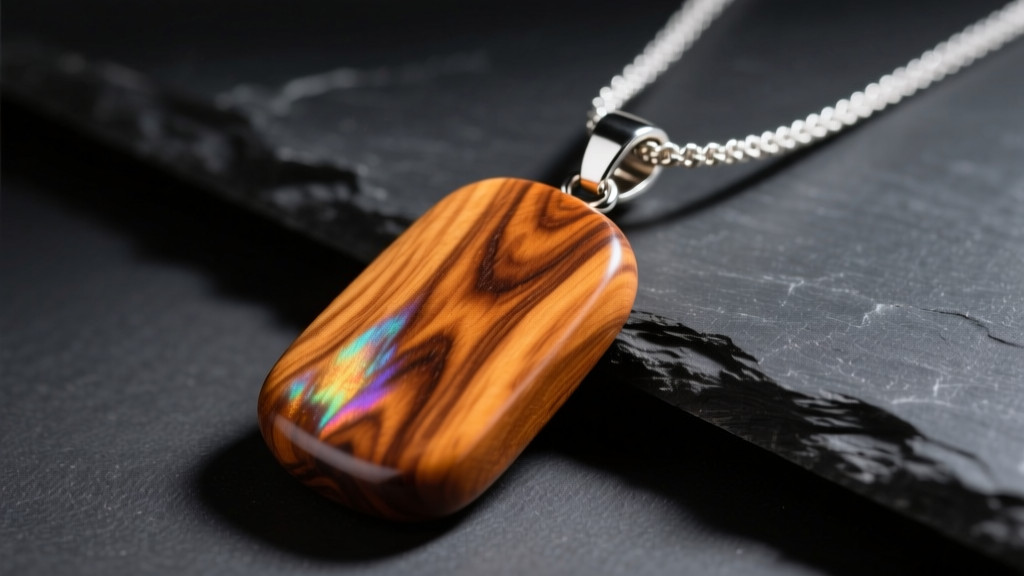
When selecting a wooden pendant necklace, buyers and collectors often focus solely on the carved design or the accompanying metal chain. However, the structural integrity, longevity, and visual evolution of the piece are strictly dictated by the specific wood species and its inherent material properties. Unlike metals or gemstones, wood is a hygroscopic and anisotropic material—meaning it absorbs moisture from the air and expands or contracts at different rates depending on the grain direction. Understanding these material realities is the difference between purchasing an heirloom-quality organic jewel and a piece that will crack, warp, or lose its hardware within a year.
The Janka Hardness Scale: Ranking Woods for Jewelry
The Janka hardness test is the industry standard for measuring the wear resistance of wood. It calculates the force (in pounds-force, or lbf) required to embed a 0.444-inch steel ball halfway into the timber. For a wooden pendant necklace, a higher Janka rating generally translates to better resistance against scratches, dents from daily impacts, and edge wear. While softwoods like Pine (380 lbf) are entirely unsuitable for jewelry due to their fragility, exotic hardwoods offer incredible durability that rivals soft metals.
| Wood Species | Janka Hardness (lbf) | Specific Gravity | Visual & Tactile Properties |
|---|---|---|---|
| African Ebony | 3,220 | 1.10 - 1.30 | Jet black, ultra-fine texture, sinks in water, polishes to a glass-like sheen without finish. |
| Hawaiian Koa | 1,170 | 0.55 - 0.70 | Warm golden-browns to deep reds, highly prized for intense chatoyancy (3D ribbon effect). |
| Hard Maple | 1,450 | 0.60 - 0.75 | Creamy white to pale yellow, tight closed grain, excellent candidate for dye stabilization. |
| Black Walnut | 1,010 | 0.55 - 0.65 | Rich chocolate browns with purple undertones, straight grain, highly workable for intricate carving. |
| Sandalwood | 1,200 | 0.85 - 0.95 | Aromatic, oily, soft to carve, requires careful sealing to preserve its natural scent profile. |
According to the comprehensive data compiled by the Wood Database, species like African Ebony and Lignum Vitae are so dense that they naturally resist moisture absorption better than lighter woods, making them exceptionally stable choices for pendants worn close to the skin.
Grain, Chatoyancy, and Visual Properties
Beyond hardness, the optical properties of the wood define the aesthetic value of the pendant. Chatoyancy—often referred to as the 'cat's eye' effect—occurs when light reflects off the three-dimensional ribbon structures within the wood's cellular walls. Hawaiian Koa and Curly Maple are famous for this phenomenon. When turned or carved so the end-grain is exposed at specific angles, the wood appears to ripple and shift in the light as the wearer moves.
Stabilization and Dye Penetration
For lighter, more porous woods like Hard Maple or Buckeye Burl, jewelers often use a vacuum stabilization process. The wood is submerged in a liquid resin (such as Cactus Juice) and placed in a vacuum chamber to draw out trapped air. Once the vacuum is released, the resin is forced deep into the cellular structure. After heat-curing, the wood becomes a wood-polymer composite. This process not only increases the Janka hardness and eliminates hygroscopic movement but also allows for the introduction of vibrant, permanent dyes that mimic the look of turquoise or lapis lazuli while retaining the organic warmth of wood.
Hardware and Bail Construction: Where Pendants Fail
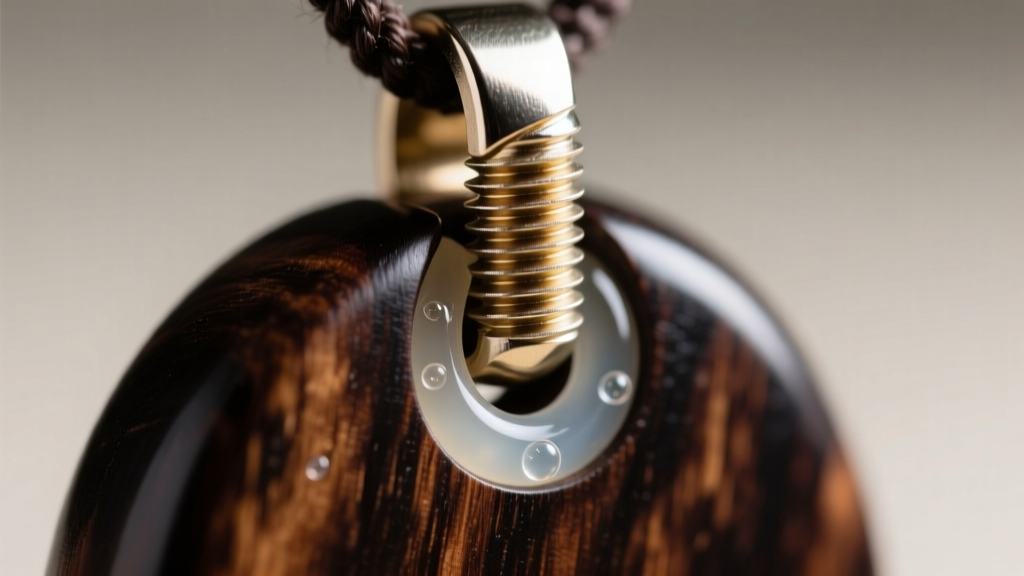
The most common point of catastrophic failure in a wooden pendant necklace is the bail—the hardware loop that connects the wood to the metal chain. Wood moves tangentially (across the growth rings) and radially (perpendicular to the rings) as ambient humidity fluctuates, but it barely moves longitudinally (along the grain). If a rigid metal bail is glued into a hole drilled parallel to the end-grain using standard cyanoacrylate (CA) glue, seasonal swelling will inevitably shatter the brittle glue bond, causing the pendant to snap off the chain.
The Threaded Insert Solution
High-end organic jewelers avoid simple glued bails. Instead, they utilize threaded brass or stainless steel inserts. A hole is drilled, and the threaded insert is driven into the wood using a slow-curing, flexible marine-grade epoxy, such as G/flex. This epoxy possesses enough tensile flexibility to absorb the microscopic expansion and contraction of the wood without breaking the seal. A threaded metal bail is then screwed into the insert, allowing the wearer to safely swap chains without degrading a glued joint.
Finishing Techniques: Oil vs. Film Builds
Because wood is porous, it will absorb skin oils, sweat, and environmental dirt, leading to a muddy, darkened appearance over time if left unfinished. The choice of finish dramatically alters both the maintenance requirements and the tactile feel of the necklace.
- Polymerized Tung Oil: A penetrating finish that cures from the inside out. It enhances the natural contrast of the grain and leaves a matte to satin, organic feel. However, it requires reapplication every 12 to 18 months and offers minimal protection against prolonged water exposure.
- CA Glue (Cyanoacrylate) Finish: Popularized by woodturners, this involves spinning the pendant on a lathe while applying thin layers of CA glue, which is then sanded and polished to a mirror shine. It creates a completely impermeable, glass-like plastic shell. While highly waterproof and durable, some purists argue it makes the wood feel like synthetic acrylic.
- Carnauba Wax: Often used over sealed woods like Ebony or Rosewood, this natural wax provides a soft, warm luster and a pleasant tactile friction, though it must be buffed regularly to maintain its water-resistant properties.
- Friction Polishes (Shellac blends): As noted by experts at Fine Woodworking, friction polishes offer a brilliant, quick shine for dense woods but can degrade when exposed to the ethanol in hand sanitizers and perfumes.
Chain Selection: Weight and Metallurgy
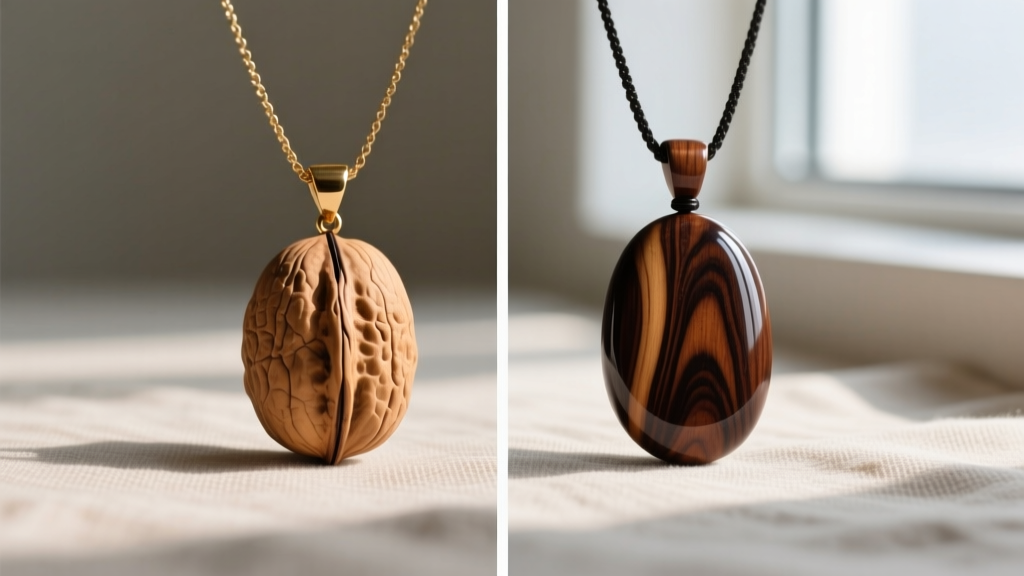
Pairing the correct chain with a wooden pendant necklace is a matter of physics and specific gravity. Even dense woods like Ebony (specific gravity ~1.2) are vastly lighter than precious metals. A heavy 5mm sterling silver Cuban link chain will physically overpower a standard 1.5-inch wooden pendant, causing the bail hardware to bear excessive torque and eventually wear through the wood fibers.
For optimal balance and longevity, select chains in the 1.5mm to 2.5mm width range. Box chains, lightweight rope chains, and standard cable chains provide excellent tensile strength without adding destructive pendulum weight. Metallurgically, titanium and oxidized stainless steel offer a modern, industrial contrast to warm wood grains, while sterling silver complements the reddish hues of Koa and Sandalwood. Avoid cheap, nickel-plated brass chains, as the plating will wear off and the resulting oxidation can stain the porous wood around the bail hole green or black.
Maintenance and Environmental Degradation
To preserve the structural and visual integrity of your wooden jewelry, you must manage its exposure to three primary enemies: UV radiation, extreme moisture, and chemical solvents.
Expert Care Tip: Never wear a wooden pendant necklace in the shower or swimming pool. While a quick splash of rain won't harm a properly oiled piece, prolonged submersion causes the wood cells to rapidly swell. When the wood dries out unevenly, internal tension builds, leading to micro-fractures along the grain lines. Always remove your pendant before applying aerosol perfumes or heavy lotions, as the alcohol and lipid bases can dissolve natural wax finishes and cloud penetrating oils.
When storing the necklace, keep it in a climate-controlled environment away from direct sunlight. UV rays will bleach exotic woods—turning rich, dark Walnut into a pale, lifeless gray over a matter of months. By respecting the hygroscopic nature of the material and investing in proper bail hardware, a wooden pendant necklace can remain a striking, durable staple in your jewelry rotation for decades.


