XOX Necklace Deep Dive: Link Mechanics, Metal Grades & Durability
Explore the structural engineering of the XOX necklace. We analyze link geometry, metal hardness, casting methods, and failure modes for lasting durability.

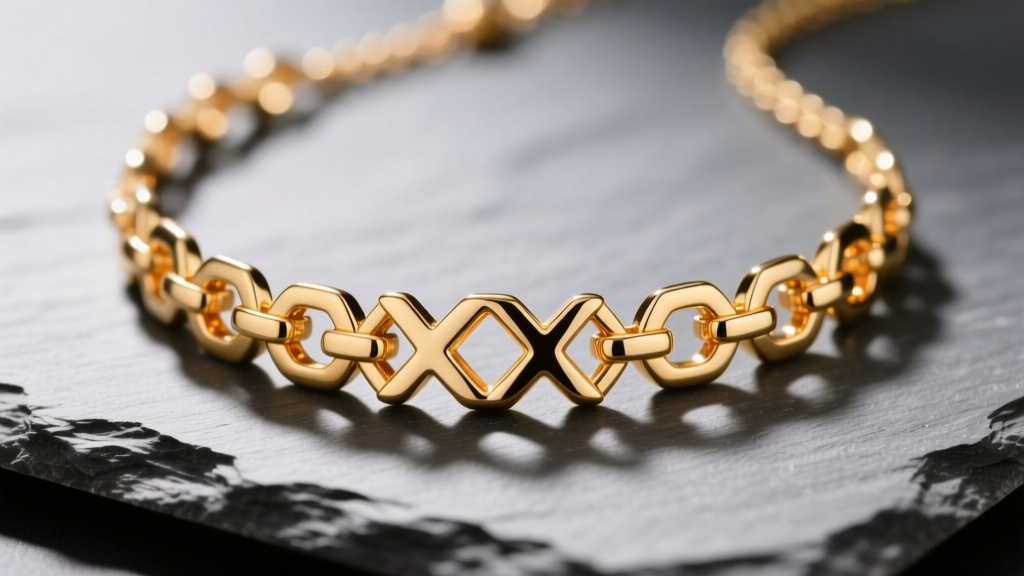
The "XOX" (hugs and kisses) motif is a staple in sentimental and everyday jewelry, but from a structural engineering perspective, an XOX necklace presents a unique set of mechanical challenges. Unlike uniform cable, curb, or rope chains, the alternating geometry of angular 'X' links and curved 'O' links creates an uneven stress distribution across the chain's length. When subjected to the daily wear and tear of neckline friction, clasp tension, and accidental snags, the structural integrity of these interlocking components is rigorously tested.
In this expert deep dive, we move beyond the aesthetic appeal of the XOX necklace to examine the metallurgy, manufacturing techniques, and mechanical failure modes that dictate its lifespan. Whether you are evaluating a fine jewelry piece for daily wear or designing a custom chain, understanding the technical specifications of link geometry and alloy hardness is critical for ensuring long-term durability.
Metallurgy and Material Grades in XOX Chains
The durability of an XOX chain is inextricably linked to the Vickers Hardness (HV) of the chosen precious metal alloy. Because the 'X' link features sharp directional changes and a central intersection, it acts as a stress concentrator. Softer metals will deform at this junction, leading to link elongation and eventual snapping.
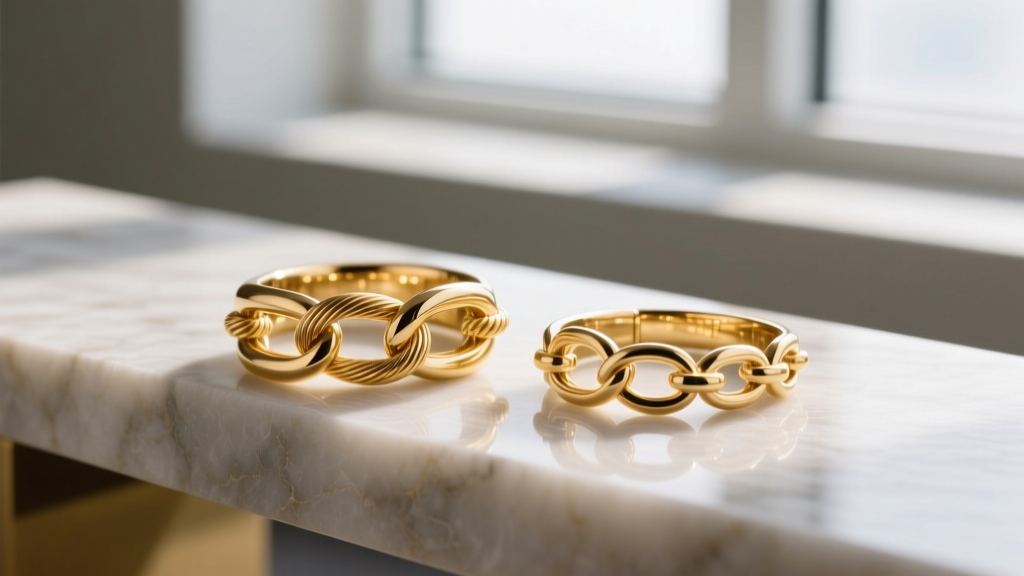
- 14k Gold (Approx. 130-150 HV): The optimal choice for structural XOX links. The higher copper and silver alloy content increases tensile strength, allowing the 'X' intersection to resist shear stress without requiring excessive wire thickness. This keeps the necklace lightweight yet highly durable.
- 18k Gold (Approx. 110-125 HV): While prized for its rich color and higher gold content, 18k gold is inherently softer. For an XOX necklace, 18k links must be manufactured with a thicker wire gauge (minimum 1.8mm) to compensate for the lower hardness, which increases the overall weight and price of the piece.
- Platinum 950 (Approx. 110-130 HV, work-hardens): Platinum is denser and highly resistant to material loss through wear. However, its malleability means the 'O' links can stretch into ovals under heavy tensile loads. According to the Gemological Institute of America (GIA), platinum's work-hardening properties mean that once an XOX link deforms, it becomes brittle at the stress point and requires careful annealing by a jeweler to prevent catastrophic failure.
- Sterling Silver (Approx. 60-70 HV): Standard sterling is generally too soft for fine, delicate XOX chains. If choosing silver, look for Argentium silver, which incorporates germanium to increase hardness and tarnish resistance, making it far more suitable for the mechanical demands of interlocking geometric links.
Link Geometry: Cast vs. Die-Struck Components
How the individual 'X' and 'O' components are formed fundamentally alters the chain's structural baseline. The jewelry industry primarily relies on two methods for producing these links, each with distinct metallurgical outcomes.
Manufacturing Comparison Matrix
| Manufacturing Method | Grain Structure | Porosity Risk | Durability Rating | Typical Price Tier |
|---|---|---|---|---|
| Die-Striking | Compressed, highly aligned | Negligible | Excellent (High tensile strength) | Premium |
| Lost-Wax Casting | Random, crystalline | Moderate to High (at X junction) | Fair to Good (Depends on QC) | Accessible / Mid-Range |
| Wire-Formed (Machine) | Drawn wire (linear grain) | None | Very Good (Seamless O links) | Variable |
As noted in technical papers presented at the Santa Fe Symposium on jewelry manufacturing, lost-wax casting of complex geometries like the 'X' link often results in micro-porosity at the central intersection where the metal cools unevenly. Die-striking, conversely, compresses the metal's grain structure, yielding a denser, harder link that is vastly superior for the high-shear environment of an XOX chain.
Structural Failure Modes in Interlocking Links
When an XOX necklace breaks, it rarely happens at random. The failure points are dictated by physics and link geometry. Understanding these failure modes is crucial for both jewelers performing repairs and consumers evaluating vintage or pre-owned pieces.

1. Shear Stress at the 'X' Apex
The center of the 'X' link is a natural stress concentrator. When the necklace is pulled laterally or caught on fabric, the interlocking 'O' links exert a multi-directional shear force on the 'X' junction. If the wire gauge is too thin (below 1.2mm in 14k gold), the metal will fatigue and snap precisely at the crossover point. High-quality XOX chains utilize a slightly flattened or beveled wire at the 'X' center to distribute this shear force over a wider surface area.
2. Tensile Failure at the 'O' Solder Joint
The 'O' link is essentially a closed loop. Its weakest point is the solder seam. Under heavy tensile loads (such as a heavy pendant attached to the XOX chain, or a sudden yank), the 'O' link will pull apart at the solder joint. To mitigate this, expert chain makers use laser welding rather than traditional torch soldering for the 'O' seams. Laser welding creates a deeper, more localized penetration without annealing (softening) the surrounding work-hardened wire, preserving the link's structural integrity.
Clasp Integration and Weight Distribution
The transition from the flexible XOX chain to the rigid clasp assembly is a critical vulnerability. The jump rings connecting the chain to the clasp must be proportionate to the wire gauge of the 'O' links. A common manufacturing flaw in mass-produced XOX necklaces is the use of thin, open jump rings that easily pull open under the dynamic weight of the chain.
"For geometric chains like the XOX, the clasp must act as a structural anchor, not just a closure. We specify soldered closed jump rings or heavy-gauge lobster clasps with integrated steel springs to handle the uneven kinetic energy transferred through the alternating X and O links." — Master Bench Jeweler Technical Guidelines
Spring ring clasps are generally discouraged for XOX chains heavier than 15 grams, as their internal tension mechanisms can fail under the erratic load distribution caused by the alternating link shapes. A solid, cast lobster clasp with a reinforced lever is the industry standard for ensuring the clasp does not become the chain's primary failure point.
Expert Buying Framework: Evaluating an XOX Necklace
When sourcing a high-quality XOX necklace, bypass the marketing terminology and inspect the physical engineering of the piece. Use this technical checklist to evaluate the chain's longevity:
- Inspect the 'X' Junction: Use a 10x jeweler's loupe to examine the center of the 'X' links. Look for pitting or micro-holes, which indicate casting porosity. A smooth, dense intersection suggests die-striking or high-quality casting with HIP (Hot Isostatic Pressing) treatment.
- Check the 'O' Seams: Run your fingernail lightly over the 'O' links. You should not feel a pronounced ridge or gap at the solder seam. A flush, laser-welded seam will feel virtually seamless.
- Verify Wire Gauge: For 14k gold, ensure the wire diameter is at least 1.5mm. For 18k gold or platinum, demand a minimum of 1.8mm to compensate for the lower Vickers hardness.
- Test the Articulation: Lay the necklace flat on a glass surface. It should drape fluidly without rigid kinks. Stiffness indicates poorly tumbled links or excessive solder overflow at the joints, which will lead to premature metal fatigue.
- Evaluate the Clasp Jump Rings: Ensure the jump rings connecting the chain to the clasp are soldered closed or feature a heavy-gauge split-ring design to prevent lateral pull-apart failures.
By prioritizing metallurgical hardness, precision manufacturing, and robust clasp integration, you can select an XOX necklace that transcends its sentimental origins to become a masterclass in durable, everyday jewelry engineering.


