How to Clean Old Jewelry Based on Metal & Gem Properties
Learn how to clean old jewelry safely by comparing metal alloys and gemstone properties. Expert tips for antique gold, silver, and porous stones.

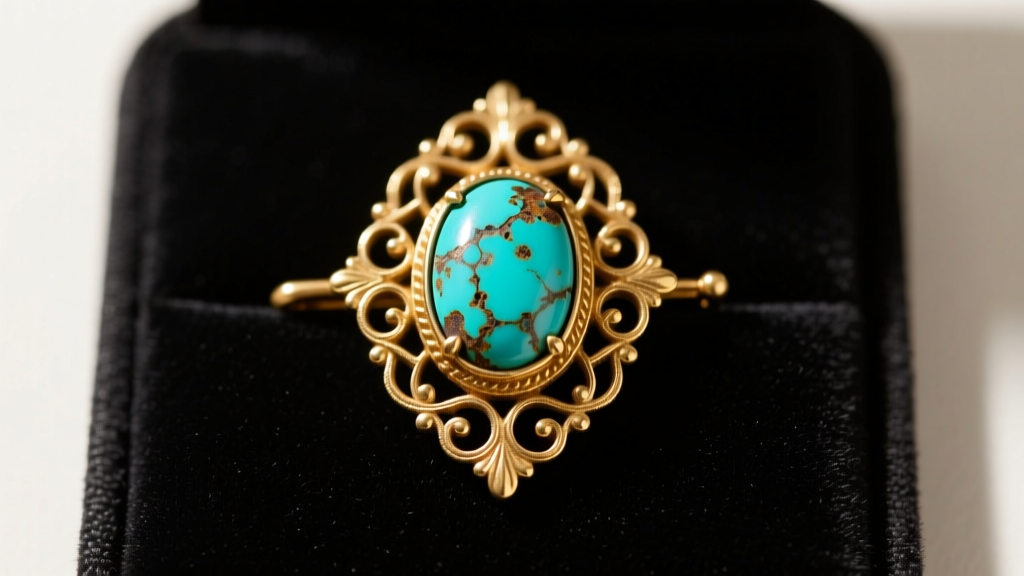
The Metallurgy of Antiquity: Why Age Changes Cleaning Rules
When collectors and inheritors ask how to clean old jewelry, the most common mistake is treating a 19th-century artifact like a modern mass-produced accessory. Modern jewelry is typically crafted from highly stable alloys—like 14k or 18k gold and .925 sterling silver—and set with durable, non-porous stones. Antique and vintage pieces, however, are metallurgical time capsules. They feature lower-karat golds with high copper content, early silver alloys that predate the sterling standard, and organic or porous gemstones that were often backed with delicate metal foils to enhance their color.
Understanding how to clean old jewelry requires a fundamental grasp of material properties, specifically Mohs hardness, porosity, and chemical reactivity. Applying a modern ultrasonic cleaner or an ammonia-based dip to an Edwardian piece can result in catastrophic failure, including the dissolution of zinc in brass alloys, the shattering of fracture-filled emeralds, or the permanent clouding of foil-backed paste stones. This guide breaks down the material science of antique jewelry to help you safely restore your pieces without stripping their historical value.
Material Comparison Chart: Reactivity & Porosity
Before applying any mechanical or chemical action, identify your materials. The table below outlines the primary vulnerabilities of common antique materials and their safe cleaning parameters.
| Material Class | Specific Alloy / Gem | Primary Vulnerability | Safe Cleaning Agent | Strictly Avoid |
|---|---|---|---|---|
| Low-Karat Gold | 9k, 10k, 12k Gold | Copper bloom, zinc dezincification | Mild non-ionic surfactant (e.g., Dawn) | Ammonia, thiourea dips |
| Historic Silver | Coin Silver (900), Britannia | Deep sulfide tarnish, soft scratching | Precipitated calcium carbonate paste | Electrolytic baths, baking soda |
| Porous Gems | Turquoise, Coral, Lapis | Water absorption, chemical staining | Dry microfiber, soft horsehair brush | Ultrasonics, steam, any liquids |
| Early Plastics | Bakelite, Celluloid, Lucite | Off-gassing, crazing, melting | Damp cloth, Simichrome (for Bakelite) | Alcohol, acetone, hot water |
| Foil-Backed | Georgian Paste, Early Garnets | Foil oxidation, water trapping | Dry brushing only, wooden toothpicks | Submersion, steam, ultrasonics |
Decoding Antique Alloys: Gold, Silver, and Platinum
Low-Karat and Rolled Gold (9k, 10k, 12k)
Many Victorian and early 20th-century pieces were crafted in 9k or 12k gold to make jewelry more accessible. Unlike 18k gold (75% pure gold), 9k gold contains 62.5% base metals, primarily copper and zinc. When exposed to harsh chemicals like ammonia or commercial silver dips containing thiourea, the zinc can undergo "dezincification," leaving the surface brittle and pitted. Furthermore, the high copper content makes these alloys prone to "copper bloom"—a reddish tarnish that occurs when the gold is exposed to sulfur and moisture.
The Expert Approach: To clean low-karat gold, use a few drops of a pH-neutral, non-ionic surfactant (like plain blue Dawn dish soap) in distilled water. Distilled water is critical; tap water contains chlorine and fluorides that can react with the copper. Gently agitate with a soft baby toothbrush, rinse in a secondary bowl of distilled water, and pat dry with a lint-free cotton cloth. Never use a hairdryer, as heat can accelerate copper oxidation.
Coin Silver and Britannia Silver
Before the widespread adoption of the .925 sterling standard, American silversmiths frequently used "coin silver" (roughly 90% silver and 10% copper), while British makers utilized Britannia silver (95.8% silver). Coin silver tarnishes much darker and faster than sterling due to its higher copper content. Baking soda and aluminum foil baths—a popular DIY internet hack—create an electrolytic reaction that strips tarnish but also strips the microscopic layer of oxidized copper, leaving the silver with a harsh, unnatural, and blindingly white finish that collectors despise.
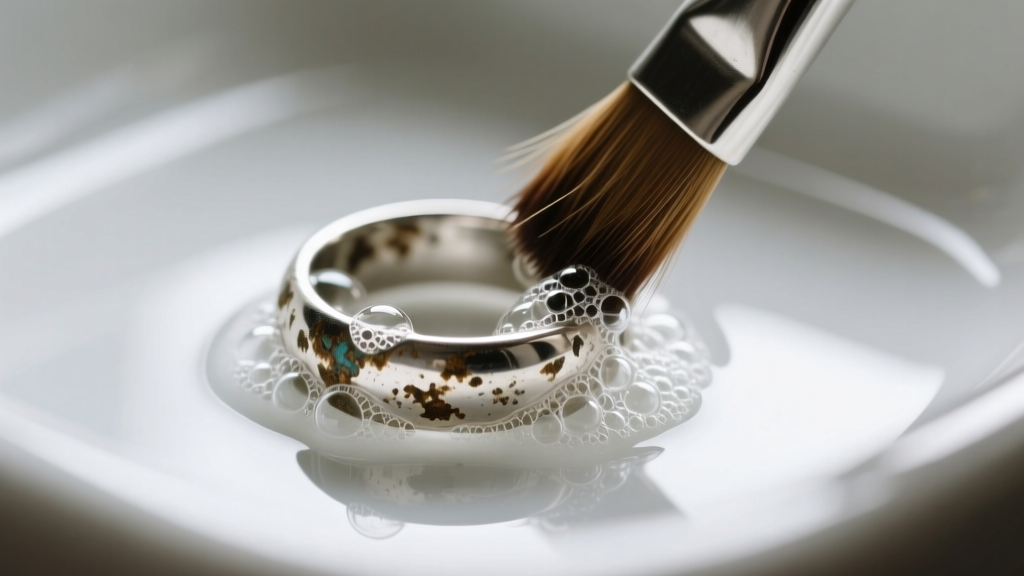
The Expert Approach: For heavy sulfide tarnish on coin silver, conservationists use precipitated calcium carbonate mixed with distilled water to form a mild paste. Applied with a cotton swab and worked in small, circular sections, this provides just enough mechanical abrasion to lift tarnish without scratching the relatively soft silver (Mohs 2.5). According to the Victoria and Albert Museum's conservation guidelines, preserving a light layer of patina in the recesses of engraved or repoussé silver is essential, as it provides visual contrast and proves the piece's age.
The Danger Zone: Porous and Organic Gemstones
The gemological landscape of antique jewelry is fraught with cleaning hazards. Modern gems are often treated with heat or radiation to stabilize them, but antique stones are frequently left in their natural, highly reactive states.
Turquoise, Coral, and Lapis Lazuli
These stones are inherently porous. Turquoise, a hydrous phosphate of copper and aluminum, can absorb oils, soaps, and even water, which alters its chemical matrix and turns a vibrant robin's-egg blue into a sickly, permanent green. Coral and lapis lazuli share similar vulnerabilities; lapis often contains calcite inclusions that will dissolve if exposed to even mildly acidic solutions like lemon juice or vinegar.
Never submerge these stones. Clean the metal settings around them using a wooden toothpick to gently dislodge grime from the bezel, and buff the stone itself with a dry, clean microfiber cloth. The Gemological Institute of America (GIA) strictly advises against ultrasonic cleaning for any porous gemstone, as the high-frequency cavitation can easily fracture stones with natural internal faults.
Jet, Bakelite, and Celluloid
Victorian mourning jewelry heavily featured Whitby jet (a fossilized wood), while the Art Deco era introduced early synthetics like Bakelite and celluloid. Celluloid is notoriously unstable; it off-gasses nitric acid as it degrades, which can actively corrode the metal settings it touches. Alcohol, acetone, and hot water will melt or craze celluloid instantly. Bakelite is more stable but develops a heavy, oxidized patina that many collectors actually prize.
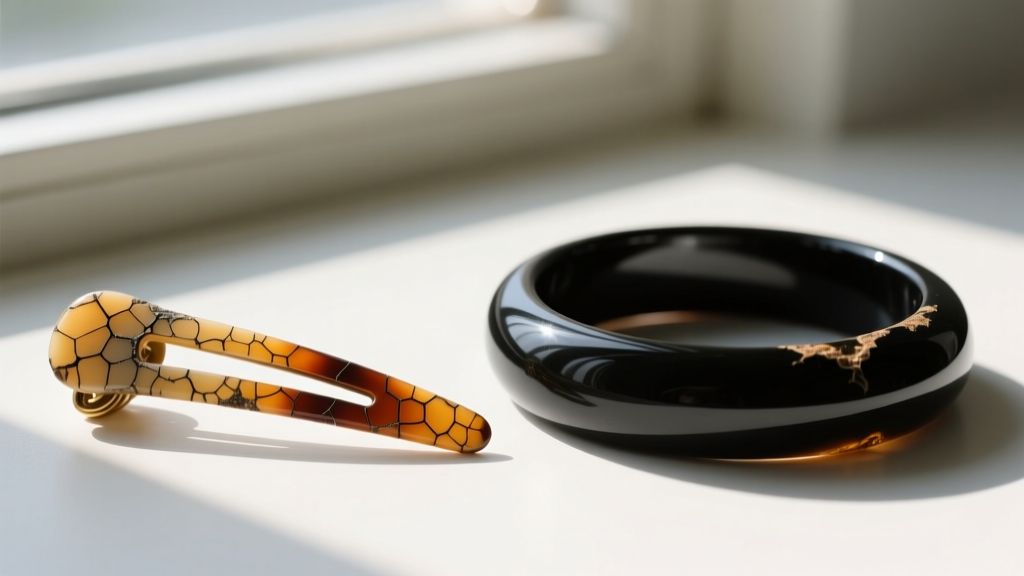
The Expert Approach: Test early plastics carefully. If you must clean Bakelite, a tiny amount of Simichrome polish on a soft cloth will remove oxidation and reveal the bright, original color beneath, followed by a buff with a clean cloth. For celluloid and jet, use only a barely damp cloth and immediately dry it. Store celluloid pieces separately in acid-free tissue paper to prevent their off-gassing from damaging neighboring jewelry.
Step-by-Step Triage: Assessing Patina vs. Tarnish
Before you begin cleaning, you must perform a visual triage. Not all darkening on old jewelry is dirt; much of it is historical evidence.
"Patina is the fingerprint of time. It is the soft, glowing luster that only decades of wear, handling, and natural oxidation can produce. Stripping a 150-year-old brooch to a mirror shine is akin to sandblasting a Renaissance painting." — Antique Jewelry Conservation Society
The Pre-Cleaning Checklist
- Inspect the Settings: Use a 10x jeweler's loupe. Are the prongs worn thin? Is the bezel pushed back? Cleaning can dislodge loose stones. Have a jeweler tighten settings before washing.
- Check for Foil Backing: Look at the back of the stones. If the setting is completely closed (a "closed-back" setting) and you see a metallic gleam behind the gem, it is likely foil-backed. Water will seep in, oxidize the foil, and ruin the stone's brilliance permanently.
- Identify the Grime: Is it skin oils and lotion (requires a mild surfactant)? Is it silver sulfide tarnish (requires a mild abrasive)? Or is it hardened cosmetic powder (requires gentle mechanical lifting with a wooden tool)?
- Test for Plating: Many antique pieces are gold-filled or rolled gold plate. Aggressive polishing cloths infused with rouge can wear right through the microscopic gold layer, exposing the brass or steel base metal beneath.
Advanced Formulations: Mechanical vs. Chemical Action
When learning how to clean old jewelry, mastering the balance between mechanical action (friction) and chemical action (solvents) is your greatest tool. For intricate filigree work from the Edwardian era, where dirt is trapped in microscopic crevices, chemical action via a mild enzymatic cleaner or a brief soak in a surfactant solution is safer than scrubbing, which can bend the delicate platinum or gold wires.
Conversely, for smooth, un-stoned surfaces like a heavy 1940s gold signet ring, mechanical action using a specialized jewelry polishing cloth (like a Sunshine cloth, which contains micro-abrasives and a mild anti-tarnish agent) is highly effective and avoids the risks of liquid exposure. Always remember: the older the piece, the gentler the touch. By respecting the material science of your antique jewelry, you ensure it survives for the next generation to admire.

