Proper Care and Cleaning After Making Wire Wrapped Jewelry
Learn expert cleaning, tarnish prevention, and structural maintenance tips for your pieces after making wire wrapped jewelry at home.

The transition from making wire wrapped jewelry to maintaining it requires a fundamental shift in mindset. While the creative process focuses on tension, gauge selection, and structural integrity, the post-creation phase demands an understanding of environmental chemistry and material science. Wire wrapping relies heavily on non-soldered joints and exposed metal surfaces, meaning your finished pieces are uniquely vulnerable to oxidation, friction wear, and environmental contaminants. Whether you are working with bare copper, brass, or sterling silver, implementing a rigorous care protocol is essential to preserve both the aesthetic and structural longevity of your designs.
The Metallurgy of Tarnish: Why Your Wire Wraps Discolor
To effectively clean wire-wrapped jewelry, you must first understand the chemical reactions causing the discoloration. Tarnish is not simply 'dirt'; it is a chemical transformation of the metal's surface layer. When working with copper wire—a favorite for beginners due to its low cost and high malleability—exposure to oxygen and moisture creates cuprite (Cu2O), which appears as a dull red or brown film. Over time, further oxidation forms tenorite (CuO), resulting in a black, crusty layer.
Sterling silver (92.5% silver, 7.5% copper) reacts differently. The copper alloy within sterling silver reacts with hydrogen sulfide in the atmosphere to form silver sulfide (Ag2S), which manifests as a yellow, brown, or black coating. According to Rio Grande's metallurgical guides, high humidity and exposure to sulfur-rich environments (such as wool, rubber bands, or certain cosmetics) accelerate this process exponentially. Understanding these reactions dictates your cleaning approach; abrasive methods that remove tarnish also remove microscopic layers of the base metal, which can weaken thin wire weaves over time.
Argentium vs. Standard Sterling vs. Copper
Not all wire requires the same maintenance. If you are making wire wrapped jewelry with Argentium Sterling Silver, you will notice a drastic reduction in maintenance needs. Argentium contains a small amount of germanium, which migrates to the surface and forms a transparent, self-healing layer of germanium dioxide. This layer blocks sulfur from reaching the silver, making it highly tarnish-resistant. Conversely, brass (an alloy of copper and zinc) suffers from dezincification in highly acidic environments, requiring specialized pH-neutral polishes to avoid pitting the wire surface.
Stone-Specific Cleaning Protocols (Avoid Disastrous Failures)
One of the most common mistakes jewelers make after making wire wrapped jewelry is applying a universal cleaning method to all gemstones. Wire wrapping frequently utilizes cabochons and raw crystals that are highly sensitive to chemicals, heat, and ultrasonic vibrations. Submerging a porous stone in a commercial silver dip can permanently ruin its color and structural integrity.
| Cabochon Material | Mohs Hardness | Ultrasonic Safe? | Steam Safe? | Recommended Cleaning Method |
|---|---|---|---|---|
| Turquoise | 5.0 - 6.0 | No | No | Damp microfiber cloth only; avoid all chemicals |
| Opal (Ethiopian) | 5.5 - 6.5 | No | No | Dry, soft brush; avoid all liquids to prevent crazing |
| Labradorite | 6.0 - 6.5 | No | No | Mild soap, lukewarm water, soft baby toothbrush |
| Agate / Jasper | 6.5 - 7.0 | Yes (caution) | Yes | Ultrasonic or mild soapy soak for heavy grime |
As noted by the Gemological Institute of America (GIA), opals contain up to 20% water. Exposing them to ultrasonic cleaners or harsh drying agents can cause 'crazing'—a network of fine cracks that destroys the stone's play-of-color. Similarly, turquoise is highly porous and will absorb skin oils, lotions, and cleaning chemicals, often shifting from a vibrant blue to a dull, muddy green. When cleaning wire wraps featuring these stones, use a cotton swab dipped in mild soapy water to carefully clean the wire weaves without touching the cabochon.
Preserving Intentional Patinas (Liver of Sulfur)
Many wire artists use Liver of Sulfur (potassium polysulfide) to create intentional, high-contrast antiqued finishes. This chemical bath forces the rapid creation of silver sulfide or copper oxide, darkening the recesses of the wire weave while leaving the high-relief areas bright after polishing. However, maintaining this patina requires avoiding common internet 'hacks'.
Warning: Never use the popular 'aluminum foil, baking soda, and boiling water' electrochemical bath on wire-wrapped jewelry with an intentional patina. This reaction converts silver sulfide back into pure silver, instantly stripping away hours of careful antiquing work and leaving your piece a flat, uniform white.
To clean a patinated wire wrap, rely exclusively on mechanical polishing. Use a treated jeweler's cloth (such as a Sunshine Cloth) to gently buff only the raised wires. The mild abrasives in the cloth will remove surface tarnish without reaching into the deep, oxidized recesses of your weave. For intricate 28-gauge weaves where a cloth cannot reach, use a soft-bristled makeup brush to gently sweep away dust and skin cells.
Structural Maintenance: Checking 28-Gauge and 30-Gauge Weaves
Care and maintenance extend beyond cosmetics; they include structural auditing. When making wire wrapped jewelry, artists frequently use 28-gauge and 30-gauge dead-soft wire for intricate weaving and coiling. Because these ultra-thin wires are manipulated repeatedly during the wrapping process, they undergo 'work hardening.' While work hardening provides structural rigidity, it also makes the wire brittle.
During cleaning, aggressive scrubbing or bending can cause these micro-weaves to snap. Always support the main structural frame (usually 16-gauge or 18-gauge half-hard wire) with your thumb while brushing the weaves. If you notice a broken weave, do not attempt to bend the wire back into place; it will likely fracture further. Instead, use flush cutters to carefully snip the broken segment and weave a replacement piece, tucking the new tail ends securely under the existing framework.
The Dangers of Stiff Brass Brushes
While stiff brass brushes are excellent for texturing heavy gauge wire before wrapping, they are disastrous for cleaning finished pieces. The bristles can easily catch on the edges of a 26-gauge weave, pulling the wire out of alignment and scratching softer cabochons like fluorite or malachite. Always opt for a soft-bristled baby toothbrush or a dedicated, extra-soft jeweler's brush when applying mild dish soap to your finished wraps.
Long-Term Storage Solutions for Wire-Wrapped Pieces
Proper storage is the most effective form of maintenance. The goal is to create a micro-environment that limits exposure to oxygen, moisture, and sulfur. Follow these strict storage protocols to keep your inventory pristine:
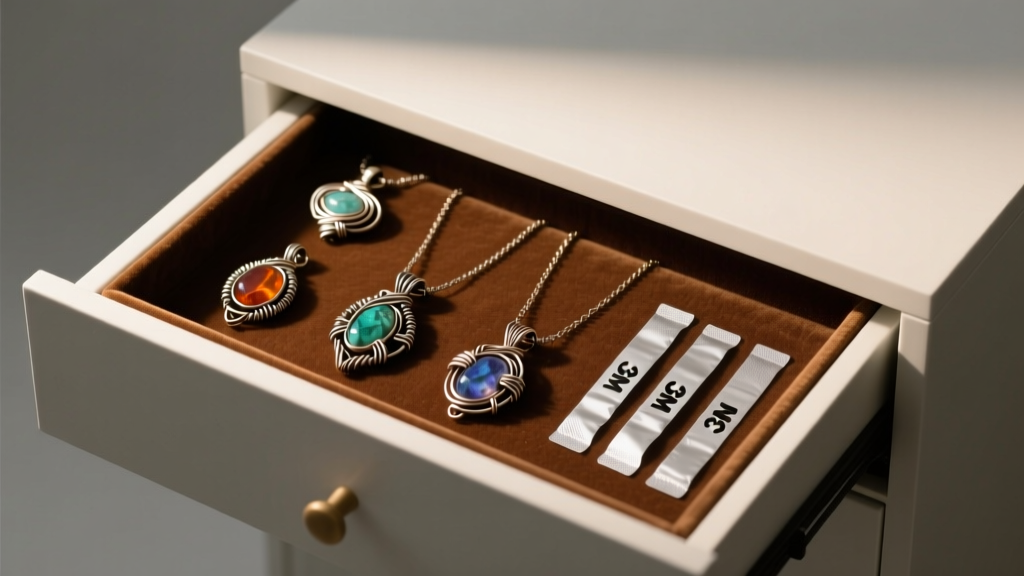
- Anti-Tarnish Strips: Place a 3M Anti-Tarnish Strip inside every storage container. These strips utilize a specialized polymer that absorbs and neutralizes airborne hydrogen sulfide before it can react with your silver or copper wire.
- Humidity Control: Include a small, rechargeable silica gel desiccant packet in your storage bins to keep relative humidity below 40%. Moisture acts as a catalyst for both copper oxidation and silver sulfide formation.
- Individual Compartments: Never toss multiple wire-wrapped pendants into a single bag. The friction from the heavier structural wires of one piece can easily scratch the cabochon or dent the soft weaves of another. Use individual velvet pouches or compartmentalized jewelry boxes.
- Avoid Cardboard and Rubber: Never store wire jewelry in standard cardboard boxes or secure them with rubber bands. Both materials off-gas sulfur compounds that will cause rapid, severe tarnishing within days.
By treating the care of your jewelry with the same precision and dedication as the initial construction, you ensure that every piece remains as structurally sound and visually striking as the day it left your bench. Mastering these metallurgical and gemological nuances is what separates a hobbyist from a true wire-wrapping artisan.